Showing posts with label gemma arterton. Show all posts

What a Drag It Is Getting Old

FILM:

Just lately, I happened to watch a few comic/drama movies that all deal with issues relating to old age and death.  I hadn't set out to.  They were all in my drama backlog for different reasons.  It just worked out that way.


Song for Marion - 2012
AKA Unfinished Song
Written & Directed by Paul Andrew Williams

This was on my viewing list because I was on a Gemma Arterton binge after re-watching Byzantium.  While she does deliver one of her most human performances here, it's really a showcase for Terrence Stamp more than anything else.

Stamp plays Arthur, a man of (unsurprisingly) little action and fewer words.  He loves his wife, Marion (Vanessa Redgrave) but struggles to express it.  He allows himself a very limited set of expectations, and finds he's happy enough with that life and outward appearance, which sometimes causes him to struggle to understand or appreciate the less tightly-capped lives of others.  Marion, for example, belongs to a choir group for senior citizens, which Arthur just can't understand.  He sees it as undignified, and he sometimes fumbles in his impulse to deride the group while still adoring his wife.

Arterton as Elizabeth is the school teacher who leads the choir, selecting the kind of modern music like Salt n' Pepa's "Let's Talk About Sex" and Motorhead's "The Ace of Spades" that the middle aged find youthful when sung by the old aged.  The purpose of the group is to have fun and to share fun, and that's just a concept that Arthur struggles to get his head around.

His emotional detachment has left a great rift between him and his son, whose commitment to parenting further shames Arthur, making it even harder for him to feel capable of healing the old wounds between them.  When Marion has a recurrence of the cancer she's struggled with before, it become clear that the end for her is near, and Arthur goes into a full-tilt panic.  He feels more powerless than ever, and CAN NOT face the idea of a world without Marion.  He becomes desperate to protect her, but there's no protecting to be done.  Her fate is sealed, and keeping her in bed isn't going to stop it.  Marion insists on continuing to sing in the choir, and Arthur, more unwilling than ever to leave her side, gets dragged along (with fairly predictable and heart-warming results).

While it would be easy to accuse the film of saccharine or schmaltz or other such unhealthy comfort eating, the performances really elevated it above the level of an after-school special for seniors.  In fact, it probably plays better to people who have aging parents than the aging parents themselves.  It's not hard to imagine our loved ones struggling to remain vital and engaged in their advancing years.  Redgrave brings that vitality to Marion, which makes Arthur's sense of loss palpable.  While Arthur's character is much different, I was reminded of Stamp's performance in The Limey, as a hard man with nothing much to say struggling to express the emotions he never wanted to acknowledge he had.  While The Limey allowed him to express that frustration through violence much of the time, here, Stamp is forced to internalize it, letting us witness his pain, and his pain about feeling pain.  We also discover that he has a shockingly beautiful singing voice.  Gemma Arterton frequently plays women with hard edges; femmes fatale, quite often.  Here, she has none of that.  She has enthusiasm for her work and expresses genuine concern for Arthur's pain and her kindness becomes more beautiful than her, well, beauty.  Christopher Eccelston gets the somewhat thankless role as Arthur and Marion's son James.  Despite the absence of grandstanding opportunities, he brought a kind likeability and a pain only thinly masked by bitterness to the role.  Maybe it's just me, but I've tended to associate him with so many cold and/or villainous roles that his vulnerability here was a real eye-opener.  I found myself genuinely moved by Song for Marion, both to laughter and... that other thing.


Robot & Frank - 2012
Written by Christopher d Ford
Directed by Jake Schreier

It's dark.

Nimble fingers work the lock-pick.  A figure in black slips into the house.  He starts working the place over for valuables.  He becomes more frantic, knocking over a framed photo.  It falls, the glass cracking.  The burglar looks stunned.  His face is in the photo.  It's his house.

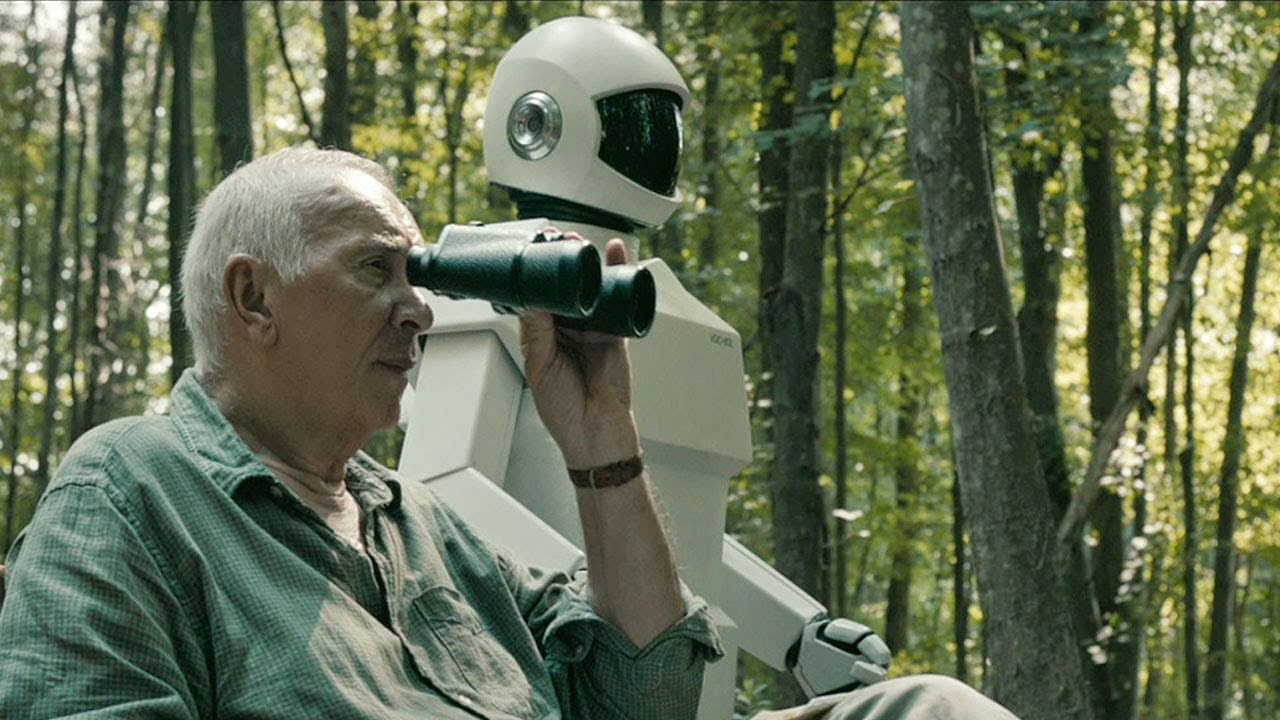
The burglar is Frank, played by Frank Langela.  He was a cat burglar, but he's retired now, he just... forgets sometimes.  Frank forgets a lot of things these days.

Frank's kids worry about him.  His daughter Madison (Liv Tyler) video calls as after as she can, but her work takes her overseas.  His son Hunter (James Marsden) calls and drives up to see him every week or two.  Frank resents the concern (as a reflection of his shame over needing it), but he's not always sure if Hunter is a married professional with kids of his own, or a student at Princeton.  His favorite way to fill the day is to walk into town and visit the local library.  Jennifer the librarian (Susan Sarandon) gently teases him about having read the same books over and over.  Frank has a thing for her.  After the library, he likes to have lunch at his favorite cafe.  Wait, where's the cafe?  How did there get to be a Lush here?  He ate here yesterday... didn't he?  To channel his frustration, Frank shoplifts a fancy soap, but the shopkeeper is strangely suspicious of him already.  Back at home, he adds the soap to a cache of similar items.

The more his memory goes off, the more his kids worry, and the more agitated Frank gets, until one day Hunter shows up with something for his father; a robot.  The robot is programmed to keep Frank active and engaged, encouraging a healthy regimen and a consistent routine.  Frank is, shall we say, not amused, but Hunter won't tell him the password, and so, for the time being, Frank finds himself with a white plastic shadow.  It's not long, however, before he finds that the robot makes a convenient ear for his complaints.  It's not long after that that he discovers (quite by accident) that the robot isn't overly particular about the legality of shoplifting, and Frank adds another fancy soap to his collection.

This gets Frank thinking, and the thinking gets his mind back in the game. He gets more engaged in his own life and the world around him.  He develops more of a relationship with the robot, which is frankly (no pun intended) fairly narcissistic, given that the robot really only acts as an extension of Frank's needs.

Robot & Frank deals with the issue of aging, regret and (most especially) memory in many ways.  There's a major reveal late in the movie that plays a little fast and loose with memory for the sake of emotional impact, but there are other instances which it's more more balanced and thoughtful.  Frank is forced to make a decision about Robot's memory, and while the issue of their potential friendship would seem to be the more obvious cause for his turmoil, I really think that it has more to do with his pain about his own memory.  Yes, there's still a sense of empathy for the "other" for which he has developed some sort of feelings, but then the "other" doesn't HAVE emotions with which to empathize, and again, I believe much of this interaction reflects Frank's narcissism.  That doesn't make Frank a bad guy.  It just means he's scared, and not without cause.

Peter Sarsgaard brings a pretty strong "I'm sorry Dave, I'm afraid I can't do that" tone to the robot's voice, which kept me wondering what he might eventually do.  It straddles the line between calming, and disturbing-because-it's-so-determined-to-be-calming, which I'm not sure is as effective as it should be.  In fact, it was so unsettling that I thought it was Michael Emerson (Lost, Person of Interest) until the credits.

One interesting discovery in Robot & Frank is that Frank Langella has a charming side.  I've gotten so used to his playing villains, heavies and other emotional pressure cookers that I was completely unprepared for how disarming he could be.  Given his responsibility for carrying the film, that quality transfers to the overall product in a highly effective way.


Get Low - 2009
Written by Chris Provenzano & C Gaby Mitchell
Directed by Aaron Schneider


Some actors spend their careers playing a wide variety of characters, putting on accents and trying to lose themselves in the character.  Robert Duvall isn't that kind of actor.  He's rarely done accents, and rather than going wide, he goes deep.  thoughtful southerners with great depth of character.  His characters needn't be specifically southern, but he brings that to them, and whether they're outwardly reserved or gregarious, these things cover and tap a deep well of personal character buried inside of them.  That depth gets an incredible opportunity to stretch its legs once more in Get Low.

Because I had originally added Get Low to my viewing list in the fits of a Bill Murray view-a-thon, it had completely slipped my mind that Robert Duvall was in it when I finally sat down to watch it, for for the first ten minutes or so, I could not identify who was behind the unruly beard and taciturn demeanor of the old country hermit.  Duvall plays Felix Bush, the backwoods hermit in 1930s Tennessee.  Felix is the stuff of local legend.  Kids dare each other to break windows in his cabin, and adults in town gossip about his history.  Did he kill someone?  Did he kill a LOT of someones?  You heard he robbed banks?  I heard something even worse.

When the local preacher visits (at considerable risk to his well-being) to tell him that one of his old associates has passed on, it serves as a conduit for Felix to confront the looming specter of his own mortality.  He hitches the cart to his cantankerous old mule (kindred spirits, no doubt) and ambles up the main street of town to discuss his own funeral arrangements with the parson.  Laying a grubby wad of "hermit cash" on the table, Felix grills the preacher about what he'd say in his memory.  The evasive response which dances around his reputation does not please Felix, and the wad of cash is gruffly withdrawn.  In an economic bit of narrative, there is another family coming into the church on their own business.  The young husband happens to work for the local funeral home, so he picks up on Felix's desires to plan a funeral as well as his dissatisfaction with the church.  His stepmother just happens to be a pivotal figure from Felix's past with whom he's reluctant to engage.  To cap things off, one of the locals decides to demonstrate his manhood by hurling insults and threats at the old man of rumors, and find himself with the "stuffing" kicked out of him in short order.

The young man, Buddy, reports back to Frank Quinn (Bill Murray), the owner of the funeral home, that the notorious old mountain man is looking for a funeral with a wad of cash, and they travel out to the homestead to make their pitch.  Getting a look at the place, Frank immediately promotes Buddy to sales associate and sends him in alone.  Felix's reputation once again becomes a topic of conversation, which gets the old man to thinking.

After the initial reluctance inherent to his character, Felix arrives at a plan.  He wants to plan his funeral.  It should be, he decides, a party, with food, music and the sharing of every story that anyone had ever heard about him.  If that meant gathering the people of four counties, then so be it.  Oh, and one more thing; he wanted it while he was still alive.

Through the process of planning Felix's funeral party and dealing with all of the issues that he and the town had with each other, peeks at his history emerge, hinting at why he sealed himself off from the world some 40 years prior, what his relationship with Miss Mattie (Sissy Spacek) had and had not been, and who the woman was in the old photograph that he talked to at night.  He has his own story to tell, but his own laconic nature, and ultimately his shame present obstacles that seem insurmountable to him at this late hour in life.

And that's what Get Low is really about.  Felix has imprisoned himself in his solitude over the guilt and shame that he carries from his past.  It's a heartfelt and deeply moving portrait of regret turned in upon itself.  As I've been rolling it around in my head the past few days, I've found myself comparing and contrasting it to another of Duvall's greatest performances in The Apostle.   Where The Apostle's Sonny flees his past and can't resist being who he's always been, Felix becomes so trapped in the past that surrenders the gregarious character he once was to sink into solitude and the bitterness that such isolation begets.


Oh Yes It's Ladies Bite and the Feeling's AR-R-RGH!


FILM:

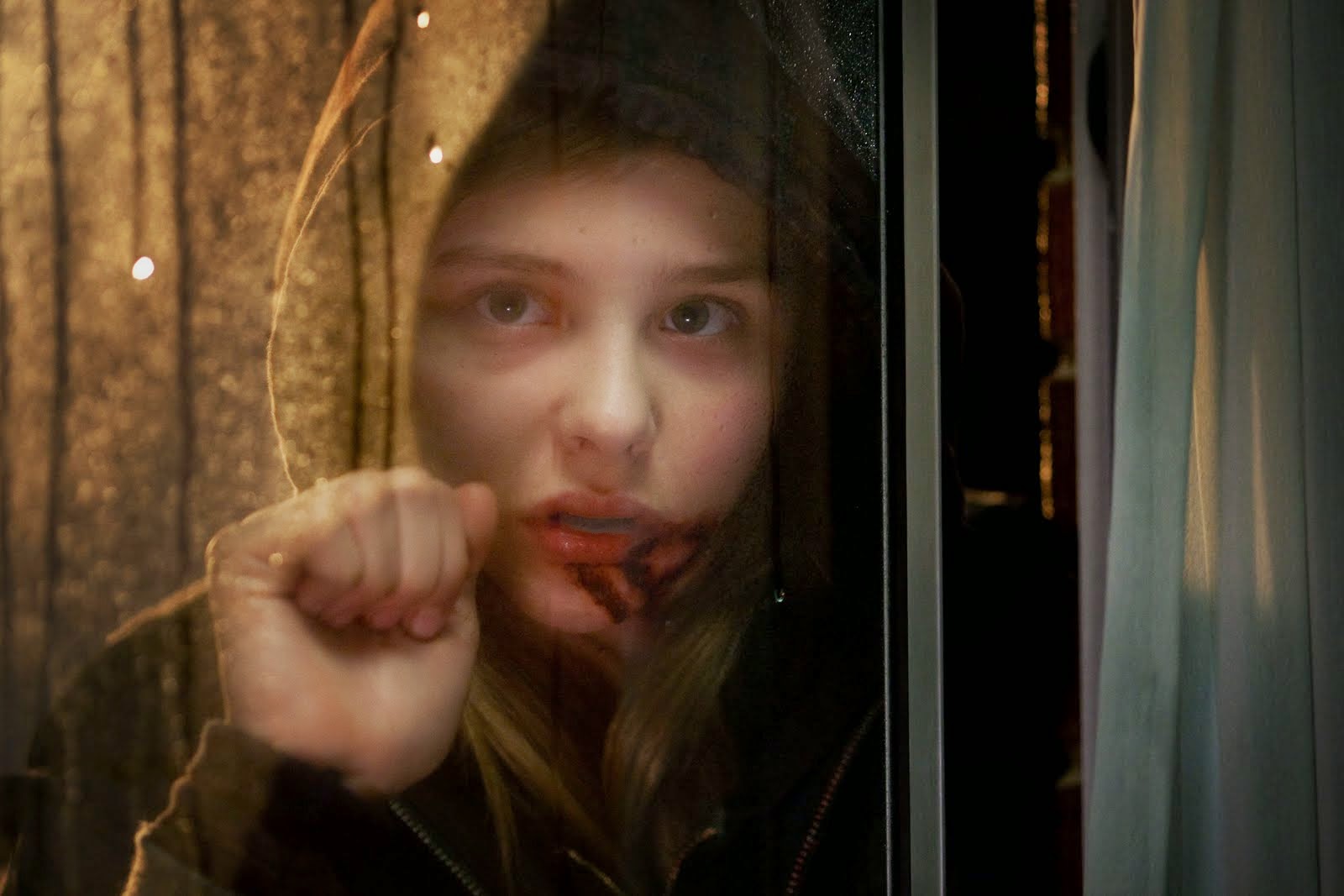
What we have here is a small selection of recent vampire movies (or movies with vampires, anyway) that prominently feature female vampires.  I suppose this is something of a response to the whole (ugh) Twilight thing in some way.  The good news is that at least 3 of them take much more thoughtful and mature approaches to the subject & theme, and the other 2 are at least willing to have a sense of humor about themselves.  I find it somewhat interesting that they all feature female vampires as protagonists, rather than mortals facing vampires as deadly foes.  I don't have a theory about that yet.  I just find it... interesting.


Let Me In - 2010
Written & Directed by Matt Reeves
from the book by John Ajvide Lindqvist

I'm pretty sure that I'm legally obligated to mention that Let Me In is adapted from the Swedish book and movie Let The Right One In.  I am not, however, required to care or to complain that the original was better.  The elitism of people who are satisfied with subtitles has been greatly over-inflated and accepted.  The fact is, a layer of text can and does create an emotional distance between viewer and film-world, and I, personally, like to feel what I'm experiencing.  It has nothing to do with intellectuality.  It's a visceral experience.  So, Let Me In, as its own film with its own experience is truly wonderful. 

Owen is a scrawny and evidently friendless 12 year old boy who lives in an apartment with his recently separated mother.  She works a lot and is emotionally preoccupied with the divorce and her own issues.  He's bullied relentlessly at school.  He's a silent outsider, satisfied to observe the lives of others with his telescope.  Being ignored is preferable to most of the attention that he gets.  While watching the courtyard of the apartment complex one night, he sees the arrival of the people who will be his new neighbors, a barefoot girl about his age, and her father.  When he meets the girl, Abby, one of the first things she tells him is that they can't be friends.  Later, he hears them fighting through the wall.  To an adult, it would look and sound a lot like an abusive situation.

Obviously Owen and Abby DO develop a relationship, or it would have been pretty silly to include them both.  They both need something that they find in each other.  Let Me In combines the emotional potency of classic young adult lit with the savagery of a vampire tale that doesn't hold back (but also doesn't show off for gore factor alone).  It manages the discomfort of both components skillfully.  It's not uncomfortable to watch, but it creates a sense of worry.  It makes sense that director Matt Reeves gained his seasoning in television.  He's not over-urgent to fill his allotted screen time with flashy moments.  He fills his moments, instead, with humanity.  I hope he hangs onto some of that as he moves on to bigger and more spectacular things.


Vamps - 2012
Written & Directed by Amy Heckerling

It is vitally important that one go into Vamps with the appropriate expectations.  If you go in looking for a vampire movie that is funny, you're going to get upset.  If, however, you're prepared to accept that Vamps is first and foremost a very silly girl-centric (yes they are women, but very girly ones despite their ages) comedy that just happens to use a little vampire mythos as a conduit for its "be yourself" ethos, then you just might enjoy it.  It's not like it deliberately misleads anyone.  It's more-or-less exactly what one should expect with Amy "Clueless" Heckerling writing and directing for Alicia "Clueless" Silverstone and Krysten "the B---- in Apartment 23" Ritter.

Silverstone & Ritter play Goody & Stacy (respectively), a couple of nutty young "gal-about-town" roommates who just happen to be vampires.  But of course they're really good vampires.  I don't mean they're good at being vampires, but they're creatures of the night with hearts of gold.  They take classes, belong to a support group for vampires who eschew human blood, feed only on mice and still feel badly about it.  That's the closest vampires can get to vegan, who of course are the only truly decent people in the world, or so I've been told.

Much of Vamps hinges on one of the more optional Vampire Rules -- that killing a sire will remove the curse from all vampires descended from them.  You see, when Stacy is impregnated by a mortal, the only way to insure the baby's survival is to lift the curse by slaying their mutual sire -- the vampire that made them both.  Two twists; they don't know where their sire, Cisserus (Sigourney Weaver) currently lairs, and lifting the curse will cause them to physically become their natural age.  Goody hasn't told Stacy that she was born in 1840.

What will happen?  You can probably guess.  I can't really recommend Vamps, but I can give you a couple of tips with which to guide yourself.  If you're someone for whom "cute" is considered a valid compliment for a movie, then you might have some fun with Vamps.  If, however, you demand ANY amount of horror from your vampire movies or out-loud laughs in your comedies, you're just going to end up griping on the internet, and haven't we all had enough of that?


Byzantium - 2012
Written by Moira Buffini from her play
Directed by Neil Jordan

I almost don't want to explain what Byzantium is about, because its narrative reveals itself so beautifully piece by piece.  Clara (Gemma Arterton) and Eleanor (Saoirse Ronan) are vampires posing as sisters.  Clara works as a stripper and sometime prostitute.  Eleanor, being younger, is a perpetual student who writes their story out again and again then releases it to the wind, because no one can know what they are.  They're forced to move to a new town when their past catches up with them, and their patterns of behavior begin anew.

Without going into detail, I still want to discuss how important those patterns of behavior are to Byzantium's narrative.  Being dead things, they're not particularly prone to personal growth.  They both continue to behave much as they did in their lives.  Clara had plenty of reasons to despise men, and she treats them as tools and/or food because they have so little else to offer her.  Eleanor is an eternal teenager, feeling outcast and afraid of the world's capacity for betrayal.  She empathizes deeply and feeds only upon those near death, often releasing the old and infirm from their suffering.

Byzantium takes a unique approach to vampire mythology, and despite the standard elements which it eschews, it doesn't feel arbitrary the way it often can when writers take liberties.  It has its own internal consistency which is revealed along with, and in the context of the story.  This is a strong contender for my favorite vampire movie ever.  That's how beautiful and thoughtful the narrative and the performances are.


Kiss of the Damned - 2012
Written & Directed by Xan Cassavetes

Kiss of the Damned isn't for everyone, but the people who it is for will be grateful for the consideration.

Djuna is a ridiculously gorgeous vampire, living in a huge country house in Connecticut.  The housekeeper comes during the day, takes phone messages, and mops up the occasional stray bits of blood.  Djuna rents videos and hunts deer by night to sate her thirst.  It's an existence that benefits from a low profile.  Then she sees Paolo, a handsome young screenwriter while browsing for movie rentals.  Her immediate sense of attraction frightens her and she struggles to keep away from him, while powerfully compelled to consume him in one or more ways.  She finally succumbs, and after a furious torrent of passion, Paolo finds he suddenly has an eternal girlfriend.  Things are good for them, exploring the exciting early stages of a relationship and for Paolo, a new consciousness.  That's when Djuna's sister Mimi shows up.

Mimi is an undying trainwreck.  She's been sent to stay in the house by its owner, their mutual friend Xenia.  Xenia is an actress, staying in the city while starring in a hit play.  She's also something of a dame in their vampire community, and Mimi was stirring up too much trouble, killing humans and leaving messes as she recklessly careens through undeath.  Naturally this arouses considerable conflict between Djuna and Mimi and puts Paolo in some difficult positions as he is processing everything new in his life.

This didn't necessarily need to be a vampire movie, but the vampirism serves as a catalyst for exploring different themes.  It is loneliness.  It's sexual yearning and risky promiscuity.  It's addiction.  It's the venue for meeting a loved one's insufferably self-involved friends.  It's the good & evil of action versus identity.  It's betrayal.  Someone could have made a very similar film without vampires, but it would have taken a lot longer.

Those who should particularly enjoy Kiss of the Damned are fans of 70s horror.  Particularly in the first act, the film powerfully evokes the slower, quieter building of unease.  Strange behaviors often go unexplained until the context establishes itself.  This isn't a vampire movie for teens on spring break.  It's for adults, and not just because it's intensely sexy.


Speaking of vampire movies for teens on Spring Break...

Vampire Academy - 2014
Written by Daniel Waters
from the Book by Richelle Mead
Directed by Mark Waters

I hope you're not chomping your popcorn too loudly or trying to do that yawn-arm thing with your date too early while watching Vampire Academy, because it's going to throw a lot of exposition at you pretty quickly.  There are 3 kinds of vampires.  The Strigoi are the savage ones that will tear a human's throat out, and they're pretty much excluded from polite vampire society (polite being a relative term here).  The Moroi are the arrogant, classist vampires who cling to royal bloodlines and only feed on voluntary vampire groupies, but they're essentially peaceful.  They also have a bit of magic going on, but this varies from individual to individual.  The Dhampir are half vampires who can handle their sunlight and protect the Moroi.  Why the Dhampir even bother with the Moroi is a question that Vampire Academy would prefer you to ignore.

Our primary players are Rose Hathaway (Zoey Deutch), a teenage Dhampir and not-yet-fully-sanctioned guardian of Lissa Dragomir (Lucy Fry), the last surviving member of one of the noble Moroi bloodlines.  Honestly, it's Rose's movie, or rather, there wouldn't be a reason to care about the movie without her.  As we join the story (already in progress), the two of them are living life on the downlow in Portland, Oregon, having ditched the Montana-located academy, St Vladimir's, and who can blame them?  Jeez, just trying to explain the set-up if becoming overly complicated, that's how much they throw at you.  VA is adapted from a series of young adult novels and was brought to the screen in part of that post-Twilight-post-Harry-Potter wave.  It's more watchable than, say, Twilight or Beautiful Creatures, but the school setting really serves to highlight the ways that it falls short of Harry Potter's achievements or even I Am Number Four's more economically and deftly delivered narrative.  The screenwriter is pretty guileless about the narrative choices he made, and it becomes painfully obvious where he decided to just lay a chunk of exposition on us that could have been casually glossed over and would have only bothered the books' most obsessive fans.  Six -- six books, I checked.

This is not to say that it's not an enjoyable movie.  Zoey Deutch as Rose really makes it work.  She's the wisecracking center of their self-serious world.  She gives us someone to root for and fills the film with enough personal appeal to keep us engaged.  While everyone around her poses with tragic gravitas and seethes with conspiracy Rose leads the chorus of snickers at all the melodrama, and allows us to join in on the fun.  So, yes, Vampire Academy is clearly targeted at teenage girls (well of course the big dance is a big deal), but it does have enough action and humor to make it a good time.  Just don't worry if you don't catch ALL the exposition or keep up with all the names of secondary characters.  It's ultimately not as important as the screenwriter thought it was, and the director seemed to understand that.