The Unusual Suspects

OR Axe and Ye Shall Receive

FILM


For the longest time, it was the psycho-killer, axe-murderer movies that kept me away from horror movies in general, specifically, it was the popular franchises of my high school years; Friday the 13th and Halloween.  I hadn't really seen them, or had only seen parts, but there was just no appeal there.  While I find serial killers to be disturbing enough, I find it even more disturbing that people are fans of them and want to watch murders committed in lurid detail.  Add to the realistic side of this some highly UNrealistic film treatment, and it's just a recipe for ugly stupidity.  I actually did enjoy the first 2 or 3 of the deconstructionist Scream series, primarily because it injected cleverness into the whole formula.

That said, in the interest of fairness, I did finally watch a few of the [ahem] "classics" which I was assured were better than the rest, as well as a number of fresher takes on the "slasher" sub-genre of horror.  Here is a round-up of some of the stabby-stabby murder movies I've seen in the last six months or so.


The Texas Chainsaw Massacre - 1974
Written by Kim Henkel & Tobe Hooper
Directed by Tobe Hooper

Discounting Psycho, this is really where it all began, and I'm not sure it's fair to hang the legacy of slasher movies on Psycho.  It's a pretty bare bones affair ( no pun intended) with the prototypical five young people on a doomed trip to the country.  The pick up and get rid of a dangerously unbalanced hitchhiker, receive warning about their isolated-house-near-the-lake plans by a creepy old-timer and stick their noses where they don't belong.  In fact, when the first 3 of the 5 youngsters technically trespass in someone else's home, it's kind of hard to feel bad for people who simply refused to pay attention to the fact that they were in Texas and reap the consequences.  In fact, they're all so unlikeable that you really have a hard time caring what happens to them.  It's really not until the third act that the film gets particularly interesting, once we're down to our last survivor.  This is where director Tobe Hooper really starts to direct hard toward the sense of fear.  It's also where the bigger picture comes together and we understand who and what Leatherface's family are.  Up until that point, my interest in the film was mostly academic.  After that point, I decided I was willing to give TCM2 a chance.

Weapon of Choice: axe, meat hook, chainsaw (natch), hammer


Halloween - 1978
Written by John Carpenter & Debra Hill
Directed by  John Carpenter

Crazy kid goes to mental hospital, becomes crazy adult, breaks out and stabs a bunch of people while wearing a creepy mask.  What Texas Chainsaw Massacre introduced, Halloween codified.  Unlike TCM, however, there's no personality in this one.  No creative kills.  It's like Old McDonald on a killing spree, with a stab-stab here and a stab-stab there.  There was ONE thing that impressed me about it, and that was a shot before the killing got started.  Before everyone knows who Michael Myers is and what he's up to, he stalks Jamie Lee Curtis, and in one shot, stands on the sidewalk in broad daylight.  THAT was the scariest thing in the movie.  A nightmare out in the open, fully lit, right in front of you.  It was a welcome diversion from all the stabs in the dark that have been the bread and butter of the slasher genre.

Weapon of Choice: butcher's knife


The Texas Chainsaw Massacre 2 - 1986
Written by L.M. Kit Carson
Directed y Tobe Hooper

This is one weird-ass movie.  Not in the "oh so surreal" sense, but as an odd sum to its combined parts.  After the original TCM, I found myself primarily interested in learning more about psychotic family of cannibalistic white trash, who really didn't get their due until Act 3.  It was only then that TCM took on a comic element, albeit a dark, perverse sort of comedy.  The sequel certainly gives the Sawyer family more screen time, and more of that blood-caked comedy, particularly the "how the hell is he alive" crazed hitchhiker brother now known as "Chop-Top."  While he capers about like Gollum on a fish bender, family troll Leatherface gets his own subplot where we learn that he's really just a sensitive simpleton behind that face mask made of faces.  There are two other non-Sawyer primary characters.  The one we get plenty of is Stretch, the radio DJ who records a phone call from a couple yuppie punks who run afoul of Chop-Top & Leatherface on an ill-advised outing.  She becomes the object of Leatherface's perverse affections.  The other is Dennis Hopper as Lefty, a former police detective whose obsession with tracking down the chainsaw killers who murdered his nephew and drove his niece insane made him a laughingstock in law enforcement.  We don't get enough of him and his quest for vengeance, but his role in the film's climax certainly helps to make up for this.  There's an odd balance of factors at work here.  The humor & satire, the gore (much more explicit than the original), the parts that go on too long and those that don't go on long enough, the places where it's totally self-aware and the places where it's totally UN self-aware, the quotable lines; it all adds up to strong "cult fave" material.  There's also the fact that it's a Golan & Globus Cannon Film; of which I was frequently reminded though numerous little low-rent 1980s touches.  Like an abdomen ripped open with a chainsaw, there's a lot going on in here... but much of it isn't pretty.

Weapon of Choice: chainsaws, hammer, hand grenade


Session 9 - 2001
Written by Brad Anderson & Stephen Gevedon
Directed by Brad Anderson

Session 9 has been included on a few "Best Ghost Story" lists online, but they are liars.  There are no ghosts.  There, I just ruined it for you, but no more than the "shaggy ghost story" format with a lame twist ruined it for me.  An asbestos clean-up crew is called in to clean up an old, abandoned mental asylum on a tight schedule.  There are all kinds of rumors about the place, and they eventually discover some very creepy tape recordings from old therapy sessions.  The stress of their schedule, their own personal problems and the spooky tapes have them all on edge when one of the crew members disappears.  It's all ghost story build-up, filled with tedious hazmat banter and a mental break payoff.  I get that it was supposed to be a shocking twist, but it felt completely unearned.  All the creepy narrative was irrelevant and the boring filler turned out to be the real "story."  Yes, as a matter of fact I am irritated about getting jacked around.  Sure, it does a clever job of misdirection, but it just adds up to a big fat "meh" as a story when it turns out not to be what it totally swore that it was, you guys.

Weapon of Choice: orbitoclast


May - 2002
Written & Directed by Lucky McKee

May is an awkward girl.  This is framed in a flashback to her as a cross-eyed child made to wear an eye patch, which isolated her from other kids from Day One of kindergarten.  That explains some of her loneliness, but upon reflection, her oddity may have had more to do with her high-strung mother, who gives May a semi-creepy handmade doll to be her best friend, but won't let her take it out of its glass case.  So as a sweet and gentle but very poorly socialized adult, May's attempts to reach out to people become more off-putting as her desperation to connect increases.  Every time she thinks she's made a human friend, they pull the rug out from under her, and something is bound to get broken.  This is one of the most heartbreaking horror movies I've ever seen (stay tuned for another), and when May's psyche breaks as well, it's almost hard to blame her.

Weapon of Choice: scalpel


Freddy vs. Jason - 2003
Written by Damian Shannon & Mark Swift
Directed by Ronny Yu

The thing I liked about Freddy vs. Jason is that, if I was going to watch a Jason movie, at least this one had Freddy to lend some personality to it.  If I cared more about either franchise (or at all, about Friday the 13th) then I'm sure I would have gotten more out of the fan service here.  What remains is vastly stupid and deeply misogynistic (particularly the horrors visited upon the excellent-in-other-things Katharine Isabelle's character).  I have sometimes enjoyed the Elm Street films, but Freddy just seems particularly rapey this time.  Sure, if I were a not-terribly-bright teenager hopped up on purple drank, I might see the appeal of the ultraviolence, but I'm not, and there are just certain sacrifices of logic and taste that I am no longer able to make.  Well-made crap, for what it's worth.

Weapon of Choice: machete, bladed glove


High Tension - 2003
Written by Alexandre Aja & Gregory Levasseur
Directed by Alexandre Aja

The French slasher Haute Tension gambles everything on a single twist which I will not reveal here.  The premise is that two college girls, Alex and Marie, head out to Marie's family's house in the country to get some studying done over the weekend, but suddenly an axe-wielding maniac shows up and starts killing off Alex's family.  Alex is captured and it's up to Marie to save her.  This sets up a taut game of cat and mouse as she evades the killer while trying to get close enough to make her move.  This leads to the big twist via a fairly large leap of faith in the narrative.  One's ability to make this leap will determine the extent to which one enjoys the movie.  On the one hand, it IS a pretty stunning reveal and as long as you're letting a movie be a movie, it's all fair.  However, the twist DOES feel unearned and inadequately explained, which adds up to more than your usual nerdy nitpick.  I can see both sides of both sides, so I had a pretty good time, but I'd also hesitate to fully recommend it.

Weapon of Choice: straight razor, cabinet, shotgun, radial saw


Dread - 2009
Written by Anthony DiBlasi
from a Story by Clive Barker
Directed by Anthony DiBlasi

A couple college students team up to do a documentary/thesis study into the subject of fear and things get out of hand.  It turns out that one of them was witness to his parents' axe murdering as a child, and this has left him ridiculously and obviously unbalanced to everyone except the characters in the movie.  Dread wants to be an intelligent movie, but without ever using any actual intelligence.  It boggled my mind how everyone was willing to give trust and enormous amounts of slack to a character which has been pretty overt about his disintegrating psyche.  It tries to end with a shocking finale, but sanity demands that the police, which much surely exist SOMEWHERE in this town, should be following the trail of blood to his door at any moment.

Weapon of Choice: axe, revolver
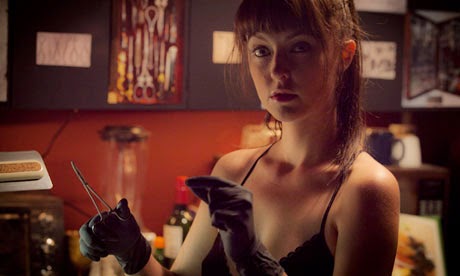

American Mary - 2012
Written & Directed by Jen & Sylvia Soska

Less than half-way into American Mary, I made a silent pronouncement to myself that its star was destined for big things in Hollywood.  It was only after I finished the movie and checked IMDb (per my compulsive tendency to do so) and realized that said star was Katharine Isabelle that I remembered that I had made the exact same declaration while watching her as a teenage werewolf in Ginger Snaps.  She brings an innate personality and charisma to these roles which I have to assume comes from her, herself, much the way a, say, Jennifer Lawrence does.  They share a similar magnetism.

As Mary, she plays a med student with a promising future and lot of sass.  Desperate circumstances lead her to an involvement in meatball surgery for semi-organized criminals.  This, in turn, puts her in contact with a walking plastic surgery nightmare whose ultimate "after" picture is Betty Boop.  Through her, Mary gets involved in the world of extreme body modifications, and a personal tragedy drives her away from school and deeper into the underworld.  She helps one woman to become more completely the "doll" that she wishes to be, removing the visible lady-bits that Barbie wouldn't have, splits tongues, removes limbs, creates diabolic beasties...  In Nietzschian fashion, Mary's time with monsters has a monstrous effect on her psyche, and it starts to consumer her.

This was a truly horrific horror flick.  The gruesomeness of the body modifications is all the closer because it's something that actually exists, and I don't just mean Joan Rivers.  While initially someone that we want to like, Mary's descent is disturbing on a number of levels, but particularly because so much of it comes about from completely understandable choices.

Weapon of Choice: scalpel


Maniac - 2012
Written by Alexandre Aja & Gregory Levasseur
Directed by Franck Khalfoun

This remake of 1980's Maniac is written by the team behind Haute Tension.  It's a much more straightforward venture and wears its twist up front.  Elijah Wood stars as the titular maniac, the socially awkward owner of a mannequin refurbishment shop.  He's also quite the active serial killer; seeking out, killing and scalping beautiful young women and attaching their scalps to the mannequins with which he's populated his home... and psychotic delusions.  The twist is that virtually the entire film is shot from the first-person perspective of Frank, our killer. Not only does this make the violence particularly lurid, but it makes us complicit in his crimes.  When Frank, mid-murder, screams at the specter of his mother in his head "WHY ARE YOU MAKING ME DO THIS?" he's also screaming at us.  By inhabiting his eyes, we give him life, and our anticipation drives him to kill.  It's a deeply effective conceit.  Where "found footage" films lend a certain reality to their events by placing us within them, putting us inside the killer draws us even closer -- disturbingly close.  It wouldn't work as a sub-genre the way that found footage has (to degrees), but it works here to create a complex experience from a fairly simple story.

Weapon of Choice: knives


The Seasoning House - 2012
Written by Paull Hyett, Conal Palmer & Adrian Rigelsford from an idea by Helen Solomon
Directed by Paul Hyett

I've mentioned truly horrific horror flicks and heartbreaking horror.  This one is both.  Set amid war in the Balkans, a deaf teen girl is stolen from her home as she witnesses her mother's murder by soldiers.  She is taken, with a number of other girls, to a ramshackle house in the country to serve as forced "prostitutes" (in reality, enslaved rape victims).  Seemingly due to the large birthmark on her face, and presumably her deafness, she is singled out from the group by the house's owner and operator.  Rather than serving as a "prostitute," she is made to work as a servant, delivering food in a bucket and worse, forced to give the other girls the heroin injections which keep them docile and dependent.  If it sounds unpleasant, that's because it is.  This is real horror.

Where it becomes more storylike and less of a sad statistic that we casually ignore is when "Angel" (so nicknamed for the necklace she wears) discovers that she can unscrew the air vents and crawl about between the walls and floors.  She uses this technique to visit the one girl in the house who recognizes her deafness and can communicate with her in sign language.  When the same group of soldiers who kidnapped her and killed her mother arrive to use the house's services, Angel witnesses her new friend's brutal death -- an accepted cost of doing business with savage killers.  Giving little thought to her actions, she attacks the soldier with a fileting knife, setting her on a desperate course of survival and revenge.  Despite the intense violence of the second half, it's nowhere near as disturbing as the first.  This is the real nightmare lived, to degrees, by millions of people in the world today.  Some may call it exploitative.  I call it necessary.

My only complaint would be the abuse of unfortunate coincidences that befall her toward the end.  By that point, I had already abandoned any hope of hope as a viewer, so anything less than watching the light go out in her eyes seemed like a victory of sorts.

Weapon of Choice: fileting knife, broken glass


So there you have it.  I learned a lot from these films.  I partly learned that I've been right about slasher horror all along.  Some of it IS abysmally stupid.  I also learned that I'd been wr-- that I'd been wro-- wrrr--  I learned that it didn't have to be that way, and that fascinating stories could be told within the loose confines of stabby death movies, giving us something new and inventive beyond the means of evisceration. 

Isn't that part of what we watch movies for?


The 10 Best Zombie Movies (for People Who Don't Necessarily Like Zombie Movies)

I'm not even going to dance around it.  The fact is, I have not been a lifetime horror fan.  As it turns out, there have been quite a few that I've liked along the way, but they seldom made me want to get deeper into the genre.  On top of that, I've been even less interested in zombie movies.  Until recently, they've predominantly been products of the lowest production values and the sparest creativity.  Gore for the sake of gore is rather a bore.

So what business do I have making a list of "Best Zombie Movies" anyway?  Well, if you're a hardcore zombie junkie, you don't need this.  You'll watch anything and you already know what you like.  I'm not approaching this as a zombie fan, but as a film fan, so my picks won't necessarily reflect the priorities of the hardcore fans.  The biggest example of this is the exclusion of George Romero's Night of the Living Dead.  While it's considered THE seminal zombie movie and (to be fair) pretty much established the sub-genre by itself, I just didn't LIKE it, and I found all the praise of its subtext to be vastly overstated.  It does, however, set the pattern upon which future zombie movies would expand.  In short: the newly dead rise from the grave and eat the living.  Fleeing strangers seek refuge.  They're gradually picked off either by zombies or their own paranoia.  One or two might survive, but chances are they'll get killed anyway.  Much as with punk rock, The Sex Pistols may have been the founders, but The Clash were the masters.  Deal with that.  Bring on the masters...


28 Days Later... - 2002
Written by Alex Garland
Directed by Danny Boyle

The Gold Standard for modern zombie movies.  While not strictly the first movie to feature "fast-movers," it was the one that popularized them.  They certainly enhance the sense of threat, but 28 Days doesn't make them the focus.  It, like many of the best ones, places the emphasis on how humans manage to survive each other in the presence of such a sudden and soul-jarring disaster.  It's interesting to me that, in the absence of hot-and-cold-running firearms in England, the story so strongly centers on protecting humanity in more ways than the physical.  Also that "Rage" is the super-contagion creating mindless killing machines.


Warm Bodies - 2013
Written by Jonathan Levine from the
Book by Isaac Marion
Directed by Jonathan Levine

Now this is something different.  Told from the perspective of a teenaged zombie who is surprised to discover that he has a perspective.  He develops thoughts and feelings, particularly concerning a living young woman.  They team up, realizing that there might be more to the whole zombie thing than eating brains or being target practice (respectively), and that realization threatens the stability of both their worlds.  It's funny.  It's sweet.  It's everything that hardcore zombie fans hate.  It dares... to have hope.  (gasp) *choke*  My only complaint is that the "Bonies," zombies who've lost all hope and become dessicated, skeletal corpses, run faster than both the regular zombies and the humans, which just makes no sense whatsoever from a biological standpoint.  Being little more than skeletons, they don't have the muscles to run fast.  They do play an important role as the ultimate threat, so I guess there's that.


Open Grave - 2013
Written by Chris & Eddie Borey
Directed by Gonzalo Lopez-Gallego

I sort of hate to include this one here because it's much better if you go into it not knowing that there are zombies, and you definitely should not expect it to be a "Zombie Movie."  On the other hand, you're unlikely to see this film without having it recommended, and it deserves to be seen.  A man awakens in a pit full of dead bodies with no idea who he is or how he got there.  He finds his way to a nearby house where a group of people is similarly afflicted.  Trust is in even shorter supply than answers.  In addition to setting up a tremendous mystery/thriller, when it does reveal its "Z" connection, its an aspect of such stories that we have rarely, if ever, seen addressed before.


The Battery - 2012
Written & Directed by Jeremy Gardner

This little indie places the focus squarely on survival.  Two former baseball teammates have stuck together ever since the outbreak, and over time it becomes clear that it's less out of any particular bond between them, and more a matter of just not wanting to be alone, and really not having any better ideas than going on.  In an unusual character twist for a z-flick, Mickey refuses to kill zombies, and doesn't show much of an instinct for survival at all.  Ben continues to carry him, and it helps that the zombies are old-school brain-dead slow-movers.  After so long together, it's clear that they're reaching the end of their ropes.  Mickey escapes into his headphones as much as possible, and Ben is starting to take a little too much glee in the zombie-slaying.  When they intercept a radio transmission from a xenophobic stronghold of survivors, Mickey becomes even more dangerous to their team as he tries to establish contact with the woman on the radio.  This is a quieter piece which nevertheless builds the tension as bad choices and bad luck collide.


Dawn of the Dead - 1978
Written & Directed by George Romero

I may not care for Romero's foundational Night of the Living Dead, but as disappointing as I found that one, I thought the next one, Dawn of the Dead, delivered.  Here, the social satire is on full display as four survivors take refuge atop a shopping mall where the zombies still stroll because it's all they can remember how to do.  With swarms of slow-walkers, the threat is much better represented than in the first, and the threat of other humans is considerably ramped up as well.  The humor is abundant, and the characters are actually likeable.  Anyone seeking a foundational zombie movie would get everything they needed here.  Romero's Dawn of the Dead is so seminal that the Dead Rising video game is basically a direct riff on it.  Also, there's...


Dawn of the Dead - 2004
Written by James Gunn from the original by George Romero
Directed by Zack Snyder

Given that Snyder's films tend to be visually impressive, but ultimately dead things anyway, it's unsurprising that this is in many ways his least disappointing film.  In fact, it's the humanity shown that makes this a worthwhile (if much less brilliant) remake.  This time, a larger group of survivors affords more opportunities for interpersonal drama... and loss.  While there was a pregnancy in Romero's Dawn, Snyder's sees it through to its unholy conclusion in the film's most unforgettable scene.  This Dawn served as an effective, uncomplicated base for the new zombie trend that was to follow.  I'm not saying it sparked it, but it provided a handy return to basics.


Shaun of the Dead - 2004
Written by Simon Pegg & Edgar Wright
Directed by Edgar Wright

Now this is one of the films that helped spark it (along with 28 Days Later).  Zombie movies seem particularly well-suited to comedy for some reason.  Perhaps it's the inherent absurdity or the opportunities for extreme behavior.  Maybe it's just whistling past the graveyard.  Notice the homage to Dawn of the Dead in the title.  Pegg & Wright's Shaun uses the zombies as metaphor for the dead end that not-quite-so-young-anymore Shaun has reached in his life due to his unwillingness to wake up and smell the choices.  Filled with quotable lines, Shaun of the Dead launched the international careers of Pegg, Wright and Nick Frost.


Zombieland - 2009
Written by Rhett Reese & Paul Wernick
Directed by Ruben Fleischer

Speaking of how zombies are well-suited to comedy, Zombieland definitely favors the comedy side of the family.  Good ol' boy Woody Harrelson joins a particularly twitchy Jesse Eisenberg on a cross-country trek post outbreak.  They run into Emma Stone and Abigail Breslin as another duo of survivors.  Neither duo wants to trust the other, but they just might need each other.  The rules of Zombie Survival are discussed, Twinkies are the ultimate food in post-civilzation America, and Bill Murray steals the show, appearing as... Bill Murray.


The Cabin in the Woods - 2012
Written by Joss Whedon & Drew Goddard
Directed by Drew Goddard

Okay, this barely qualifies as a zombie movie, but there ARE zombies, and it IS a great movie.  As has happened time and again in ages past, five young people go to a remote cabin and unleash a terrible evil.  The evil they happen to unleash in this case is an inbred frontier family of living deadness.  The blood begins to flow... but there's more going on here than meets the dangling eyeball.  Though frequently overlooked as such, this is a fully qualified entry in the greater Whedon family of quality entertainments.


ParaNorman - 2012
Written by Chris Butler
Directed by Chris Butler & Sam Fell

Norman Babcock is like a lot of kids his age.  He's fascinated with monster movies; zombies in particular.  Norman is NOT like a lot of kids.  Norman sees dead people.  Everywhere.  All the time.  This tends not to endear him to his classmates at school, and frustrates the hell out of his family.  When his crazy uncle dies, it falls to Norman to perform the ritual that will protect his town from the curse of a colonial era witch or the dead will walk again.

Norman does not perform the ritual.

Mayhem ensues, and everyone has a lesson or two coming their way.  ParaNorman is a funny and touching work of stop-motion animation from Laika, the studio behind Coraline and The Box Trolls.


Honorable Mentions:
Maybe not great films, but ones that offer something fresh or interesting to the zombie library.


Deadgirl - 2008
Written by Trent Haaga
Directed by Marcel Sarmiento & Gadi Harel

I almost forgot this one because it's so unsettling.  A couple of teenage boys explore a long-since abandoned asylum, discovering a locked door buried behind a hallway crammed full of old equipment and refuse.  Behind the door, they find the body of a girl in much better condition than her surroundings.  To their surprise, she's not exactly dead... but not exactly alive either.  What follows is, shall we say, some of the poorer behavior of which opportunistic teenage boys are capable.  The tension and fear at work in Deadgirl hinge primarily on human behavior.  Their secret discovery builds conflict between them, and the tinder of conflict grows until something has to ignite it.  While relatively light on the gore, Deadgirl is probably the most genuinely horrific film on this entire list.


Dance of the Dead - 2008
Written by Joe Ballarini
Directed by Gregg Bishop

A zombie plague strikes on the night of the senior prom and it falls to the schools dateless misfits to rescue their classmates, or at least achieve a little cathartic release on what remains.  A fun, funny high school flick with lots of head-smashy goodness.


28 Weeks Later - 2007
Written by [see link for writing team]
Directed by Juan Carlos Fresnadillo

This loosely related sequel to 28 Days Later is in nowhere near the same class as the original, but taken on its own terms, it does tell a unique story.  It's a more traditional zombie movie with the hook being that it focuses on the members of a single family and their recurring bouts of terror as England experiences the cleansing, and recurrence of the "Rage Virus." 


World War Z - 2013
Written by [see link for writing team]
Directed by Marc Forster

WWZ is rumored to have had a troubled production, and it shows.  While possessing many flaws, the fact remains that WWZ is a high-budget mad spectacle, and for that alone, it's worth a viewing.  Granted, some of this spectacle also qualifies as flaws -- such as ridiculously fast-moving zombies forming a giant mound to reach the top of a stories-high protective wall which should be beyond both zombie logic and basic physics, but it's undeniably freaky and cool nevertheless.  It also follows the efforts to sort out the cause and develop a cure, which is an aspect that we rarely get to see.


This list is subject to change pending further viewing.


The Absolute Best Found Footage Feature Films

Chronicle - 2012
Written by Max Landis
Directed by Josh Tank

Three high school boys from Seattle discover... something ...in the woods that gives them super powers, and then proceed to act like high school boys with super powers, documenting their discoveries and activities with cell phones and other cameras.  I had very little idea of what to expect from Chronicle, and many times when I did think I knew what was going to happen, it went and did something more realistic.  The light story premise left lots of room for actual character development based on human behavior.  Each of the boys developed their super skills along their own paths depending on their own individual natures, and their natures developed differently with the introduction of so much power.  An apt metaphor for adolescence if ever there was one.  The shaky camera stuff gets to be a bit much at times, but as someone who has lived in Seattle, there's definitely something to be said for the verisimilitude of seeing a place that I know presented in a naturalistic fashion.  Chronicle is a just plain good movie in any category applicable.


The Bay - 2012
Written by Michael Wallach
Directed by Barry Levinson

I have to admit, when I saw that Barry Levinson had done a found footage horror film, I felt a momentary sadness over greatness brought low.  This is, after all, the same Barry Levinson that gave us Diner, Rain Man, Bugsy and The Natural.  Well I needn't have worried.  The Bay is not only one of the most effective found footage films I've seen, but one of the most affecting horror movies as well.  Believability is always a goal when a filmmaker frames their narrative in the realistic conceit of gathering up video records from the scene of an event.  That's part of what makes them so appealing to the makers of horror, which relies on believability to deliver authentic scares.  The Bay frames its tale with recent real-life news stories about mass die-offs of fish and birds around America, and then simply nudges the idea a bit further, making the threat seem much bigger and closer than the movie screen.  Set in Levinson's beloved Maryland, a small town celebrating July 4th on Chesapeake Bay experiences a sudden -- and disgusting -- outbreak of a skin-blistering illness, which goes from bad to OH MY GOD SO BAD in the space of hours.  I believe that the low budget involved granted Levinson a little more leeway to express some rage at the government and industries that show little interest in the well-being of average Americans.  It's a real threat that we already feel inside us, and The Bay unleashes that like something eating its way out of us.


Troll Hunter - 2010
Written & Directed by Andre Overdal

Think of it like a "storm hunter" documentary that you'd see on cable, only instead of chasing storms across the American plains, they're chasing the trolls of Scandinavian folklore across the northern reaches of Norway, albeit with some actual hunting involved.  It's pretty formulaic for a found footage horror film with long periods building tension (particularly between bickering characters) punctuated with increasingly large monster encounters.  What makes Troll Hunter so effective is the strangeness of this insight into realistically presented foreign cryptids in their native setting (this wouldn't work as well set in America -- you hear me Hollywood?) and the deft way that they're inserted into real environments.  The trolls work better here than did the giants in Jack the Giant Slayer, for example.  I guess Norwegians loved it too, but I find that my distance from the material made it more plausible within its context.  The only ones who'll complain are the younger generation that grew up on CGI and complaining about everything on the internet.


Cloverfield- 2008
Written by Drew Goddard
Directed by Matt Reeves

Cloverfield felt like a bit of a bait-and-switch when it first came out.  It had been pimped as something of a neo-Godzilla movie, but when it came out it was... less epic of scale, shall we say.  Well, the fault was largely in our expectations, and in the promotion of the film, but not in the filmmakers themselves.  What Cloverfield IS is a survival horror movie set against the backdrop of a sci-fi monster epic.  We rarely see the monster, since our camera-holders are trying to get away from it, and I'm of the opinion that this is more-or-less for the best as it's a really unappealingly designed monster.  So rather than focusing on the creature, it follows a group of 20-somethings from a party interrupted by a monster attack on New York, through the dangers (big monster, little monsters, broken buildings, the military) of a city under siege, to their eventual rescue or demise.  It, as much if not more than any other city-trashing film of recent years, serves as a metaphor for 9/11 (or, I suppose, the invasion of Baghdad from the perspective of a Baghdadi), albeit abstracted from such complicated real-world concerns.  Once you set aside expectations, the biggest real problem with Cloverfield is that the characters are not as likeable as we'd like and some of their demises are all too welcome.


The Tunnel- 2011
Written by Enzo Tedeschi & Julian Harvey
Directed by Carlo Ledesma

The Tunnel, in retrospect, reminds me The Bay in several ways.  For one, there is a real-world framework; a network of tunnels and reservoirs beneath Sydney, Australia.  The tunnels have a long history of use and disuse for subways, war bunkers and eventually a retreat for the homeless.  This much, evidently, is true.  The film puts this in the context of a government plan to use the tunnels for new water storage which is unceremoniously scrapped, leaving one ambitious news team wondering just what is going on down there.  The Tunnel is assembled like a documentary, interviewing the members of the news team and cutting in their captured footage as they evade security to access the tunnels and then attempt to escape the... whatever ...that they find down there.  The whatever is a stealthy sumbitch, making for many creepy and harrowing moments.


Apartment 143 - 2011
Written by Rodrigo Cortes
Directed by Carles Torrens

Commonly dismissed as a Paranormal Activity knock-off, Apartment 143 beats it in all the ways that matter.  Most importantly, there's more of an actual story going on here, with better acting, more interesting camera placements, and a more sensible escalation of threat.  Rather than a tedious pastiche of home movie/security cam footage, the film starts with the arrival of a team of paranormal investigators.  They create a MUCH stronger narrative than any PA, and indeed a stronger narrative than most found footage films.  A single father and his son & daughter are haunted by more than the memories of their recently departed wife & mother.  It's up to the team of experts to figure out exactly what it is invading their home, and why.  The biggest flaw is the completely unnecessary "BOO!" in the last 2 seconds of the film.  By then you're already reflecting on what a good haunting tale you just watched anyway.


As Above, So Below - 2014
Written by Drew & John Erick Dowdle
Directed by John Erick Dowdle
with Perdita Weeks, Ben Feldman & Edwin Hodge

Think "Lara Croft and the Gates of Hell."  A young English scholar is determined to finish her father's quest for the Philosopher's Stone.  In the opening, we see her raiding an underground chamber in Iran for a codex that leads her back to the gravestone of Nicholas Flammel in Paris.  The information she finally gains suggests a chamber buried deep below Paris, through ancient catacombs (AKA tombs), far beyond the bounds of the usual tourist sites.  She enlists a camera man, a fellow scholar with whom she shares a history, and a team of Parisian urban explorers to find the chamber.

Things go from weird to spooky to creepy to SOOPER CREEPY to "RUN, DAMMIT, WHY AREN'T YOU FASTER?"  The creepy elements are really well done and I definitely caught a few distinct chills.  It doesn't over explain or go too big.  Where a lot of found footage horror involves a bunch of assholes wandering around the [woods, factory, asylum, mansion, carnival, etc.] just bitching at each other in generic locales of low-budget decay, the Dowdle brothers plotted this much more conscientiously, moving from creepy set piece to creepy set piece, deepening the mystery and mixing it up with claustrophobia, fear and panic.

It's not exactly an all original take on found footage, but it does what it does rather well, and it avoids a lot of the common pitfalls.  Most importantly, the characters are interesting enough that I cared what happened to them, and it creates a palpable sensation of fear.


Honorable Mentions:
These are flawed or less impressive films that nevertheless offer something unique and/or satisfying.


Paranormal Activity - 2007
Written & Directed by Oren Peli

The film that launched not just one mega horror franchise, but two!  In addition to the premise-milking American films, it has its own Japanese franchise as well, plus numerous copies and spoofs.  There's 2 reasons for this.  1) They soo-ooper cheap to make, and 2) they make filthy lucre, largely because they're effective.  The first film creates the basic chemistry for those to follow.  A couple starts to hear things in their new house and set up a bunch of cameras to see if they can find evidence of whatever is going on.  Along the way they bicker incessantly, consult a psychic, make bad decisions, and never ever seem to go to work.  Visual effects are used sparingly and much of the tension comes from the slowly intensifying sounds and attacks that come at night.  The anticipation remains much more frightening than the overt moments, and it's the homeowners' terror that becomes most infectious.  I suppose it you're non-responsive to the emotions of others, you might not find it scary, but for human beings, it can get pretty chilling.  There is a possession element to the film, which doesn't really work for me as I disbelieve in possession whereas ghosts remain squarely within the realm of unknown possibility, but it's a twist earned within the context of the story, so I can't really count it as a negative.


Frankenstein's Army - 2013
Written by Miguel Tejada-Flores & Chris W. Mitchell
Directed by Richard Raaphorst

Toward the end of WWII, a small Russian unit is sent into Nazi territory on a search and rescue mission.  Little do they know that their real mission is to uncover a secret science lab where the heir to Victor von Frankenstein has been continuing his work.  The film suffers from a few breakdowns in logic, the performances aren't all so good, and the conceit of lugging around a giant camera (with sound and color, no less) wears thinner in places here than it does in many other found footage narratives, but much of that is cancelled out by BRUTAL NAZI MECHA-ZOMBIES!  Imagining the fun that the monster designers had is infectious fun itself.


Europa Report - 2013
Written by Philip Gelatt
Directed by Sebastian Cordero

Based in the latest information that Jupiter's moon Europa contains water under a thick crust of ice, Europa Report speculates on a near-future international mission to learn more about it.  We know from the start that what we're viewing is ostensibly the recovered mission footage of the ill-fated investigation.  Because so much of the film takes place in transit, the pacing suffers from a lot of "too slow" and a sudden burst of "too much too fast."  Nevertheless, it's an interesting approach to a genuine near-future possibility, and while the characters aren't necessarily engaging, neither are they off-putting.  It's hardly Gravity, but it definitely gives it a run for its money on a dollar-for-dollar basis.


Grave Encounters - 2011
Written & Directed by The Vicious Brothers

The crew of a "Ghost Hunters" type show locks themselves into an allegedly haunted old mental asylum, and finds that the "allegedly" is completely unnecessary.  The former residents, and even the building itself plot against them, driving them to a sense of panic, and savoring their fear before picking them off.  It is, perhaps, over-reliant on jump scares, Halloween make-up, low-rent CGI and bad, bad character choices, but jump scares are still scares, and the sense of fear permeates.


V/H/S - 2012
see link for writing & directing credits

A group of punk-ass hoodlums commits various punk-ass crimes and video records everything for sale to an unknown benefactor.  When hired to steal a video tape from an old man's house (which they, of course, record), they discover a huge collection of bizarre video tapes, thus setting up the anthological format for V/H/S.  Each tape is a short film from a different team of writers and directors, depicting various scenarios which inevitably end in gruesome death.  It's in no way suspicious to the hoodlums with cameras that the videos feature people with cameras getting killed.  The films vary quite a bit, which is to be expected, given the format.  There are some curiosities of logic, like who would put digital cell phone videos onto VHS tapes.  The build-up to each video spends an excess of time focusing on the banalities of "selfie" videos, and the conceit does get strained again here when we find ourselves wondering why the hell people are still fussing around with cameras when they're running for their lives.  Also, some of the acting and effects are... not so much, but despite all the negatives, it still ends up being an interesting and entertaining little fake found footage film festival with scenarios that probably play better as shorts than they would in longer form, so for that, V/H/S has something to offer.

A lot of people prefer V/H/S 2.  I don't.  Out of the whole series thus far, the third, Viral, is actually my favorite.  The makers of Viral demonstrate that they are aware of our awareness of found footage films and nudge the approach forward, putting more thought into how they develop their narratives.


The Poughkeepsie Tapes - 2009
Written & Directed by John Erick Dowdle

Presented as a documentary, The Poughkeepsie Tapes reveals the story of a sadistic and very likely brilliant serial murderer who videotaped much of his bloody avocation.  This one was pretty morbid, possessing the "snuffiest" quality of any of these.  I realize, however, that that's also its appeal, as it leaves the viewer feeling dirty and threatened.  The biggest horror of the film is not his murders, but the one he kept alive.  It's not necessarily in character for one with his psychological profile, but it gives the movie its greatest impact.


Lake Mungo - 2008
Written & Directed by Joel Anderson

Another pseudo-documentary, this one is perhaps the most successful at presenting itself as a believable documentary, and it tells an uncommonly good story fairly well, but it's ultimately not really scary and indeed leaves one wondering what all the trouble was for.  Following the drowning death of Australian teen Alice Palmer, she may or may not still be appearing to loved ones and others, raising questions about whether of not she's dead.... or otherwise.  The film is propelled by an intriguing story with several twists, but in the end it's more sad than spooky.


This list is subject to update pending future viewing.

UPDATE: Added As Above, So Below and comments about V/H/S Viral - 12/3/2014

American History A thru X... Featuring the Quest for Love

TELEVISION:

Roots
Miniseries, 1977

Roots: The Next Generations
Miniseries, 1979


The TV miniseries adaptation of Alex Haley's Roots has loomed large in the background of my psyche ever since I saw it as a child in 1977.  I subconsciously expect everyone to have seen it and integrated it into their view of American history, and it sometimes shocks me when I realize that I'm talking to someone who doesn't understand the less-than-idyllic perspective of this country that Roots makes clear.

Roots and Roots: The Next Generations (henceforth to be referred to collectively as "Roots" unless otherwise specified) tells the story of one branch of author Alex Haley's American family, from "the African" Kunta Kinte, brought to America as a slave before the Revolutionary War, on up to Haley's publication of Roots: The Saga of an American Family in 1976.  Haley has always called the book a work of "faction," being based on what facts he could glean from oral family history and surviving records, with gaps filled in by the general truth of African-American history and out-and-out fictive storytelling to make the whole pastiche tell a story.


The Saga of an American Family

The long, long journey begins with Kunta Kinte, a young African tribesman in the area now known as Gambia.  One day in the 1760s, he was out looking for a tree to carve into a drum when he was captured by white slavers and packed like merchandise into a ship's hold for delivery to the American Colonies, enduring the horrors that we now understand such a journey to have entailed.  Kunta, we are shown, resists more than most and ultimately suffers the consequences for his untamed spirit.  He's whipped severely and eventually has half of one foot cut off to keep him from running away again.

In addition to a general desire for freedom, part of Kunta's motivation for running away is to see another slave from the ship that he has fallen in love with, but he eventually "jumps the broom" with Belle, a born and bred American slave.  They have a daughter whom he names "Kizzy," a word from his tribe meaning to "stay put."

But Kizzy doesn't stay put.  She grew up alongside her owner's daughter, who thought it would be funny to teach her to read and write.  When Kizzy gets older, she forges some travelling papers for a fellow slave she had fallen in love with.  This leads her owner to sell her to a much less "gentlemanly" farmer, who has a particular fondness for the sexual company of young slave girls.

Kizzy has a son by him named George.  He grows to become an expert cock-fighter, gaining the title Chicken George.  Unlike his mother and grandfather, George is not a born runner.  His prowess with the roosters grants him something of an elevated status, though less than that of a "house" slave.  It's only later his life, when he grows in his perspective of his owner's abuses and betrayals that he sets his sights more and more on freedom.  George marries Matilda and they have a son, Tom.  When their owner falls on hard times, he hires out Chicken George to a wealthier man who can still afford high stakes cock-fighting, promising George his freedom when he returns in three years (a promise he has betrayed before).

Three years turns into significantly more, but as promised, George is granted his freedom when he returns.  Unfortunately, free blacks are not allowed to live in the county where Matilda and Tom are owned, so George is absent from their lives for years at a time.  They are finally reunited when the Civil War frees them all.  This, roughly, constitutes the arc of the original Roots miniseries.


In The Next Generations, Tom takes the stage, leading the family out of slavery and the abuses of sharecropping. Tom is able to carry over a marketable skill from slavery and earns what is for a freed slave, a respectable income as a blacksmith.  This puts him in a leadership position in the negro community, which in turn sees him courted by white politicians.  When the Klan becomes active, he starts notching a code into the horseshoes of suspected white men, thus revealing their identities.  Turning them in backfires on him, and race relations in town go from antipathy to antagonism.

This places him on the front line of political betrayal as politicians lobby for their support as voters, while competing to be the biggest racist available for the white vote.  When the whites conclude that it would just be easier to deny blacks the vote, it's Tom who bears the humiliation of literacy testing and insulting denial of his rights with measured dignity.

Tom's daughter Cynthia courts and eventually married Will Palmer.  Will has had the good sense to see an opportunity for stable work and proved himself to the owner of the lumber yard.  He keeps the business running despite the aging, unreliable, alcoholic owner and eventually the community leaders (including the bank that holds the mortgage) ask him to take over operation of this essential community function.  The Palmer family grows into the middle class, which naturally begets resentment from ignorant white farmers.

Will is able to send his daughter Bertha to college where she falls in love with Simon Haley, the son of a poor sharecropper.  Simon's father decides he can't afford any more useless schooling for his son, but Simon is committed -- not just to elevating himself, but the race.  He spends a summer working as a Pullman coach porter.  He experiences the betrayals of corporate America and witnesses the traps set for the working negro -- both the external; such as company spies trying to shake loose potential union agitators, and the internal; such as gambling addiction.  He dedicates himself to sticking it out, and in a chance encounter demonstrates dignified customer service and thoughtful humanity to a patron who turns out to be the publisher of the Saturday Evening Post.  When he shows the faith to return to school without being sure where he's going to get the rest of his tuition, he finds that the publisher has already paid it, provided that Simon had the will to take a chance on himself.

No sooner than Simon has completed his bachelor's degree (literally no sooner, in fact, on the very day), he joins the army to serve in World War I, with ideas of elevating the image and position of American negroes through service.  The negro soldiers are given the worst jobs and treated as cannon fodder, but he survives.  He returns to an America where news photos of black soldiers with guns have paranoid racists terrified beyond reason, and Simon and his friends are caught up in the Knoxville race riots of 1919.

After that, Simon and Bertha are finally able to get on with their life together.  Simon earns a Master's Degree in agriculture and goes to work helping farmers to get the most from their land without sucking it dry.  As you might expect, poor white farmers react adversely to an educated black man suggesting what they should or should not grow on their land -- or in most cases, the landowner's land.  When a landowner tries to swindle a black sharecropper, Simon is literally caught in the crossfire.  Simon and Bertha have three sons, including Alex Haley.

Alex is resistant to his father's plans for him, dropping out of college at 17 and ending up in the Coast Guard, at Simon's insistence that military service would do him good (seemingly forgetting the Hell that it was for him).  While serving in perpetual kitchen duty in the Guard, World War II breaks out.  At a church-sponsored dance for servicemen, Alex meets Nan, whom he courts chastely over the course of several dances, and eventually marries, apparently on the crest of teenage hormones.

During the war, Alex develops a talent -- and a cottage industry -- for writing love letters on the behalf of his shipmates to their girls.  This begins to pull writing into focus as his passion.  After the war, he's so committed to writing that he ignores his wife and children, and they eventually leave him.  He continues to struggle to get work and scrapes by writing for magazines.  Magazine assignments include interviews with the George Lincoln Rockwell; head of the American Nazi party, and Malcolm X.  The latter turns into a full book length autobiography, which was Haley's first high-profile work.

Following this, he begins to take more and more of an interest in the family's oral history of "The Old African" Kunta Kinte and the generations that flowed from him.  Again, he becomes obsessed with his work, neglecting his relationship with his then girlfriend.  He follows the threads of history through what few records remain, and finally talks a publisher into funding a trip to Gambia to complete his research.  In Gambia, he is introduced to a griot (storyteller) from the Mandinka tribe, who tells him the story of the tribe, including the capture of Kunta Kinte.  The circle is complete.


Now, there's obviously a lot more to the story than this, and I did a deliberately incomplete job of summarizing it, but I felt it was necessary to provide some framework for the considerations to follow.  I left out a lot of the horrible treatment perpetrated against Haley and his ancestors, and I also left out most of the occurrences of white conscience, but they are there in the series.


The Goods

As a production, Roots is showing its age, much in the way that Kunta Kinte showed his age by turning from a young LeVar Burton to a middle-aged John Amos in the space of six years.  It didn't have the highest production values to begin with, being a television production of the 1970s.  Many scenes look like the product of the Universal back lot.

The performances, in particular, have not aged with the greatest of grace.  Many of the actors are suited to the tastes of another age and there are some over-the-top, stagey, or just -- ahem -- not-so-good moments in the acting.  It plays as melodrama more than drama in places.  Then again, there are still plenty of powerful and touching moments.  These things will matter more to some than others.  We're living in an age where naturalism is a given expectation for many, and yet Halle Barry and Renee Zellweger have both won Oscars, so there's that.

For film buffs, it's fun to watch just for the stars bursting from the seams.  From Ed Asner and LeVar Burton to James Earl Jones and Marlon Brando with most of the black actors of the 70s, Henry Fonda and Olivia de Havilland in between.

One of the weaker links in the series is the music.  There are many times when it seems really inappropriate in tone.  This is owed largely to a lot of aw-shucksy good-ol'-times-in-Dixie banjo in awkward places.  The variations on the primary Roots theme, however, maintain a sense of consistency as one family thread weaves through time.

That being said, the narrative remains powerful, creating an engaging emotional link between the viewer and the characters that threads throughout the history of the United States.  Where something like (the perfectly good) 12 Years a Slave presents us with an isolated story of one black man who was made a slave, Roots gives us a greater context for this experience.  We see it from different angles, in different times, with a broader inclusion of the families it involved.  And then we see that history evolve as America evolved, and the lineage of one family connected, generation by generation into a time and America that we more closely recognize as our own.  It takes it out of isolation and makes it ours.  It disallows us from treating our history as something separate from our world today.  This is still one of the most important things to have ever run on broadcast television and it's a shame that it isn't run more often.  It ought to be part of the curriculum in American schools, public or otherwise.


Fact, Fiction, "Faction," Factions and Truth

As I mentioned earlier, Haley calls Roots a work of "faction," which is to say that it a blending of fact and fiction.  It's a given that he wasn't present for two hundred year old conversations, but as it turns out, some of the presumed facts were not necessarily so.  Shortly after the miniseries aired on television, Haley was sued for plagiarism by another author, and settled with him, admitting that certain parts of Kunta Kinte's story had been inspired by a book called The African by Harold Courlander.  Furthermore, not all of the details about Kunta square up with historical records.  On top of this, it is alleged that the Mandinka griot Haley met may not have been a griot at all, but told the story he believed Haley wanted to hear.

Because of these inconsistencies, you will find some people on the internet declaring the entire work a lie and a scam.  Racist organizations and individuals use these elements to discount the entire narrative because, frankly, it makes them and their racist pappy and grandpappies look bad.  Poor them.

Roots may not be entirely factual, but it is TRUE, and in a way, that's better for all of us.

In the late 60s and early 70s, as black cultural awareness was exploding, the concept of digging into one's familial roots was fostered, but not originated by Alex Haley's Roots.  It's fairly normal human behavior for one to want their family to have a significant heritage, a qualitative pedigree.  Look at the Mormon obsession with genealogy or the importance many Southerners and Midwesterners place on "blood kin."  Whole swaths of the Bible are dedicated to who allegedly begat whom.  All over the world, we have people who are unable to let go of centuries-old ethic divides that fall somewhere in the range of irrelevant-to-outright-destructive.

Everyone wants to feel good about the place they come from, because for much of the world, this is what tells them who they are.  It's normal.  It might not be the healthiest thing for us, moving into a much smaller, much more fluid world, but that's normal human behavior.  No sane person ever said that humans were sane people.

For African Americans, the pursuit of this knowledge and the desire to make peace with who and where they came from is much, much more reasonable than most.  They had that stolen from them.  They had the fact of their birth treated as a kind of sin, to be punished in the harshest possible way by the most extreme of possible hypocrites.

Not only do we look to our heritages for identity, but also for validation.  We have a latent impression left over from everything from tribal to monarchical culture that our ancestors make us special.  I am by no means letting the United States off the hook with this behavior.  The sense of entitlement exercised by the wealthy is just as stupid and sick as any inbred prince (see: Romney, Mitt; Bush, George W. ad nauseum).  Speaking from my own experience; while I never had much interest in my own family's lineage (outside of Cherokee connections), there were exactly 2 points of interest for me pertaining to my family tree.  One; that on my mother's side, we are alleged to have descended from Peter, the "Little Dutch Boy" who stuck his finger in the dike to hold back the flood.  Two; that on my father's side, my Oklahoman grandmother's research showed that we were descended from Godwin, Earl of Wessex.  The reason that I, as a young person, took an interest in these two particular points in my lineage was that they seemed special, which meant that I could be special; that I was heir to bravery and nobility.  (It's perhaps befitting the disappointments of adulthood to now discover that The Little Dutch Boy isn't even a Dutch story and it seems that Godwin managed to back both sides of the Battle of Hastings still come out a loser.)

I'm hardly alone in this behavior.  And again, it makes a lot of sense that African Americans, who for so long had been treated as less-than-human might want, like any of us, to have that general desire to belong as much as any human, and that personal desire to be special -- especially a writer like Alex Haley who had a hard time just feeling accepted by his own father, who had achieved so much in other fields.

Normal.  Understandable.

So when Haley began filling in the gaps of his family history, it's both normal and understandable that he would fill it in with things like the bravery of Kunta Kinte in resisting the slavers, and the dignity with which he endeavored to keep the language of his people alive in his bloodline.  We don't know the facts of his case, but we DO know for a fact that someone resisted, and paid the price, and that someone struggled to keep a sense of identity alive, not necessarily in Haley's lineage, but in the totality of the African American experience throughout 400 years of slavery.

That it's not necessarily true of Haley makes it essentially true for all who share in the legacy of black slavery.  The collective narrative is enriched.  While it may matter to Alex Haley to connect his family to various important moments in Black American History, what matters to everyone else is that the history of black people in America is part of ALL Americans' history.

This is also, by the way, why "Black History Month" robs us all.  What we are really talking about is American History, with a focus on the contributions of Black Americans.  There was once a time when it made sense to make it more proprietary and pride based, but it's time that it was folded into ALL our histories the same way that we should ALL be folded into an equitable society.

When we couch things in the context of "sides," we rob ourselves and others of the truth, and in so doing, we are further robbed of the opportunity to grow from it.


And Now a Word About THAT Word...

The word is "nigger," and now I'm done using it.*

Roots, however, uses it a lot.

That is not a valid reason to avoid Roots or to hide children away from it, because when Roots uses it, it uses it in context.

Context is the single biggest thing missing in our national sort-of-discussion-but-really-just-reactionary-agenda-pushing about "The N Word."  When I used it, just about, I used it in the context of discussing the word.  That is something that a thoughtful person in a free society is allowed to do.  I didn't use it in the context of a person or even a race, but in the context of the word itself.

Roots -- or rather the characters IN Roots -- use it in its traditional historical context, and in our modern context, we see it with a new perspective and meaning.  When it's used by one character against another in Roots, it is intended as the deepest of debasements.  It's use is intended to rob human beings of their humanity, to indicate that their purpose is limited and subject to the whims of others.

When, however, we hear that use in our time, it has a meaning that goes beyond the intention.  When it's used now, it means that the speaker wants to mean the old meaning, which really tells us about the user.  So the stigma that has been placed on using the word is not a law, is not a threat, but is the burden of the implications of its use.  No one is (or should be) telling others that they cannot legally use the word.  However, using the word as a debasement tells all of the rest of us that YOU, sir or madam, are a racist piece of shit.  THAT is the meaning of the word in a modern context.  Being racist is not okay.  We know this now, and those who resist knowing that have made the CHOICE to be WRONG.  Not wrong like a bad answer, but wrong as a state of being.  Where the words say "You can't say that," the meaning is "You can't say that... if you want to be seen as a decent human being."

For those who are feeling like arguing with me about the application of context right now, consider the following two scenarios:
  • A Tea Party Congressperson uses the word in an email.
  • Ice Cube uses the word in song.
Yeah, not exactly the same thing, are they?  I'm not exactly comfortable with either use, but I accept that context colors the meaning and the level of offense.  Once we accept this, then we can move on to some finer distinctions.

So, when Roots uses it -- and it used it a shocking amount for something I watched on network television as a child (to my current perspective) -- it uses it in context.  The white characters use it as a debasement.  The show does not.  The black characters use it as victims of said debasement.  When Quentin Tarantino uses it in his screenplays, he also uses it in context.  In Django Unchained, he used it in exactly the same context as Roots, and in exactly the same context as 12 Years a Slave.  Accusing Tarantino of being racist for writing the words into a racist character's mouth is like accusing Steven Spielberg of the Holocaust for writing it into Schindler's List.  So yeah, we're done bitching about Quentin.

I'm not going to get into the hair-splitting finer points of how the word is used within the African American community today.  Contextually, I've seen about 3 or 4 different uses & meanings for it, but that ain't my particular cross to bear.  Instead, I'll simply offer this story...

One day, when I was working as a paraeducator for disabled and/or behaviorally challenged students, I got hoodwinked into serving as a school bus monitor on one of the short busses.  These were kids whose histories of behavior made it untenable for them to remain in an ordinary neighborhood school.  Because I had been sandbagged with bus duty and they did not know me, they decided to stir shit with me just because they didn't know how not to.  The ringleader of the group was a chunky black boy, probably around 12 years old.  Having worked with plenty of these kids by that point, I took a position of eye-rolling semi-amusement, and I volleyed his impotent and illogical insults back at him by turning his words around and giving them back.  When he saw that he wasn't getting the kind of reaction he wanted, he made a comment about "what kind of nigger" he was (*okay, done using it NOW).  Now me, I don't use the word unless I'm discussing it in context because I hate what it says about both the subject of its use and the user themselves.

As soon as I stopped responding, he crowed with victory, knowing that if I had used it, it would mean my job, and if I hadn't, it meant he won the volley.  In either case, this was a kid who had learned to take even smallest cheating victory, because there was very little victory of any other kind in his life.

How tragic, I thought, that he would accept a word that debased him and his people as a shortcut to petty victory.  How much sadder then, to think that this was certainly not a tactic that he had invented himself, but picked up from the polarized behavior of an American culture that prizes reactionary legalism over the truth gathered from widening our perspectives.

And that's all that I have to say about how it's used in the black community.

Now, the way that it's used by whites is a godforsaken disgrace.

I will sum this up in a brief discussion of not-a-doctor Laura Schlessinger, who DID use the word, repeatedly and on the air, with a black caller.  The "point" she was trying to make by hijacking a discussion about the caller's interracial marital problems was why she wasn't allowed to use it when many black people were still able to.  This is hardly a unique complain amongst conservative culture trolls, and it's as wrong-headed as pretty much everything else about them, but more pointedly so.

First of all, the question itself is false.  No one is saying that she CAN'T use it.  Constitutionally, she can and there is no law on the books anywhere in the nation that says she can't.  What not-a-doctor Laura is REALLY saying is "Why can't I use it without bearing the responsibility of how its use defines me?"  She wants to be racist without being seen as "a racist."  This vehement resistance to the meaning of words is pretty hilarious (you know, the pathetic kind of hilarity) when you consider these are the same people who claim the world will end if the word "marriage" is redefined.

Sidebar: My definition of "marriage" has changed several times, just as
a matter of living my life and learning more about myself and others.
Are you sure you really mean to be saying what you're saying about
yourself when you fret about about what it means in the lives of
people who are not you, because it's pretty brave of you, admitting
that you're that craven, weak & stupid.

Could go on.  Won't.  The incident led to the end of her awful career of being shitty to people and telling them how to ruin their lives by accepting her version of morality, as it should have.  She can say it all she wants in the privacy of her own personal hell.

Anyway, that was the roundabout way of saying, yes, Roots has THAT WORD in it, and yes, THAT WORD is offensive, but Roots uses it in its appropriate context.

It should be offensive.  

A large part of American history is.

The question is what we choose to learn from it, and we're not learning if we're not talking about it.