FILM:
The Place Beyond The Pines - 2013
Directed by Derek Cianfrance
see link for writing team
The first thing to understand about The Place Beyond The Pines is that most descriptions fail to explain it adequately. From what I'd read, I expected some kind of protracted game of cat and mouse between Ryan Gosling's motorcycle-stunt-rider-turned-bank-robber and Bradley Cooper's ambitious-but-stalwart-cop-in-a-corrupt-department. Sort of like a, say... Vanishing Point versus Copland or Heat meets The Departed... 'cept, you know, with motorcycles.
Well, it's not that. At least not the way you think it is.
The Place Beyond the Pines is really three movies in the space of a movie-and-a-half. The first act belongs to Gosling's character, Luke. He is indeed a sideshow stunt rider who walks away from his job when he learns that he left more behind than tender memories the last time he passed through Schenectady, NY. Eva Mendes is the mother of his child who can't decide what she wants. In order to support his son and be involved (as his own father wasn't), Luke ends up robbing banks using his riding skills to get away swiftly. When his partner (the brains of the operation) backs out on him, Luke's next job goes from bad to worse.
This leads to a fateful encounter with Bradley Cooper as Avery, a rookie cop with a law degree and big plans for the future. The second act is his, as the fallout from the encounter brings him the kind of notoriety that could help to fulfill those ambitions, but also involves him with the inner circle of corrupt good-ol'-cops. His intermittent conscience leads him into conflict with the cops, but for the time, ambition has all the answers.
The third act is set 15 years later and belongs to their teenage sons who are unaware of the history between their fathers. The choices of the past ripple through the future, shaking the lives of all involved.
Each act is very different; not merely in perspective but in tone and momentum, but they do add up to a really impressive and satisfying arc. It's an action crime flick, then a cop drama and finally a coming of age movie. The film doesn't judge the characters or even really push the story very hard. All the events flow naturally from a single choice. It's an engaging consideration of the way that choices echo through time, giving particular attention (intentional or not) to self-defeating behaviors. Luke and Avery are both haunted by their fathers in their own choices, which gets passed on to their own sons.
A Change of Tune
So I'm sitting here watching The Black Stallion and I noticed something curious.
In the climactic horse race at the end of the film, there is almost no music. A good 2/3 of the race is nothing but the sound of thundering hooves and panting breath. When music does finally enter, it's long, slow string tones tying the racing back to their time on the island. It's a thing of pure beauty.
If that film were made today, the entire race would be bloated out to at least twice as long to give the director more time to manipulate the viewer, and it would be drowned out with some kind of tuneless and turgid Hans Zimmer score. God damn I hate Hans Zimmer. His dronefests are symptomatic of what is wrong with movies these days. So much artistry and storytelling has been sacrificed for crass manipulation. It's no longer enough to tell a story well. Now you have to tell viewers what they're supposed to feel, and those feelings are no better distinguished than an emoticon in a text message.
In the climactic horse race at the end of the film, there is almost no music. A good 2/3 of the race is nothing but the sound of thundering hooves and panting breath. When music does finally enter, it's long, slow string tones tying the racing back to their time on the island. It's a thing of pure beauty.
If that film were made today, the entire race would be bloated out to at least twice as long to give the director more time to manipulate the viewer, and it would be drowned out with some kind of tuneless and turgid Hans Zimmer score. God damn I hate Hans Zimmer. His dronefests are symptomatic of what is wrong with movies these days. So much artistry and storytelling has been sacrificed for crass manipulation. It's no longer enough to tell a story well. Now you have to tell viewers what they're supposed to feel, and those feelings are no better distinguished than an emoticon in a text message.
Shorts on Film
My resolution for the new year (inasmuch as I believe in such things) is to update more. Toward that end, I will be allowing myself to relax and share shorter impressions of more things, rather than getting bogged down in longer articles so much (I still have three unfinished from the past year). If this seems to skew to the negative, it's because I'm also working on a separate list of the Best of 2013, and many of these are those that did not make the cut.
Escape From Tomorrow - 2013
Written & Directed by Randy Moore
The story behind the Escape From Tomorrow is really more interesting than the movie itself. Much of it was filmed surreptitiously within Disney World, unbeknownst to corporate and park management. That's pretty cool. Sadly, the long, long segments of park-wandering lose their fascination for the viewer much earlier than they did for the filmmaker. It was actually possible to watch much of it on fast forward without missing a thing. The acting is just bad and the story wasn't really a story so much as a pastiche of weirdness and creeping dread. There are some interesting and funny parts, but it doesn't add up to a satisfactory whole. Think of it as a (what was once called) a "head" film for the digital age of paranoia. It's a bad trip for characters and viewers alike.
Blue Jasmine - 2013
Written & Directed by Woody Allen
I have only myself to blame.
I was immediately put off by blurbs describing the story as "a troubled New York socialite imposes on her sister after her philandering Wall Street husband's indictment brings on a nervous breakdown." Don't get me wrong. I have nothing against nervous breakdowns, but vapid and solipsistic New York socialites really aren't my bag. Then it started getting all kinds of awards attention, so I decided to give it a chance and received a stark reminder about trusting my instincts. The characters are miserable and unpleasant. No one learns anything. All hopes are false. The character arc is not-so-much an arc as a body tumbling down an incline, left for dead.
The acting is good and the photography is pretty. It might even be a good movie, but that simply doesn't trump its unlikeability for me. I may be done with Woody Allen.
Captain Phillips - 2013
Written by Billy Ray
Directed by Paul Greengrass
I didn't expect much from Captain Phillips. I had a pretty good idea about the story, and while it's true that it held few surprises, Greengrass' way with cinematic pacing kept me engaged throughout. I had a pretty good idea what to expect from Tom Hanks, and while it's true that his New England accent held few surprises, he really delivered the emotional intensity to keep pace with the third act. I had a sense, watching the film, that the characters existed outside of the part of their lives that we're shown. It wasn't so much a matter of the story, to suggest this, but their emotions and behaviors that showed us they were connected to things outside of the frame. Obviously this is something we're meant to feel more often, from characters in films, but the fact that it stood out to me so starkly makes me think; maybe we haven't been getting what we should. Involving and entertaining -- this is what we watch movie for.
12 Years A Slave - 2013
Written by John Ridley - Directed by Steve McQueen
In 1841, Solomon Northrup, a free black man, was kidnapped and sold into slavery. This wasn't so uncommon at the time, but what is exceptional about it is that he was eventually freed and wrote a book about it. That's not just a summary; that's pretty much the entire story. 12 Years A Slave offers no surprises and very little insight. I watched Roots again last year, so this really felt like a reprise. Where Captain Phillips held few surprises, it made up for it with its own kinetic momentum. 12 Years A Slave, however, has very little momentum other than the desire to see him free again, with a slow, languorous pace which I believe was designed to convey the sensation of 12 long years. The film is beautiful to behold and performances range from the excellent (mainly Chiwitel Ejiofor) to the eye-rollingly melodramatic, and points between. I'm not exactly complaining. As long as the idea holds appeal to you as a viewer, this is an excellently made film and you should enjoy it much as you expect to. If, however, you're looking for something that will enrich your understanding of the American Shame of Slavery, it's only going to tell you what you already know.
One thing I want to say about 12 Years A Slave is how I appreciate it telling its own story. Last year, we had a bunch of whiny-ass writers and directors bitching about Django Unchained using slavery themes. Steve McQueen DID something -- shared HIS voice and vision -- rather than gripe, and for that, I respect him even more. Your turn, Spike Lee. Deliver, or shut the hell up.
Also, can we talk about how fucking creepy Paul Dano is? Guh!
Saving Mr. Banks - 2013
Written by Kelly Marcel & Sue Smith - Directed by John Lee Hancock
Another short-on-plot, long-on-character piece of end-of-the-year obvious Oscar-bait. In fact, I think this is a slot within that frame that comes around every year; the Gentle Biopic (often set in Old Hollywood). It was Hitchcock last year and The King's Speech the year before. Anyway, what we get here is the fairly light story of the strained relationship between P.L. Travers, author of Mary Poppins and Walt Disney, who deeply wanted to bring it to the screen. Emma Thompson really carries the film. The filmmakers give us her extremely prickly character, and then actually bother to develop that, causing us to question why and lending the film its main momentum. Tom Hanks does his affable Tom Hanks stock character here, which is endearing enough, but offers far less depth than Thompson (or indeed, Hanks in Capt. Phillips). He does a nice job with the speech at the end that magically makes everything all okay.
American Hustle - 2013
Written by Eric Singer & DOR - Directed by David O. Russell
Great performances, especially from Amy Adams. The plot isn't particularly engaging and it falls to the characters to propel the film forward, which they do, mostly without falter. However, I can't say that they ever give us much to care about.
I, personally, find it interesting that we're now calling David O. Russell a director with a "confrontational method" where back around the time of Three Kings we merely recognized him as an unbalanced asshole.
Enough Said - 2013
Written & Directed by Nicole Holofcener
I wanted so badly to like this movie. It starts out as a sweet romantic comedy about adults-of-a-certain-age finding each other and negotiating the silliness of dating, all while enjoying funny conversations. Then it turns on you like a good curry made with bad goat. People stop acting like adults and the plot-like substance which emerges turns out to be a DEEPLY STUPID sitcom kind of set-up. And then that just drags on, VERY, VERY UNCOMFORTABLY for the remainder of the film. When Dreyfus' immature behavior catches up with her, it's hard to care because she's been such a cowardly a-hole. I just wanted Gandolfini's character to get these HORRIBLE women out of his life. As disappointing as getting a Fony GameStation 4 with Carl of Duty 9 for Christmas.
The Heat - 2013
Written by Katie Dipold - Directed by Paul Feig
I really wasn't sure we needed another comedic take on the buddy cop movie after Cop Out and The Other Guys, but The Heat delivers enough energy and silliness to make it a good, fun time. The viewer is responsible for checking their higher sensibilities at the door. It's obvious, when we see Melissa McCarthy chasing down a perp in her car (because she'd lose him in the length of a block on foot) that the idea of her as a badass break-the-rules kind of cop is laughable in an uncomedic way, but she sells it with the same goofball mania that she brought to Bridesmaids and her SNL appearance. It's funny, and that's its job.
Escape From Tomorrow - 2013
Written & Directed by Randy Moore
The story behind the Escape From Tomorrow is really more interesting than the movie itself. Much of it was filmed surreptitiously within Disney World, unbeknownst to corporate and park management. That's pretty cool. Sadly, the long, long segments of park-wandering lose their fascination for the viewer much earlier than they did for the filmmaker. It was actually possible to watch much of it on fast forward without missing a thing. The acting is just bad and the story wasn't really a story so much as a pastiche of weirdness and creeping dread. There are some interesting and funny parts, but it doesn't add up to a satisfactory whole. Think of it as a (what was once called) a "head" film for the digital age of paranoia. It's a bad trip for characters and viewers alike.
Blue Jasmine - 2013
Written & Directed by Woody Allen
I have only myself to blame.
I was immediately put off by blurbs describing the story as "a troubled New York socialite imposes on her sister after her philandering Wall Street husband's indictment brings on a nervous breakdown." Don't get me wrong. I have nothing against nervous breakdowns, but vapid and solipsistic New York socialites really aren't my bag. Then it started getting all kinds of awards attention, so I decided to give it a chance and received a stark reminder about trusting my instincts. The characters are miserable and unpleasant. No one learns anything. All hopes are false. The character arc is not-so-much an arc as a body tumbling down an incline, left for dead.
The acting is good and the photography is pretty. It might even be a good movie, but that simply doesn't trump its unlikeability for me. I may be done with Woody Allen.
Captain Phillips - 2013
Written by Billy Ray
Directed by Paul Greengrass
I didn't expect much from Captain Phillips. I had a pretty good idea about the story, and while it's true that it held few surprises, Greengrass' way with cinematic pacing kept me engaged throughout. I had a pretty good idea what to expect from Tom Hanks, and while it's true that his New England accent held few surprises, he really delivered the emotional intensity to keep pace with the third act. I had a sense, watching the film, that the characters existed outside of the part of their lives that we're shown. It wasn't so much a matter of the story, to suggest this, but their emotions and behaviors that showed us they were connected to things outside of the frame. Obviously this is something we're meant to feel more often, from characters in films, but the fact that it stood out to me so starkly makes me think; maybe we haven't been getting what we should. Involving and entertaining -- this is what we watch movie for.
12 Years A Slave - 2013
Written by John Ridley - Directed by Steve McQueen
In 1841, Solomon Northrup, a free black man, was kidnapped and sold into slavery. This wasn't so uncommon at the time, but what is exceptional about it is that he was eventually freed and wrote a book about it. That's not just a summary; that's pretty much the entire story. 12 Years A Slave offers no surprises and very little insight. I watched Roots again last year, so this really felt like a reprise. Where Captain Phillips held few surprises, it made up for it with its own kinetic momentum. 12 Years A Slave, however, has very little momentum other than the desire to see him free again, with a slow, languorous pace which I believe was designed to convey the sensation of 12 long years. The film is beautiful to behold and performances range from the excellent (mainly Chiwitel Ejiofor) to the eye-rollingly melodramatic, and points between. I'm not exactly complaining. As long as the idea holds appeal to you as a viewer, this is an excellently made film and you should enjoy it much as you expect to. If, however, you're looking for something that will enrich your understanding of the American Shame of Slavery, it's only going to tell you what you already know.
One thing I want to say about 12 Years A Slave is how I appreciate it telling its own story. Last year, we had a bunch of whiny-ass writers and directors bitching about Django Unchained using slavery themes. Steve McQueen DID something -- shared HIS voice and vision -- rather than gripe, and for that, I respect him even more. Your turn, Spike Lee. Deliver, or shut the hell up.
Also, can we talk about how fucking creepy Paul Dano is? Guh!
Saving Mr. Banks - 2013Written by Kelly Marcel & Sue Smith - Directed by John Lee Hancock
Another short-on-plot, long-on-character piece of end-of-the-year obvious Oscar-bait. In fact, I think this is a slot within that frame that comes around every year; the Gentle Biopic (often set in Old Hollywood). It was Hitchcock last year and The King's Speech the year before. Anyway, what we get here is the fairly light story of the strained relationship between P.L. Travers, author of Mary Poppins and Walt Disney, who deeply wanted to bring it to the screen. Emma Thompson really carries the film. The filmmakers give us her extremely prickly character, and then actually bother to develop that, causing us to question why and lending the film its main momentum. Tom Hanks does his affable Tom Hanks stock character here, which is endearing enough, but offers far less depth than Thompson (or indeed, Hanks in Capt. Phillips). He does a nice job with the speech at the end that magically makes everything all okay.
American Hustle - 2013
Written by Eric Singer & DOR - Directed by David O. Russell
Great performances, especially from Amy Adams. The plot isn't particularly engaging and it falls to the characters to propel the film forward, which they do, mostly without falter. However, I can't say that they ever give us much to care about.
I, personally, find it interesting that we're now calling David O. Russell a director with a "confrontational method" where back around the time of Three Kings we merely recognized him as an unbalanced asshole.
Enough Said - 2013
Written & Directed by Nicole Holofcener
I wanted so badly to like this movie. It starts out as a sweet romantic comedy about adults-of-a-certain-age finding each other and negotiating the silliness of dating, all while enjoying funny conversations. Then it turns on you like a good curry made with bad goat. People stop acting like adults and the plot-like substance which emerges turns out to be a DEEPLY STUPID sitcom kind of set-up. And then that just drags on, VERY, VERY UNCOMFORTABLY for the remainder of the film. When Dreyfus' immature behavior catches up with her, it's hard to care because she's been such a cowardly a-hole. I just wanted Gandolfini's character to get these HORRIBLE women out of his life. As disappointing as getting a Fony GameStation 4 with Carl of Duty 9 for Christmas.
The Heat - 2013
Written by Katie Dipold - Directed by Paul Feig
I really wasn't sure we needed another comedic take on the buddy cop movie after Cop Out and The Other Guys, but The Heat delivers enough energy and silliness to make it a good, fun time. The viewer is responsible for checking their higher sensibilities at the door. It's obvious, when we see Melissa McCarthy chasing down a perp in her car (because she'd lose him in the length of a block on foot) that the idea of her as a badass break-the-rules kind of cop is laughable in an uncomedic way, but she sells it with the same goofball mania that she brought to Bridesmaids and her SNL appearance. It's funny, and that's its job.
A Very Scary Pairing
FILM:
Insidious - 2010 and Insidious Chapter 2 - 2013
Directed by James Wan
Written by Leigh Whannell
Ever since director James Wan shook up the horror genre with Saw in 2004, he's been the "It" director of horror films. Rather than continuing to churn out Saw sequels, as he surely had an opportunity to do, he's brought even spookier tales to the screen in films like The Conjuring and Insidious 1 & 2. It would not be unfair to call Wan this generation's John Carpenter. His next film will be the seventh Fast & Furious, which seems like a good fit, given Wan's intense and unsubtle approach to direction. While Wan never shies away from clubbing the viewer over the head with his story beats on film, it's his partnership with writer/actor Leigh Whannell (the guy who is not Cary Elwes in Saw) that truly stands out as an example of thoughtful and clever storycraft.
Nowhere is that more evident than in Insidious and Insidious Chapter 2 -- the latter in particular. I'm discussing them together because they are the rare case in horror movies where the sequel was clearly planned from the beginning rather than invented as a way to separate teens from more of their allowance.
Insidious is a modern take on the fairly rote themes of the possession story. A family starts to experience an increasingly unnerving series of haunting events. Mom picks up a creepy voice on the baby monitor. Floor boards creak. Locked doors are blown open. Visions of the dead begin to creep in. All that good stuff.
Wan takes a pretty heavy hand with the presentation of these things. Many scares are telegraphed from miles away and the viewer can frequently point to the split second when a spook will suddenly appear. It's hard to say whether we're simply so conditioned by movies that we respond so strongly to the rote pacing of a scare, or whether the alchemy of film has so refined the process of scaring us based on our natural tendencies. I suspect it's a little of both. The music, in particular, seems designed to not-just-suggest how we should be feeling, but to scream it in our faces like an archetypical drill sergeant. "YOU are FEELing TENSION right now, you damned panty-waist! That TENsion is BUILDing to a POINT. Right NOOOW, I want you're skin to be CRAWLING, soldier, and what I want is LAW, DO YOU HEAR ME, maggot? THAT was the moment of relief before (SKREE-SKREE-SKREE) a FRIGHT that will cause your BOWELS to release like MONteZUma's REvenge! Now STRAIGHTEN UP, you wussy little pukes!" It's... a bit much, at times. And yet, it often works. I genuinely had to question the wisdom of watching the sequel on quite so chilly a December evening.
The series of scares builds up to an increasing threat toward the children of the family, until the older son falls into an unexplainable coma. When all scientific approaches have been exhausted, his grandmother brings in a psychic/paranormal investigator. She believes that the boy has been astrally projecting got lost in the limbo between the world of the living and the great beyond. The greater threat is that his spiritually vacated body is to ghosts what a boarded up row house is to London squatters. If he can't find his way back to his body soon, something else will.
As it turns out, the father encountered the same danger as a child and had his memories suppressed for his own safety. Tapping into a talent for astral travel, he's able to cross over and seek out his son's wandering soul. It's here that things cross the line from a build up of scares to openly explicit boogeyman territory. The spirit world is all darkness and fog with moaning people in gray makeup. It was just... too much ...in my opinion. It was tense, but it wasn't scary anymore.
Insidious ends with a death and a mystery, which leads directly into Insidious Chapter 2.
The sequel takes a much more fluid approach to time, opening with a flashback to the father's childhood and the events that would (literally) come back to haunt them all. It then rejoins the story a few hours after the end of the first film. The family has gone to stay with grandma in the father's childhood home while the police conduct their investigation into the death at their house. It quickly becomes clear that the "insidious" spirits are not done with them yet, and the chilling process of building up fear begins again. The filmmakers hit us pretty hard with their escalation of terror. While things get worse at home, grandma is out with the paranormal investigators tracking down the origins of their ghosts, find that this rabbit hole leads directly into a Hell of human making.
We are returned to the land of darkness and fog, and while it's all still very sound-stagey, the established mythos makes it more effective the second time around. We're not looking for naturalism anymore, but accepting it as a conceit of the series. It takes on a number of twists of its own, now that we know what to expect from it. It's still not as scary as the real world scares; the anticipated, the startling and the unknown, but it contains its own tension and drama. This time, rather than wholly containing the climax within this world, there is paralleling tension and drama in the material world, creating a much more effective anxiety.
I'm of the opinion that it ends with something of a joke. As the camera moves in on one character's face, it's like a game of chicken for well-trained horror fans. We KNOW it can't end with a pure sigh of relief... or can it? Wan & Whannell allow themselves to have it both ways, both wrapping up the story while still leaving room for the inevitable sequel rooted in the the first two.
It's really in the crafting of the narrative that they shine. I've kind of made a point of both sides of Wan as a director. He knows all the notes and hits them hard, but it's often too hard, with too much... flair. Kind of like a female pop vocalist in the post-Whitney Houston era. Ease up on the friggin' melisma, you know?
In the script, however, Whannell weaves together a variety of scares in a tightly-paced fashion, and story elements that actually add up, rather than merely existing to make the viewer jump. It's in Chapter 2 that the cleverness is truly revealed, as mere haunts from the first movie turn into pivotal story beats in the second. It's one thing to unspool a mystery, but it's even more thrilling when you discover that the mystery is bigger and more complex than you suspected. Taken as a whole, I felt that Insidious 1 & 2 delivered both bigger and deeper than Saw. Forget your M. Night Shyamalan (which you really should have done by now anyway); Leigh Whannell is your guy for twisty stories. I really hope that he's able to break out on his own. His narrative skill would be amazing in a TV series.
And now, just for shiggles; another Wan/Whannel afterlife joint... Doggie Heaven.
Insidious - 2010 and Insidious Chapter 2 - 2013
Directed by James Wan
Written by Leigh Whannell
![]() |
| The party starts here. |
Ever since director James Wan shook up the horror genre with Saw in 2004, he's been the "It" director of horror films. Rather than continuing to churn out Saw sequels, as he surely had an opportunity to do, he's brought even spookier tales to the screen in films like The Conjuring and Insidious 1 & 2. It would not be unfair to call Wan this generation's John Carpenter. His next film will be the seventh Fast & Furious, which seems like a good fit, given Wan's intense and unsubtle approach to direction. While Wan never shies away from clubbing the viewer over the head with his story beats on film, it's his partnership with writer/actor Leigh Whannell (the guy who is not Cary Elwes in Saw) that truly stands out as an example of thoughtful and clever storycraft.
![]() |
| "You have something on your shoulder..." |
Insidious is a modern take on the fairly rote themes of the possession story. A family starts to experience an increasingly unnerving series of haunting events. Mom picks up a creepy voice on the baby monitor. Floor boards creak. Locked doors are blown open. Visions of the dead begin to creep in. All that good stuff.
Wan takes a pretty heavy hand with the presentation of these things. Many scares are telegraphed from miles away and the viewer can frequently point to the split second when a spook will suddenly appear. It's hard to say whether we're simply so conditioned by movies that we respond so strongly to the rote pacing of a scare, or whether the alchemy of film has so refined the process of scaring us based on our natural tendencies. I suspect it's a little of both. The music, in particular, seems designed to not-just-suggest how we should be feeling, but to scream it in our faces like an archetypical drill sergeant. "YOU are FEELing TENSION right now, you damned panty-waist! That TENsion is BUILDing to a POINT. Right NOOOW, I want you're skin to be CRAWLING, soldier, and what I want is LAW, DO YOU HEAR ME, maggot? THAT was the moment of relief before (SKREE-SKREE-SKREE) a FRIGHT that will cause your BOWELS to release like MONteZUma's REvenge! Now STRAIGHTEN UP, you wussy little pukes!" It's... a bit much, at times. And yet, it often works. I genuinely had to question the wisdom of watching the sequel on quite so chilly a December evening.
![]() |
| "Dear God, no... not cosplayers!" |
As it turns out, the father encountered the same danger as a child and had his memories suppressed for his own safety. Tapping into a talent for astral travel, he's able to cross over and seek out his son's wandering soul. It's here that things cross the line from a build up of scares to openly explicit boogeyman territory. The spirit world is all darkness and fog with moaning people in gray makeup. It was just... too much ...in my opinion. It was tense, but it wasn't scary anymore.
Insidious ends with a death and a mystery, which leads directly into Insidious Chapter 2.
![]() |
| "What was that?" |
We are returned to the land of darkness and fog, and while it's all still very sound-stagey, the established mythos makes it more effective the second time around. We're not looking for naturalism anymore, but accepting it as a conceit of the series. It takes on a number of twists of its own, now that we know what to expect from it. It's still not as scary as the real world scares; the anticipated, the startling and the unknown, but it contains its own tension and drama. This time, rather than wholly containing the climax within this world, there is paralleling tension and drama in the material world, creating a much more effective anxiety.
![]() |
| "Watch it with the spoilers!" |
I'm of the opinion that it ends with something of a joke. As the camera moves in on one character's face, it's like a game of chicken for well-trained horror fans. We KNOW it can't end with a pure sigh of relief... or can it? Wan & Whannell allow themselves to have it both ways, both wrapping up the story while still leaving room for the inevitable sequel rooted in the the first two.
It's really in the crafting of the narrative that they shine. I've kind of made a point of both sides of Wan as a director. He knows all the notes and hits them hard, but it's often too hard, with too much... flair. Kind of like a female pop vocalist in the post-Whitney Houston era. Ease up on the friggin' melisma, you know?
In the script, however, Whannell weaves together a variety of scares in a tightly-paced fashion, and story elements that actually add up, rather than merely existing to make the viewer jump. It's in Chapter 2 that the cleverness is truly revealed, as mere haunts from the first movie turn into pivotal story beats in the second. It's one thing to unspool a mystery, but it's even more thrilling when you discover that the mystery is bigger and more complex than you suspected. Taken as a whole, I felt that Insidious 1 & 2 delivered both bigger and deeper than Saw. Forget your M. Night Shyamalan (which you really should have done by now anyway); Leigh Whannell is your guy for twisty stories. I really hope that he's able to break out on his own. His narrative skill would be amazing in a TV series.
And now, just for shiggles; another Wan/Whannel afterlife joint... Doggie Heaven.
Somehow...
...I know that Patrick Duffy starred on The Man From Atlantis, a show I've never seen....
...But I don't even know what Trigonometry IS.
The Breakers Are Broken
FILM:
Spring Breakers - 2013
Written & Directed by Harmony Korine
WARNING: The following review discusses a despicable movie about despicable people. If you are sensitive to descriptions about despicability, I suggest that you stop reading here. Reader discretion is advised... Mom.
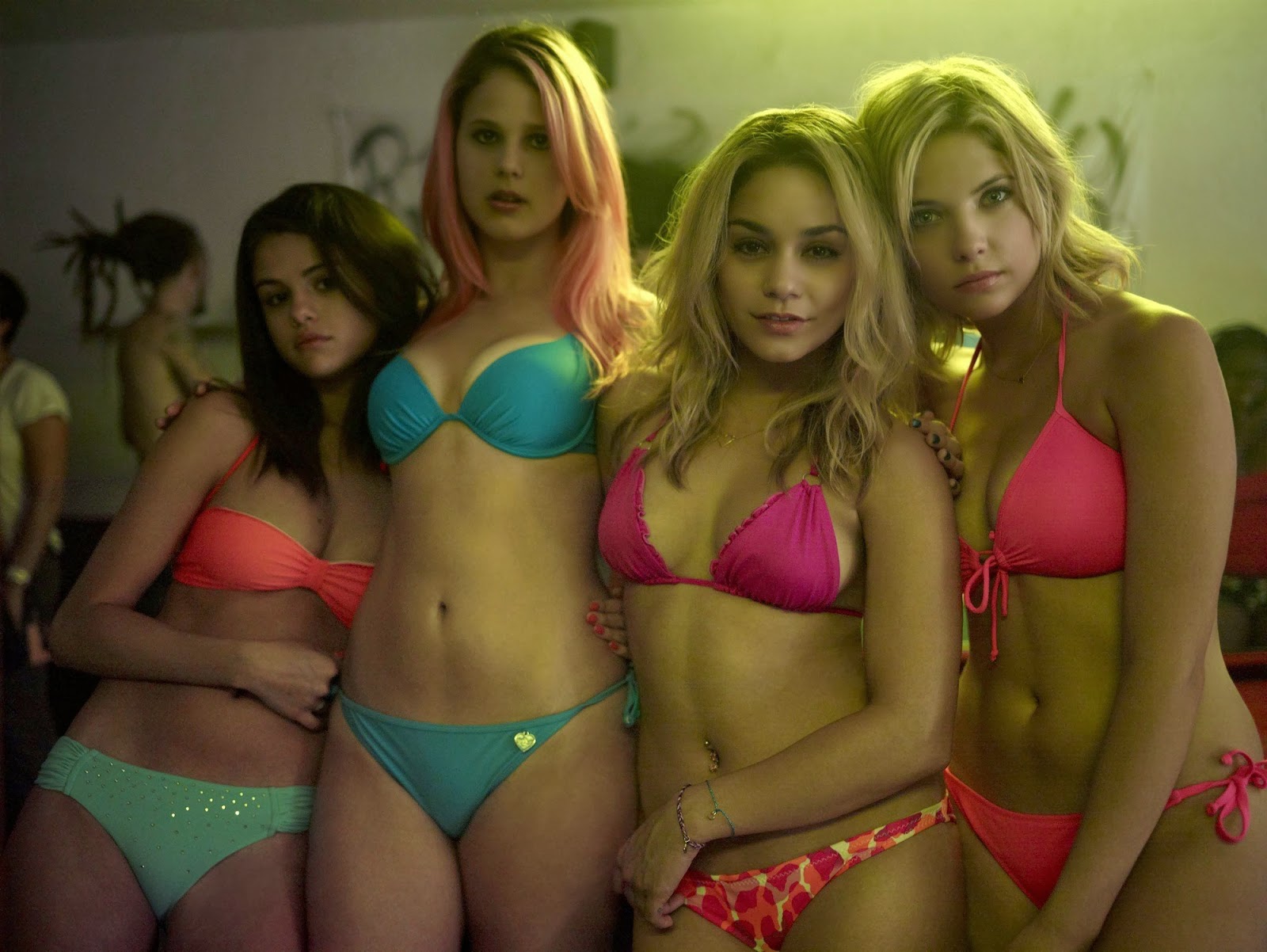
Spring Breakers is a terrible movie about terrible people making terrible choices and encountering virtually NO believable consequences for their terrible actions. The -- I hesitate to call it a story since it bears none of the benchmarks of storytelling but merely unfolds as a delirious wandering from one occurrence to the next -- thing that happens in the movie is that four stupid college girls want to go to Spring Break in Florida, so two of them rob a diner with a third driving getaway. Then they all go to Florida and act like fools with zero sense of self-preservation, which is evidently totally okay because nothing too bad really happens to them while they wreak havoc in the lives of others. If that's non-specific, hang in there, because I have no reservations about "spoiling" the "plot" of this back-alley abortion of a film.
It's entirely possible to hear the general concept of the film and to assume that it's going to be a fun and silly romp. It is not. I came to the independent conclusion that it was more like a horror story, and I've since discovered that I'm not alone in how ugly and perverse this movie is.
How do I hate Spring Breakers? Let me count the ways...
Starting with the most obvious but least offensive element; Spring Breakers is shot in a dreamy, semi-hallucinatory style, detached from any concept of presenting a scene as a piece of narrative or exposition. Some people have tried to claim the mantle of "neorealism" for Spring Breakers, but there is far too much evidence that any form of realism could never have been the intention of a mess this unrealistic. The style is "realistic" the way a mean girl's Facebook page is realistic. Yes, these things exist, but that doesn't mean that they have any sort of perspective on reality. MUCH of the movie plays like a series of photos, shaky-camera video clips and vague, self-obsessed statements that seem designed more to convince the individual themselves that they're being fulfilled than the sharing of any genuine informational or emotional content. It is absolutely impossible for a sane, mature human being to give any credibility to pastiches of wandering sunset-colored light smears and the leers of drunken frat boys with voice-overs about "wonderful people" and "finding myself." Anyone with any experience in the real world MUST roll their eyes at such moments -- and the entire movie is those moments.
The similarly themed The Bling Ring from Sofia Copolla uses the detached technique as well, and why it's not as gawdawful as Spring Breakers, it's still the weakest movie I've seen from Copolla. It works in Lost in Translation, but Lost in Translation has some heart in it, and features human beings who behave like human beings in a world of other human beings.
There IS, I believe, a case to be made for the style. Like I said, it's annoying but not egregious, and annoying as it is, it provides one possible loophole for some of Spring Breakers' greater crimes.
The music was hideous. I couldn't tell if it intentionally used the most generic dubstep possible as a way of making a point about the generic bad taste of dubstep fans, or if that's just the way dubstep IS. I have chosen to conclude the latter in the absence of any evident self-awareness (self-obsession is not the same thing as self-awareness).
The characters were not JUST unlikeable, they were un-not-want-to-kill-able. Despite figuring out early that I hated these characters and this movie, the ONE reason I watched it all the way to the end was because I wanted to see at least one of them get killed. Seriously. They deserved to die, and not just because I hated them so completely, but because in a real world, they would have gotten themselves killed with their choices. This is why the "neorealism" claims are such complete horse crap. There is not one shred of realistic behavior in this trainwreck.
There are four girls, but really only two characters among them. There are three completely generic stupid blonde sluts, and then the one who isn't. Now, don't get me wrong. I don't use the term "slut" lightly. This is not some Rush Limbaughian endeavor to slander mature women who are in charge of making perfectly responsible choices with their bodies and their lives. I employ the term not to slander all women, but to define by their character and choices the kind of women who slander the gender, and indeed the species, through unexamined, undiscerning, uninformed, unaware, unconscionable actions based less on "choice" and more on animalistic id. They want. They react to that want without consideration. If these characters were male, they'd be serial rapist football players and we'd be appalled by any movie that didn't see them facing the natural fallout for their behavior. Spring Breakers instead takes the side that it's all good as long as they don't lose their scholarships.
So, we have the three generic blondes demonstrating similar character but less depth than webcam porn videos. Even in their classes, they're fixated on getting fucked up and sucking dick. One of the blondes is a pink blonde, but except for a couple moments, behaves pretty much as a unit with the other two -- who may or may not be twins, that's how bland and ill-defined they are. Then there's the dark-haired one who is different. You can tell because she has dark hair. She also belongs to a caricature of a campus Christian group. It's through her that we see any kind of morality, but the story seems to take the position that her morality and choices are naive, cowardly and weak, but worst of all, a total bummer, you guys!
Then there's James Franco as Alien, the drug-dealing hood who has clearly looked no further than the least imaginative gangsta rap for the images upon which he has modeled his life. Every gun he hangs above his bed, every bottle of booze, every piece of electronics, every car and customization, every attitude he expresses or goal to which he aspires are items he mentally circled in the lifestyle catalogue of terrible hip-hop. Alien goes to great pains to express his alienation as a white man in the black man's world he has both mentally invented, and to which he imagines himself to be a part.
He's also a racist cop-out as a story element. He's "black" culturally, in the crassest, shallowest way possible, thus appealing to the pseudo-rebellion of ignorant suburban trash, but he's not ACTUALLY black, which makes him acceptable to the ingrained fears of ignorant suburban trash.
That said, Franco as Alien is the ONLY thing that less-than-completely sucks about this movie. He has the only funny lines or emotional depth beyond "Hee hee, I'm so DRUNK!" here.
As bad as all these crimes are, they're but elements to Spring Breakers greatest sin. Not ONLY is the story thinner and shittier than diarrhea-drenched toilet paper, but it simply lacks ANY sort of credible behavior from the characters or the world around them. I'm not even holding it to "realism" which is clearly not present here. A story needn't be "real" to be credible or believable, but it should behave in ways that make sense. When I saw Olympus Has Fallen, about North Korean super-ninjas taking over the White House, my first impulse was to declare it the stupidest movie I'd seen in years. Then I remembered that I'd seen Spring Breakers, which is far, far stupider. The stupidity that they share is based on characters which simply do not behave like credible versions of human beings in any context. One shot, symptomatic of the stupidity in Olympus Has Fallen involves multiple Secret Service agents and Marines trying to run through a doorway through which the attackers were pouring machine gun fire. The ENTIRETY of Spring breakers is like a slow-motion version of this one shot. It's just one long stupid sequence of behavior that resembles no human being that would be allowed off the ward without a chaperone.
It starts off with the girls all impatient to get done with classes so they can get away from all their misery. Right away, the part of me that is older than 22 wanted to tell these spoiled little shits to go fuck themselves. "Oh really? You're suffering the fate of an EDUCATION, paid for by your hated parents?" I guess some people relate to that, but nobody I wouldn't tell to go fuck themselves, themselves. So while the blondes get themselves increasingly lathered up for drug-binging and semi-anonymous sex, the not-blonde feigns enthusiasm for some pretty farcical Christianity.
Upon discovering that they don't have as much money saved as they thought they did, the girls suffer a bout of self-righteous pouting about how much they suffer and how much they deserve to go to Florida and act out their Girls Gone Wild fantasies. This leads the blondes to the conclusion that they should steal the money, per their perceived "right." So the two most vacuous of the group hold up a diner with a hammer and a ridiculously realistic squirt gun and DON'T get their asses kicked, while the pink blonde keeps the motor running. It's actually a well-shot sequence, if you ignore sanity.
So off they go to Florida, and it's just like the MTV wet dream they've fantasized about, with the booze and drugs, the so-NOW-it's-already-tired blaring music, the horny, leering young binge-aholics and all sundry creepy hangers-on that they evidently longed for. At this point, all they're risking is drug overdose, date rape and STDs -- you know, college. This alone should serve as motivation for people to RAISE YOUR GODDAMN CHILDREN BETTER.
All of this is presented in the previously mentioned dreamy Twitter pastiche with all kinds of moronic "I think I really FOUND myself here" voiceover.
Then during another night of raging against the machine (YEAH!), and trashing a motel room with a bunch of other similarly drug-addled entitlement brats, they end up arrested and facing a judge. Rather than facing up to their actions and contacting their parents, they find their bail paid by corn-rowed white boy Alien.
This is where things start to make even LESS sense. Alien takes them to a dirtier-and-seedier-than-a-farmer's-pocket bar, where they do NOT get raped and/or forced into prostitution. The "good" girl (AKA the not-blonde) gets very uncomfortable and starts crying about wanting to leave because "something bad is going to happen." Now, if there was any credibility here, something bad WOULD happen, but it doesn't. Alien agrees to take her to the airport and she's gone.
The other three remain, becoming some kind of little crime family complete with matching hoochie wear and balaclavas for their gang war on the dealer that brought Alien up in the game. Alien believes he's found a sense of belonging with them, and they go native, slumming it with their just-bad-enough bad boy. The pink blonde takes a bullet in the shoulder, and she decides to cash out and go home too.
This just leaves the two with absolutely no personality, which they share between them, to act out their most debauched fantasies, so strongly compelled and self-loathing are they to rebel against their poor little rich girl lives. In a final assault on the rival dealer, Alien is killed and the two of them wander through a shooting gallery on a yacht, murdering mostly black gang members as casually as they'd piss daddy's money away at Abercrombie.
Then they drive away in Alien's Ferrari. The end.
So I just sat through a movie of foul barely-there characters who make unimaginably stupid choices and suffer no real consequences thanks to completely impossible luck. These are not anti-heroes. These are villains. Alien may have been a colossal loser, but he had a reason to be in the life he was, in the world he was. He was born to it and made sense of it the best his limited intellectual resources would allow. He and his rival/father figure were respectful of the rules of the game. Then a bunch of walking text messages come into his life and stir up his whole world to the point that dozens end up dead, almost certainly leaving a citywide gang war in their wake.
And this is entertaining why? I'm not saying there's not a good way to tell such a tale, but the shallowest means possible is not the way to do it. What horrifies me about this in a way that no ghost or zombie ever could is that A) some people (among our younger and stupider demographics) think this is actually "realistic" and relate to characters with no character, and B) find that to be entertaining.
The only way the story MIGHT make sense to me ALMOST would be if one of the generi-blondes started drinking early and daydreamed the whole thing while goofing off in class. That would explain a world that seems to support their solipsism, leading them into danger for the sake of fun and then letting them off the hook just because they're SO freakin' special despite there being absolutely nothing special about them.
There are indeed repetitions of the nattering postcard sentiments that the whole trip has been "like a dream." I, personally, do no buy that this is the case, and it wouldn't end up mattering if it did.
If it were the intention of the director to frame it as a dream, he failed to lay claim to it in an adequately clear way. A plot point with the power to change it from a horrible story about horrible people doing horrible things with no consequences to a flaky story about boring people who are merely horrible on the inside isn't something to mess around with. As much like a horror story as it is, actual horror movies don't don't screw around on the switcheroo.
But let's say I was prepared to buy that line. It still begs the question why on Earth I would possibly CARE, even to a greater extent than it did before. Really? So an idiot had a daydream about being an idiot... only it was easier than it usually is for the poor, oppressed stupid spoiled sluts of America? Quit bothering me kid, I have better movies and drying paint I'd rather watch. I knew a kid in the sixth grade who constantly drew tanks and airplanes blowing each other up on his notebooks, and I think he was disturbingly fascinated with WWII Nazi regalia. His notebook doodles were a less nihilistic and better developed fantasy than Spring Breakers, but I still don't want to watch a fucking movie about it.
No matter how you slice it, Spring Breakers is a bad movie in every way possible, but some of the ways are disturbingly worse than others. There's no "getting it" that will make it seem otherwise, unless the "it" is a frontal lobotomy.
Spring Breakers - 2013
Written & Directed by Harmony Korine
WARNING: The following review discusses a despicable movie about despicable people. If you are sensitive to descriptions about despicability, I suggest that you stop reading here. Reader discretion is advised... Mom.
Spring Breakers is a terrible movie about terrible people making terrible choices and encountering virtually NO believable consequences for their terrible actions. The -- I hesitate to call it a story since it bears none of the benchmarks of storytelling but merely unfolds as a delirious wandering from one occurrence to the next -- thing that happens in the movie is that four stupid college girls want to go to Spring Break in Florida, so two of them rob a diner with a third driving getaway. Then they all go to Florida and act like fools with zero sense of self-preservation, which is evidently totally okay because nothing too bad really happens to them while they wreak havoc in the lives of others. If that's non-specific, hang in there, because I have no reservations about "spoiling" the "plot" of this back-alley abortion of a film.
![]() |
| I'd hit that... with a dump truck, if I know what's good for me. |
How do I hate Spring Breakers? Let me count the ways...
Starting with the most obvious but least offensive element; Spring Breakers is shot in a dreamy, semi-hallucinatory style, detached from any concept of presenting a scene as a piece of narrative or exposition. Some people have tried to claim the mantle of "neorealism" for Spring Breakers, but there is far too much evidence that any form of realism could never have been the intention of a mess this unrealistic. The style is "realistic" the way a mean girl's Facebook page is realistic. Yes, these things exist, but that doesn't mean that they have any sort of perspective on reality. MUCH of the movie plays like a series of photos, shaky-camera video clips and vague, self-obsessed statements that seem designed more to convince the individual themselves that they're being fulfilled than the sharing of any genuine informational or emotional content. It is absolutely impossible for a sane, mature human being to give any credibility to pastiches of wandering sunset-colored light smears and the leers of drunken frat boys with voice-overs about "wonderful people" and "finding myself." Anyone with any experience in the real world MUST roll their eyes at such moments -- and the entire movie is those moments.
The similarly themed The Bling Ring from Sofia Copolla uses the detached technique as well, and why it's not as gawdawful as Spring Breakers, it's still the weakest movie I've seen from Copolla. It works in Lost in Translation, but Lost in Translation has some heart in it, and features human beings who behave like human beings in a world of other human beings.
There IS, I believe, a case to be made for the style. Like I said, it's annoying but not egregious, and annoying as it is, it provides one possible loophole for some of Spring Breakers' greater crimes.
The music was hideous. I couldn't tell if it intentionally used the most generic dubstep possible as a way of making a point about the generic bad taste of dubstep fans, or if that's just the way dubstep IS. I have chosen to conclude the latter in the absence of any evident self-awareness (self-obsession is not the same thing as self-awareness).
The characters were not JUST unlikeable, they were un-not-want-to-kill-able. Despite figuring out early that I hated these characters and this movie, the ONE reason I watched it all the way to the end was because I wanted to see at least one of them get killed. Seriously. They deserved to die, and not just because I hated them so completely, but because in a real world, they would have gotten themselves killed with their choices. This is why the "neorealism" claims are such complete horse crap. There is not one shred of realistic behavior in this trainwreck.
There are four girls, but really only two characters among them. There are three completely generic stupid blonde sluts, and then the one who isn't. Now, don't get me wrong. I don't use the term "slut" lightly. This is not some Rush Limbaughian endeavor to slander mature women who are in charge of making perfectly responsible choices with their bodies and their lives. I employ the term not to slander all women, but to define by their character and choices the kind of women who slander the gender, and indeed the species, through unexamined, undiscerning, uninformed, unaware, unconscionable actions based less on "choice" and more on animalistic id. They want. They react to that want without consideration. If these characters were male, they'd be serial rapist football players and we'd be appalled by any movie that didn't see them facing the natural fallout for their behavior. Spring Breakers instead takes the side that it's all good as long as they don't lose their scholarships.
So, we have the three generic blondes demonstrating similar character but less depth than webcam porn videos. Even in their classes, they're fixated on getting fucked up and sucking dick. One of the blondes is a pink blonde, but except for a couple moments, behaves pretty much as a unit with the other two -- who may or may not be twins, that's how bland and ill-defined they are. Then there's the dark-haired one who is different. You can tell because she has dark hair. She also belongs to a caricature of a campus Christian group. It's through her that we see any kind of morality, but the story seems to take the position that her morality and choices are naive, cowardly and weak, but worst of all, a total bummer, you guys!
![]() |
He's also a racist cop-out as a story element. He's "black" culturally, in the crassest, shallowest way possible, thus appealing to the pseudo-rebellion of ignorant suburban trash, but he's not ACTUALLY black, which makes him acceptable to the ingrained fears of ignorant suburban trash.
That said, Franco as Alien is the ONLY thing that less-than-completely sucks about this movie. He has the only funny lines or emotional depth beyond "Hee hee, I'm so DRUNK!" here.
As bad as all these crimes are, they're but elements to Spring Breakers greatest sin. Not ONLY is the story thinner and shittier than diarrhea-drenched toilet paper, but it simply lacks ANY sort of credible behavior from the characters or the world around them. I'm not even holding it to "realism" which is clearly not present here. A story needn't be "real" to be credible or believable, but it should behave in ways that make sense. When I saw Olympus Has Fallen, about North Korean super-ninjas taking over the White House, my first impulse was to declare it the stupidest movie I'd seen in years. Then I remembered that I'd seen Spring Breakers, which is far, far stupider. The stupidity that they share is based on characters which simply do not behave like credible versions of human beings in any context. One shot, symptomatic of the stupidity in Olympus Has Fallen involves multiple Secret Service agents and Marines trying to run through a doorway through which the attackers were pouring machine gun fire. The ENTIRETY of Spring breakers is like a slow-motion version of this one shot. It's just one long stupid sequence of behavior that resembles no human being that would be allowed off the ward without a chaperone.
It starts off with the girls all impatient to get done with classes so they can get away from all their misery. Right away, the part of me that is older than 22 wanted to tell these spoiled little shits to go fuck themselves. "Oh really? You're suffering the fate of an EDUCATION, paid for by your hated parents?" I guess some people relate to that, but nobody I wouldn't tell to go fuck themselves, themselves. So while the blondes get themselves increasingly lathered up for drug-binging and semi-anonymous sex, the not-blonde feigns enthusiasm for some pretty farcical Christianity.
Upon discovering that they don't have as much money saved as they thought they did, the girls suffer a bout of self-righteous pouting about how much they suffer and how much they deserve to go to Florida and act out their Girls Gone Wild fantasies. This leads the blondes to the conclusion that they should steal the money, per their perceived "right." So the two most vacuous of the group hold up a diner with a hammer and a ridiculously realistic squirt gun and DON'T get their asses kicked, while the pink blonde keeps the motor running. It's actually a well-shot sequence, if you ignore sanity.
So off they go to Florida, and it's just like the MTV wet dream they've fantasized about, with the booze and drugs, the so-NOW-it's-already-tired blaring music, the horny, leering young binge-aholics and all sundry creepy hangers-on that they evidently longed for. At this point, all they're risking is drug overdose, date rape and STDs -- you know, college. This alone should serve as motivation for people to RAISE YOUR GODDAMN CHILDREN BETTER.
All of this is presented in the previously mentioned dreamy Twitter pastiche with all kinds of moronic "I think I really FOUND myself here" voiceover.Then during another night of raging against the machine (YEAH!), and trashing a motel room with a bunch of other similarly drug-addled entitlement brats, they end up arrested and facing a judge. Rather than facing up to their actions and contacting their parents, they find their bail paid by corn-rowed white boy Alien.
This is where things start to make even LESS sense. Alien takes them to a dirtier-and-seedier-than-a-farmer's-pocket bar, where they do NOT get raped and/or forced into prostitution. The "good" girl (AKA the not-blonde) gets very uncomfortable and starts crying about wanting to leave because "something bad is going to happen." Now, if there was any credibility here, something bad WOULD happen, but it doesn't. Alien agrees to take her to the airport and she's gone.
![]() |
This just leaves the two with absolutely no personality, which they share between them, to act out their most debauched fantasies, so strongly compelled and self-loathing are they to rebel against their poor little rich girl lives. In a final assault on the rival dealer, Alien is killed and the two of them wander through a shooting gallery on a yacht, murdering mostly black gang members as casually as they'd piss daddy's money away at Abercrombie.
Then they drive away in Alien's Ferrari. The end.
So I just sat through a movie of foul barely-there characters who make unimaginably stupid choices and suffer no real consequences thanks to completely impossible luck. These are not anti-heroes. These are villains. Alien may have been a colossal loser, but he had a reason to be in the life he was, in the world he was. He was born to it and made sense of it the best his limited intellectual resources would allow. He and his rival/father figure were respectful of the rules of the game. Then a bunch of walking text messages come into his life and stir up his whole world to the point that dozens end up dead, almost certainly leaving a citywide gang war in their wake.
And this is entertaining why? I'm not saying there's not a good way to tell such a tale, but the shallowest means possible is not the way to do it. What horrifies me about this in a way that no ghost or zombie ever could is that A) some people (among our younger and stupider demographics) think this is actually "realistic" and relate to characters with no character, and B) find that to be entertaining.
The only way the story MIGHT make sense to me ALMOST would be if one of the generi-blondes started drinking early and daydreamed the whole thing while goofing off in class. That would explain a world that seems to support their solipsism, leading them into danger for the sake of fun and then letting them off the hook just because they're SO freakin' special despite there being absolutely nothing special about them.There are indeed repetitions of the nattering postcard sentiments that the whole trip has been "like a dream." I, personally, do no buy that this is the case, and it wouldn't end up mattering if it did.
If it were the intention of the director to frame it as a dream, he failed to lay claim to it in an adequately clear way. A plot point with the power to change it from a horrible story about horrible people doing horrible things with no consequences to a flaky story about boring people who are merely horrible on the inside isn't something to mess around with. As much like a horror story as it is, actual horror movies don't don't screw around on the switcheroo.
But let's say I was prepared to buy that line. It still begs the question why on Earth I would possibly CARE, even to a greater extent than it did before. Really? So an idiot had a daydream about being an idiot... only it was easier than it usually is for the poor, oppressed stupid spoiled sluts of America? Quit bothering me kid, I have better movies and drying paint I'd rather watch. I knew a kid in the sixth grade who constantly drew tanks and airplanes blowing each other up on his notebooks, and I think he was disturbingly fascinated with WWII Nazi regalia. His notebook doodles were a less nihilistic and better developed fantasy than Spring Breakers, but I still don't want to watch a fucking movie about it.
No matter how you slice it, Spring Breakers is a bad movie in every way possible, but some of the ways are disturbingly worse than others. There's no "getting it" that will make it seem otherwise, unless the "it" is a frontal lobotomy.
![]() |
| This is a man who could have saved himself a lot of trouble. |
Ghoul, Interrupted
or One Slew Over the Cuckoo's Nest
FILM:
The Ward (2010)
Written by Michael & Shawn Rasmussen, Directed by: John Carpenter
My recent interest in horror movies has inevitably led my path to cross with that of John Carpenter. Now, I was pretty familiar with his more action-oriented work product, but as he's arguably neck-and-neck with Wes Craven in terms of influence on the horror genre, it was inevitable that I'd end up watching his classic work from the 70s and 80s. Carpenter kind of fell out of favor after that, which is a shame, because I found The Ward to be one of the most satisfying horror movies I've ever seen.
The movie doesn't exactly throw you into the action as much as wake you up to find that you're already hurtling through a plate glass window. The classic horror opening -- a teen girl in terror meets an unfortunate end -- is so abbreviated that it leaves one struggling to catch up from "go." This is immediately followed by another teen girl in terror. She sets fire to a farm house and is gathered up by the police in short order.
Before she -- or we -- know it, she's the newest resident of the North Bend Mental Hospital of North Bend, Oregon... and it's 1966. At this point, I must admit, I was feeling highly skeptical. A lot was going on and none of it was making a hell of a lot of sense. As it turns out, this is all as it should be.
As the girl, Kristen, explores the secrets of the ward, and the mysteries about herself, we discover the answers along with her. She shares the ward with four other girls, a frequently absent or inconveniently present staff, and a very vengeful ghost. The other girls each have specifically individuated personalities (or personality archetypes anyway), which is more than can be said for a lot of genre movies. The staff is menacing and controlling, except for the times when they appear to be gone altogether. I had to mutter an "Oh come ON..." when the action led Kristen through a kitchenette with an unsecured meat slicer on the counter (mercifully NOT an implement of death here). As the story progresses, the staff appear to be covering up the ghost's deadly deeds, building upon the mystery of just what is going on.
Act 1 works on blending familiar ghost story and mental patient tropes. Act 2 becomes a somewhat standard one-by-one reduction of cast members with asylum-themed gore. More questions are raised; not the least of which is, "Is anyone RUNNING this place?"
It's in Act 3 that The Ward reveals all its been holding back. As the ghost story unfolded, I became more and more skeptical. It seemed fairly rote. The part that keeps it interesting is the ongoing question of what others know, and when they seem to know it. Everyone is holding information back from Kristen, and the way that information is revealed constitutes the backbone of the narrative, rather than a mere arbitrary series of deaths (as in Carpenter's Halloween). In Act 3 there was a major confrontation with the ghost and... something that should not happen in a ghost story. This had me rolling my eyes and ready to write the whole thing off. Then came the big reveal. Now, I often pick up on third act reveals in the first five minutes of a movie (sometimes just from the poster), but I didn't see this one coming until maybe 5 minutes beforehand because Carpenter knows the song so well and wasted so few notes in the introduction.
There was, of course, a SUPER obvious horror movie final minute, but as a horror movie, it was obligated to offer nothing less. So often, the last minute of a horror movie sneaks in one last "Gotcha!" just for the sake of making you jump, which can betray the narrative arc. This one makes sense...ish in the context of the story.
The performances were above average for the genre and did a lot to sell the story, although I was never quite able to accept Amber Heard (Kristen) as a citizen of the 60s. The crimping iron was overplayed in the effort to make her look raggedy. I was also left wanting more screen time for Jared Harris as the resident shrink. He has a remarkable ability to be likeable and unsettling all at once, which keeps one guessing about his motives, even as one wants to trust him.
I don't know that I was ever scared by The Ward, but I remained intrigued from start to finish, and I felt that my patience as a viewer was rewarded in a way that so many movies simply do not deliver these days.
FILM:
The Ward (2010)
Written by Michael & Shawn Rasmussen, Directed by: John Carpenter
My recent interest in horror movies has inevitably led my path to cross with that of John Carpenter. Now, I was pretty familiar with his more action-oriented work product, but as he's arguably neck-and-neck with Wes Craven in terms of influence on the horror genre, it was inevitable that I'd end up watching his classic work from the 70s and 80s. Carpenter kind of fell out of favor after that, which is a shame, because I found The Ward to be one of the most satisfying horror movies I've ever seen.
The movie doesn't exactly throw you into the action as much as wake you up to find that you're already hurtling through a plate glass window. The classic horror opening -- a teen girl in terror meets an unfortunate end -- is so abbreviated that it leaves one struggling to catch up from "go." This is immediately followed by another teen girl in terror. She sets fire to a farm house and is gathered up by the police in short order.
Before she -- or we -- know it, she's the newest resident of the North Bend Mental Hospital of North Bend, Oregon... and it's 1966. At this point, I must admit, I was feeling highly skeptical. A lot was going on and none of it was making a hell of a lot of sense. As it turns out, this is all as it should be.
As the girl, Kristen, explores the secrets of the ward, and the mysteries about herself, we discover the answers along with her. She shares the ward with four other girls, a frequently absent or inconveniently present staff, and a very vengeful ghost. The other girls each have specifically individuated personalities (or personality archetypes anyway), which is more than can be said for a lot of genre movies. The staff is menacing and controlling, except for the times when they appear to be gone altogether. I had to mutter an "Oh come ON..." when the action led Kristen through a kitchenette with an unsecured meat slicer on the counter (mercifully NOT an implement of death here). As the story progresses, the staff appear to be covering up the ghost's deadly deeds, building upon the mystery of just what is going on.Act 1 works on blending familiar ghost story and mental patient tropes. Act 2 becomes a somewhat standard one-by-one reduction of cast members with asylum-themed gore. More questions are raised; not the least of which is, "Is anyone RUNNING this place?"
It's in Act 3 that The Ward reveals all its been holding back. As the ghost story unfolded, I became more and more skeptical. It seemed fairly rote. The part that keeps it interesting is the ongoing question of what others know, and when they seem to know it. Everyone is holding information back from Kristen, and the way that information is revealed constitutes the backbone of the narrative, rather than a mere arbitrary series of deaths (as in Carpenter's Halloween). In Act 3 there was a major confrontation with the ghost and... something that should not happen in a ghost story. This had me rolling my eyes and ready to write the whole thing off. Then came the big reveal. Now, I often pick up on third act reveals in the first five minutes of a movie (sometimes just from the poster), but I didn't see this one coming until maybe 5 minutes beforehand because Carpenter knows the song so well and wasted so few notes in the introduction.
There was, of course, a SUPER obvious horror movie final minute, but as a horror movie, it was obligated to offer nothing less. So often, the last minute of a horror movie sneaks in one last "Gotcha!" just for the sake of making you jump, which can betray the narrative arc. This one makes sense...ish in the context of the story.The performances were above average for the genre and did a lot to sell the story, although I was never quite able to accept Amber Heard (Kristen) as a citizen of the 60s. The crimping iron was overplayed in the effort to make her look raggedy. I was also left wanting more screen time for Jared Harris as the resident shrink. He has a remarkable ability to be likeable and unsettling all at once, which keeps one guessing about his motives, even as one wants to trust him.
I don't know that I was ever scared by The Ward, but I remained intrigued from start to finish, and I felt that my patience as a viewer was rewarded in a way that so many movies simply do not deliver these days.
Then Suddenly...
Having spent my life up until now really not caring about (if not actively repelled by) horror movies, I find that I've developed an interest in them recently.
I chalk this up to a lowered tolerance for gore and an heightened appetite for cheap thrills brought on by a heavy diet of our modern action flicks.
As I reflect upon this, a few more things occur to me...
One, that many of this generation's filmmakers were heavily influenced by the horror movies of their youth. Joss Whedon, of course, had 2 major TV series built around vampires and sundry other supernatural beings and co-wrote one of the best horror movies in recent years, the deconstructionist The Cabin in the Woods, which came out the same year as his mega-massive ultra-blockbuster, The Avengers. Zach Snyder, director of this year's Man of Steel, got his big-boy pants with his remake of zombie classic Dawn of the Dead.
Two, that our special effects have gotten SO much more realistic that the old ways seem pretty quaint anymore. I watched the notoriously gory Re-Animator the other night, and it played as pure camp. A severed head with dangling gore was just surgical tubing and stage blood. It was clear that the head, sitting in a pan, was just an actor poking his head through a hole in the table. This was just... fun. Meanwhile, the recent film The Raven included a scene cribbed from The Pit and The Pendulum where they felt obligated to show the ENTIRE slicing-through of a human body, cut by cut. It wasn't scary. It wasn't fun. It was just crass and uncomfortable. The mind had already pictured what would happen, but had to wait, and wait, as the film caught up in masturbatory detail. I'd rather watch the old stuff, and not just because The Raven mostly sucked.
Three, that horror stories represent a very fundamental form of storytelling. They have essential story elements and push specific emotional reactions, like romances and pornography. Our filmmaking has become MUCH more targeted and manipulative of emotional reactions. One need look no farther than the commercial success and influence of Michael Bay to see this. As much as it makes you hate yourself, it's almost impossible not to feel his fingers working your heart-stings like a marionette with schmaltzy slow motion power ballad sequences. Yeah, you know the one I mean. Well, horror films are all about the emotional reaction, and obviously some take more evolved approaches to this than others. There's "BOO! Ha, I GOT you!" and the ever-so-slightly creeping dread or dangerous curiosity, and for good or ill, it seems that the "Boo!" approach has a more direct impact on the safer commercial vehicles.
I chalk this up to a lowered tolerance for gore and an heightened appetite for cheap thrills brought on by a heavy diet of our modern action flicks.
As I reflect upon this, a few more things occur to me...
One, that many of this generation's filmmakers were heavily influenced by the horror movies of their youth. Joss Whedon, of course, had 2 major TV series built around vampires and sundry other supernatural beings and co-wrote one of the best horror movies in recent years, the deconstructionist The Cabin in the Woods, which came out the same year as his mega-massive ultra-blockbuster, The Avengers. Zach Snyder, director of this year's Man of Steel, got his big-boy pants with his remake of zombie classic Dawn of the Dead.
Two, that our special effects have gotten SO much more realistic that the old ways seem pretty quaint anymore. I watched the notoriously gory Re-Animator the other night, and it played as pure camp. A severed head with dangling gore was just surgical tubing and stage blood. It was clear that the head, sitting in a pan, was just an actor poking his head through a hole in the table. This was just... fun. Meanwhile, the recent film The Raven included a scene cribbed from The Pit and The Pendulum where they felt obligated to show the ENTIRE slicing-through of a human body, cut by cut. It wasn't scary. It wasn't fun. It was just crass and uncomfortable. The mind had already pictured what would happen, but had to wait, and wait, as the film caught up in masturbatory detail. I'd rather watch the old stuff, and not just because The Raven mostly sucked.
Three, that horror stories represent a very fundamental form of storytelling. They have essential story elements and push specific emotional reactions, like romances and pornography. Our filmmaking has become MUCH more targeted and manipulative of emotional reactions. One need look no farther than the commercial success and influence of Michael Bay to see this. As much as it makes you hate yourself, it's almost impossible not to feel his fingers working your heart-stings like a marionette with schmaltzy slow motion power ballad sequences. Yeah, you know the one I mean. Well, horror films are all about the emotional reaction, and obviously some take more evolved approaches to this than others. There's "BOO! Ha, I GOT you!" and the ever-so-slightly creeping dread or dangerous curiosity, and for good or ill, it seems that the "Boo!" approach has a more direct impact on the safer commercial vehicles.
I've noticed something lately...
I've been watching movies that got terrible reviews, and have found that a LOT of them weren't that bad... or weren't bad at all. I'm still figuring out what to make of this. Naturally my first concern was that my own taste had been corrupted, but a little bit of consideration put that to rest.
What I came up with instead is -- short version -- the internet, The long version is a deeper consideration of the way that the internet polarizes opinions, and has developed into an environment where anger is taken for granted as a default behavior. It's tainted everything from opinions on movies to personal relationships all the way on up to the management of a once-great nation. The complete story of the internet's impact on human life has not yet been told, and I think there are some subplots that are going to come roaring to the surface in later chapters.
I've been watching movies that got terrible reviews, and have found that a LOT of them weren't that bad... or weren't bad at all. I'm still figuring out what to make of this. Naturally my first concern was that my own taste had been corrupted, but a little bit of consideration put that to rest.
What I came up with instead is -- short version -- the internet, The long version is a deeper consideration of the way that the internet polarizes opinions, and has developed into an environment where anger is taken for granted as a default behavior. It's tainted everything from opinions on movies to personal relationships all the way on up to the management of a once-great nation. The complete story of the internet's impact on human life has not yet been told, and I think there are some subplots that are going to come roaring to the surface in later chapters.
Silver Lyings Playbook
FILM:
Silver Linings Playbook
2012
Written & Directed by David O. Russell
At
the heart of Silver Linings Playbook there is a central conceit which
is a lie. It's a film, which like so many other romantic comedies
(loosely defined) is predicated on the premise that, when we're at our
lowest, most desperate and broken circumstances, someone will come along
who just "gets" us, accepts us, sees us for what we can be, and totally
wants to get it on although we've done nothing endearing.
This is Hollywood bullshit.
Now, don't get me wrong, I'm willing to accept all kinds of Hollywood fantasy and to extend my disbelief to some pretty remarkable extents, but this conceit isn't just fantasy; it's a damned dirty lie. It just doesn't happen. When we're at our lowest, most desperate and broken circumstances, people cannot wait to get the hell away from us. Yes, I speak from experience. I used to believe in this premise, and I can tell you; they don't come. The only one who can accept us at our worst and life us out of it is ourselves, and if we can't do it ourselves, then we will never crawl our way out of it.
Of course
Silver Linings Playbook is FAR from the only offender on this count, but
it's because of all that it does so well, and how deeply seductive that
lie is framed in the person of Jennifer Lawrence, that I found it so
stinging in this presentation. It wasn't until after the movie ended
that I found myself dallying in daydreams of emotional rescue and a
smokin' hot ass, and finally thought, "hey, wait a minute..."
The reason the lie works so well is the earnestness with which it is told. The texture and vulnerability with which Pat (Bradley Cooper), his family and friends are painted gives them an authenticity -- if not in terms of the real world, then at least within the context of their world. Bradley Cooper, as a former teacher just getting out of the mental hospital is electric, at least for the first ten to fifteen minutes. I had to make a conscious choice to come into this film with an open mind about him, because I've had a hard time shaking the impression that he's got to be a royal douche in real life, based largely on some of his earlier roles. He managed to cure me of that preconception, and then completely forget about him once Jennifer Lawrence walked into the frame. So seldom has the phrase "You can't take your eyes off of her" been so true. Even when Cooper is in full manic meltdown, bouncing around the screen, Lawrence is the gravity at the center of the solar system.
Just in case starting thing out with a complaint confused you, let me be clear, I really liked this movie. The characters are interesting and defined beyond their service to the story. The performances of said characters are delivered with color and affection by skilled professionals drawing from deep wells of talent. The "sports victory" conclusion, while an obvious and over-used trope in its own right, downplays most of the obvious beats and finds its weight in personal victory rather than aggrandized significance. And the romance, while somewhat (and appropriately) baffling, triggers such an empathetic sense of yearning that it's hard not to be seduce by it.
...and that's a lie. A dirty, beautiful lie.
Silver Linings Playbook
2012
Written & Directed by David O. Russell
At
the heart of Silver Linings Playbook there is a central conceit which
is a lie. It's a film, which like so many other romantic comedies
(loosely defined) is predicated on the premise that, when we're at our
lowest, most desperate and broken circumstances, someone will come along
who just "gets" us, accepts us, sees us for what we can be, and totally
wants to get it on although we've done nothing endearing.This is Hollywood bullshit.
Now, don't get me wrong, I'm willing to accept all kinds of Hollywood fantasy and to extend my disbelief to some pretty remarkable extents, but this conceit isn't just fantasy; it's a damned dirty lie. It just doesn't happen. When we're at our lowest, most desperate and broken circumstances, people cannot wait to get the hell away from us. Yes, I speak from experience. I used to believe in this premise, and I can tell you; they don't come. The only one who can accept us at our worst and life us out of it is ourselves, and if we can't do it ourselves, then we will never crawl our way out of it.
Of course
Silver Linings Playbook is FAR from the only offender on this count, but
it's because of all that it does so well, and how deeply seductive that
lie is framed in the person of Jennifer Lawrence, that I found it so
stinging in this presentation. It wasn't until after the movie ended
that I found myself dallying in daydreams of emotional rescue and a
smokin' hot ass, and finally thought, "hey, wait a minute..."The reason the lie works so well is the earnestness with which it is told. The texture and vulnerability with which Pat (Bradley Cooper), his family and friends are painted gives them an authenticity -- if not in terms of the real world, then at least within the context of their world. Bradley Cooper, as a former teacher just getting out of the mental hospital is electric, at least for the first ten to fifteen minutes. I had to make a conscious choice to come into this film with an open mind about him, because I've had a hard time shaking the impression that he's got to be a royal douche in real life, based largely on some of his earlier roles. He managed to cure me of that preconception, and then completely forget about him once Jennifer Lawrence walked into the frame. So seldom has the phrase "You can't take your eyes off of her" been so true. Even when Cooper is in full manic meltdown, bouncing around the screen, Lawrence is the gravity at the center of the solar system.
Just in case starting thing out with a complaint confused you, let me be clear, I really liked this movie. The characters are interesting and defined beyond their service to the story. The performances of said characters are delivered with color and affection by skilled professionals drawing from deep wells of talent. The "sports victory" conclusion, while an obvious and over-used trope in its own right, downplays most of the obvious beats and finds its weight in personal victory rather than aggrandized significance. And the romance, while somewhat (and appropriately) baffling, triggers such an empathetic sense of yearning that it's hard not to be seduce by it.
...and that's a lie. A dirty, beautiful lie.
Subscribe to:
Posts (Atom)