Showing posts with label Werewolf. Show all posts

Papa Was a Howlin' Stone


FILM:


Werewolf: The Beast Among Us - 2012
See link for writing team
Directed by Louis Morneau

I hadn't heard of this one at all until the other day when I wrote about In the Company of Wolves and found that Stephen Rea had three werewolf movies to his credit.  Having seen the other two (Underworld: Awakening being the other) I decided to give it a shot.  The prospect of paranoia within the community sounded vaguely intriguing.

It wasn't that intriguing.

The Beast Among Us is an action movie first, and a fairly generic one at that.  The horror is primarily relegated to a bit of gratuitous gore.  It packs very little punch because it doesn't give us anything to care about.

Somewhere in the poorly defined Europe of the poorly defined past, a plague of poorly defined werewolves has stricken the countryside.  A team of werewolf hunters rides into town to deal with the menace.  But this isn't your run-of-the-mill werewolf (within this movie's mill-house, anyway).  This one turns on the waxing and waning nights of the full moon as well; rather than simply the fully full moon.  Because gravity, evidently -- and just you hush your mouth about the moon having the same gravity every night no matter which direction it's reflecting.  All you need to worry about is that these kinds of werewolves are deadlier, and potentially able to transform at will, possibly because they were born, not made.  The werewolf lore gets pretty cluttered except for in the places where it's not explained at all.

There's plenty of mistrust to go around, but very little of it plays into the kind of tense cat-and-mouse story mechanics that you wish it would.  In fact, there just really aren't many reasons to care about anything that happens because the characters are generally dull and unpleasant, and indeed, there turn out to be more bad guys than good guys.  The twists are supposed to be engaging, but they're so telegraphed by secretive behavior that they never really matter.

Oh, the film tries to define the characters, but does so through making them types.  This most strongly stands out with the hunters who are cartoonishly defined the way that "colorful" teams of mercenaries are in b-movies; through their appearance and/or their weapons.  Team leader is a Cowboy.  His lieutenant is the Casanova.  There's the Battle-Scarred Brute with the eye patch and the 2-legged horse, and his yeah-yeah-you-tell-'em-boss Toady.  And there's the Sassy Chick with the Big Guns (or an over-sized crossbow anyway).  Among the townspeople, the overworked doctor is the Stern Master to the Earnest Scholar, son of the Seen-It-All Barmaid and boyfriend of the Pretty Rich Girl.

The werewolf effects show about the same level of imagination, delivering mediocre CGI so uninspired and unexamined that the creature's downy hair makes it look cuddly.  The transformation constitutes little more than a morphing effect, which simply isn't interesting in the slightest.  The beast is most menacing when you don't see it at all.  Like the film as a whole, there's potential there, but the execution is tepid.

It's not even inspiring enough to really bag on it.  Six months from now, I'll probably stumble across it again on IMDb and think it sounds interesting, only to remember that I've seen it and it wasn't.


Wolf Children - 2012
Written by Mamoru Hosada & Satoko Okudera
Directed by Mamoru Hosada

For as little as The Best Among Us gave me to care about as a viewer, the anime film Wolf Children did the opposite.  This movie is ALL ABOUT caring, and its pacing and characterizations draw in the viewer in subtle and powerful ways.  Not a horror movie in the slightest, it is nevertheless about wolves who are people too, or vice versa.  The subject of full moons and silver bullets is addressed early on, only so it can be dismissed as mythology and the things that really matter can be explored.

Wolf Children is roughly three stories in one, and action is central to none of them.  It sets a rather leisurely pace, relying on its establishment of humanity within its characters to compel interest in what might happen next, or simply, what we might learn next.

Timid yet joyously spirited college student Hana notices a new student in class one day, and develops an instant infatuation with him.  As it turns out, he's not officially a student at all, but a humble yet decidedly dreamy mover.  Soon, they're a couple, due largely to her efforts.  His initially aloof behavior is rooted in a desire to protect himself, for you see, he is a wolf.  Rather than scaring Hana away, she accepts him as he is.  He is, as far as he knows, the last wolf left in Japan.  They're not an aggressive species, but often forced into isolation simply out of societal fears. Within two years, they've had two babies with wolfy dispositions of their own.  With all those mouths to feed, he goes out hunting one night... and doesn't return.  Between school, work and two babies who are sometimes wolves, Hana can't keep up, and decides a fresh start out in the country is called for.

The next part of the film is primarily concerned with the the struggles of single-motherhood, especially when your children are apt to turn into canines in the blink of an eye.  Hana has to learn how to farm to keep her family fed, and the help she's given is delivered in the most begrudging way possible by a surly old neighbor.  Once harvest comes and she hasn't given up, she's finally accepted into the community.  Her daughter, Yuki is a rambunctious pup, and her son Ame is a sickly little thing.  They both require their own kind of attention, on top of the needs of farm life.

The last major arc in the story concerns the children's lives as students.  Hana has learned to manage things at home a little better and takes a part time job with a conservationist group.  Yuki starts school after convincing her mother that she can control her changes, chanting "I'm going to be a little girl all the way home" to calm herself.  She thrives on the social contact.  Ame, when it's his turn for school, doesn't, and finds himself troubled by the role of wolves in the stories that they read.  In time, their relationships outside the home; Yuki with a sensitive new boy in class and Ame with his "sensei," the fox that roams the mountain behind their home, will open up new and very different paths for them and their future lives.

Wolf Children is similar in tone to some of Studio Ghibli's quieter films like Whisper of the Heart or Only Yesterday.  There were a number of moments that specifically evoked Ghibli movie for me.  It takes a very slice-of-life approach to its fantasy-based premise, and ultimately uses that premise as a vehicle for telling an allegorical tale about aspects of the human condition; single parenthood and the life choices of children coming into their own chief among them.  I don't know how intentional it was, 'cause Japan, but there would seem to be a pretty powerful story here about the struggles of raising mixed-race children in a world that hasn't come to terms with the concept as much as it thinks it has.

If I had to complain (and it's the internet, so, you know, there's a law that I must), it would be that the wolfish side of the kids and their father is pretty mild.  It's not until Ame's story arc emerges that being wolf really takes on much gravity of its own.  I also have some reservations about the wolves keeping their human hair, and this strays uncomfortably close to the world of "furries."  I feel uneasy even typing the word.  Google with caution if you're curious about the movie.  That territory is arguably breached when Hana and her wolfy young swain "mate" while he's in transitional form.  I respect that it's symbolic of her acceptance and his ability to be "naked" to her in a uniquely vulnerable way, but damn you internet for tainting this moment!  Okay, obligation fulfilled; petty complaints registered, much of it not the film's fault.

Wolf Children is simply beautiful in every possible way.  The art is exceptional.  The music affecting.  It's not that it's slow-paced as much as it leaves the spaces in between the beats, and it's in those spaces that the characters have room to grow.  It's the growth of those characters that engages us and reveals the tenderness of their humanity, which is the greatest beauty of all.  It's not about things happening, it's about the thing they make happen; the people they are over time and the choices they make, most often as expressions of love deeply felt.

Yeah I bawled.  I bawled at the moon.


That wraps it up for Werewolf Week.  I have to admit that I enjoyed it more, overall, than Anthoholic.  Starting tomorrow, we'll be back to a more arbitrary selection process leading us on through Halloween.  BE THERE.


What It Feels Like for a Girl (Part Two: The Snappening)

As discussed yesterday, Ginger Snaps attained a certain level of cultish success, at least within horror circles, and relative to cost analyses for mid-to-low budget Canadian horror.  As is the way with horror, the idea of sequels became a consideration, however Ginger Snaps ended with a relatively conclusive story closure.  For one thing, how do you make a sequel to "Ginger Snaps" when Ginger is dead?  Well, the producers found two ways (or found writers who found ways) that differed as greatly from the original as they did from each other, and then released them both in the same calendar year.


FILM:


Ginger Snaps 2: Unleashed - 2004
Written by Megan Martin
Directed by Brett Sullivan

Following the events of Ginger Snaps, Brigette is now out on her own, laying low, and struggling to keep her own lycanthropic infection at bay.  The Brigette to whom we're re-introduced is still socially reclusive, but clearly stronger and more self-reliant as a matter of maturation through necessity.  Survival is a full-time occupation for Brigette, and she meticulously charts her physical changes, dosing herself on monkshood to fight her slide toward the wild side.  She's on her own, but not totally alone.  She's haunted (and taunted) by visitations (or delusions) of Ginger, particularly when she knows she's slipping.  When she overdoses on the poison to stave off a flare-up, she awakens to find herself in rehab, cut off from the resources she needs to stay in control of herself.

To a large extent, Unleashed plays like a "Women on the Psych Ward" thriller, or alternately, a "Just Say NO to Lycanthropy" after-school special about the horrors of monkshood addiction.  Brigette has to deal with fellow patients while her grasp on self-control is slipping away, an exploitative orderly with access to her medicine, and Ghost, the strange young girl who suspects Brigette's true nature, and just might know a way out of the hospital.  To make matters much worse, she can smell the male werewolf that stalks her, eager for a mate.  This plays into some distinctly sexual connotations about controlling the beast within.

In ways, this is the most horrific of the three Ginger Snaps films.  The humor of the original really didn't make the jump to the sequels.  There are definitely some ironic beats about rehab, but none of the satirical edge that so invigorated the original.  This is Brigette, the sullen one, alone against herself most of all.  If Emily Perkins had to carry the first film, she's bench pressing this one.  Katharine Isabelle's role amounts to little more than a cameo.  That makes Unleashed much darker with a greater sense of foreboding .  It's a high definition, slow motion train wreck as Brigette fights to avoid certain doom.  The ending feels a little undeserved, but it certainly fits the narrative arc of the film and the character.


Ah, there's one more thing that bears mentioning.  I took some issue with the soggy and hairless werewolf in the first film, but the sequels seem to demonstrate that the transformation is by-and-large a much more gradual process than we're accustomed to in other movies.  The werewolves grow more hair over time, the further they move away from being human.  In fact, they turn out to be some of the wolfiest werewolves (that aren't just wolves) in any of werewolf movie I've watched.


Ginger Snaps Back: The Beginning - 2004
Written by Christina Ray & Stephen Massicotte
Directed by Grant Harvey

"Together again... for the very first time!"

Rather than curing and/or resurrecting any characters for another go around, this is a sort-of prequel that inserts Ginger and Brigette into the origins of their curse.  Set in 1815, The Beginning tells the story of a time when the Wendigo's curse from native legends reached a transformative turning point on the Canadian frontier.  Traveling alone in the wilderness, the two girls with secrets behind them arrive at a frontier outpost in the dead of winter to find a dwindling troupe of soldiers and trappers with a few secrets of their own.

On one hand, this entry has the least humor of the bunch.  On the other hand, when Ginger responds to a tense and ominous dinner where simmering rage and racial, sexual & religious bigotry are on full display with "These people are fucked," it's clear that they're not taking themselves TOO seriously.

With a forest full of werewolves, an absent supply shipment and an atmosphere thick with paranoia and superstition, the Fitzgerald girls find themselves walking a precarious path between threats.  The only person who doesn't seem to be completely out of his mind is the native hunter, who just might be able to help them find some answers... if they don't all get killed first.

Ginger Snaps Back plays heavily on the threatening group dynamic.  Every interaction tugs threads of fear, tension and mistrust.  Additionally, it features the most outright carnage, closing things out with a bang.  Less is made of the sexual themes, unless you count the suspicions of the puritanical preacher (the type for whom everything is subtextually sexual) toward the girls.

If The Beginning had actually been the first film released, I doubt that Ginger Snaps would have become the kind of modest phenomenon that it did, but it's a sufficient excuse for getting the band back together one last time, and it's a dark little frontier adventure that metes out tension and a growing sense of fear from start to finish.


New Moon Rising


FILM:

Wer - 2013
Written by William Brent Bell & Matthew Peterman
Directed by William Brent Bell


Wer is a completely fresh and au courant take on the werewolf legend, updating the concept in the most significant way that I have seen in a generation.  I don't expect it to redefine the sub-genre, but it certainly breathes fresh life into the idea.

What starts out as a mystery and legal thriller eventually turns into an all-out action/horror piece in the second half.  It's not exactly a found footage film, but it does rely heavily on footage from video cameras, police cameras, security cameras and such, combined with psuedo-documentary shooting (like, say, The Office, though never acknowledging the camera) for the meat of the storytelling.  The news reports and found footage cut into the film provide a sense of verisimilitude that sells the idea that this is a more realistic approach to the concept in our modern context.

The film opens with vacation video of an American family in France, out enjoying a campfire in a field by moonlight -- full moonlight.  Something stirs in the trees.  Bad things happen.  Very bad things.  Cut to news reports about the attack. and the capture of the suspect, then hospital footage of the surviving family member talking to the police.  Whoever it was, whatever it was, was hairy and had these teeth...

Taking the case on behalf of the defendant is a French-American lawyer with the civil rights commission, Kate Moore.  Kate very aggressively challenges the French police who are all too willing to treat their suspect as though he's already been convicted.  He is, after all, a giant of a man, extraordinarily hairy, socially isolated, lives conveniently close to the crime and... Eastern European.

Kate and her team (one of whom happens to be a former lover) press the authorities to come up with some physical evidence linking their client, Talan Gwynek to the crime as evidence carries much more weight than testimony in the French legal system, and so far the police have none.  DNA analyses repeatedly come back as tainted.  The deeper they look into Talan's story, the more convinced they become that he suffers from a genetic condition called porphyria; an actual disorder that can cause bone deformities, skin problems (including excess hair growth) and receding gums (which would make the teeth look abnormally large).  In other words, all the things that have made Talan an outcast, but also something that would make him too weak to commit the kind of carnage of which he is accused.

I'm going to pause here for a moment to discuss a situation in horror movies that try to inhabit our skeptical world while still being monster movies in the end.  Characters spend the first act or two doubting and denying that vampires or zombies or ghosts or werewolves could possibly exist, and on the face of it, we find this acceptable because that's what we imagine we'd do in that situation.  The snag in this situation is that we as viewers already know that there's going to be a vampire of zombie or ghost or werewolf, or we wouldn't have bothered to watch the movie in the first place.  As such, the amount of time spent in denial can become increasingly frustrating to us as viewers.

I bring this up because, while I could play along and keep up the sense of mystery, we all know that there's going to be a werewolf in this werewolf movie.  So, although Wer does an excellent job of treating Talan's various conditions as scientifically explainable and logically believable to the characters, someone's throat has got to get torn out sooner or later.

Someone's throat indeed; and once it does, the chase is on.  Wer makes extraordinarily clever use of its lower-budget CGI effects.  We don't get a transformation as complex as American Werewolf's or Professor Lupin's, but the subtler werewolf is befitting the film's more believable world's tone.  There's one specific moment where the narrative turns for both the characters as well as the viewers, and the simple effect used there creates a jarring sense that we (and by "we" I particularly mean "they," the characters) are dealing with an entirely new situation that outstrips expectations.

Meanwhile, throughout the story, two subplots have been building that will develop into Wer's final confrontation and its final twist.  The twist at the end isn't a jump-out-and-grab-you one, but it does change some of the film's meaning.  It's a rare treat that a horror film's final twist is actually supported by the narrative and not merely tacked on for "gotcha" value, so the film scores a full point for that alone (were this a scoring game).

I almost didn't watch Wer, because the whole defense attorney angle didn't really sound that appealing to me, but I found it to be a tremendously refreshing take on the mythos, and I'm encouraged to know that the old dog can still hunt.


Leader of the Pack


FILM:


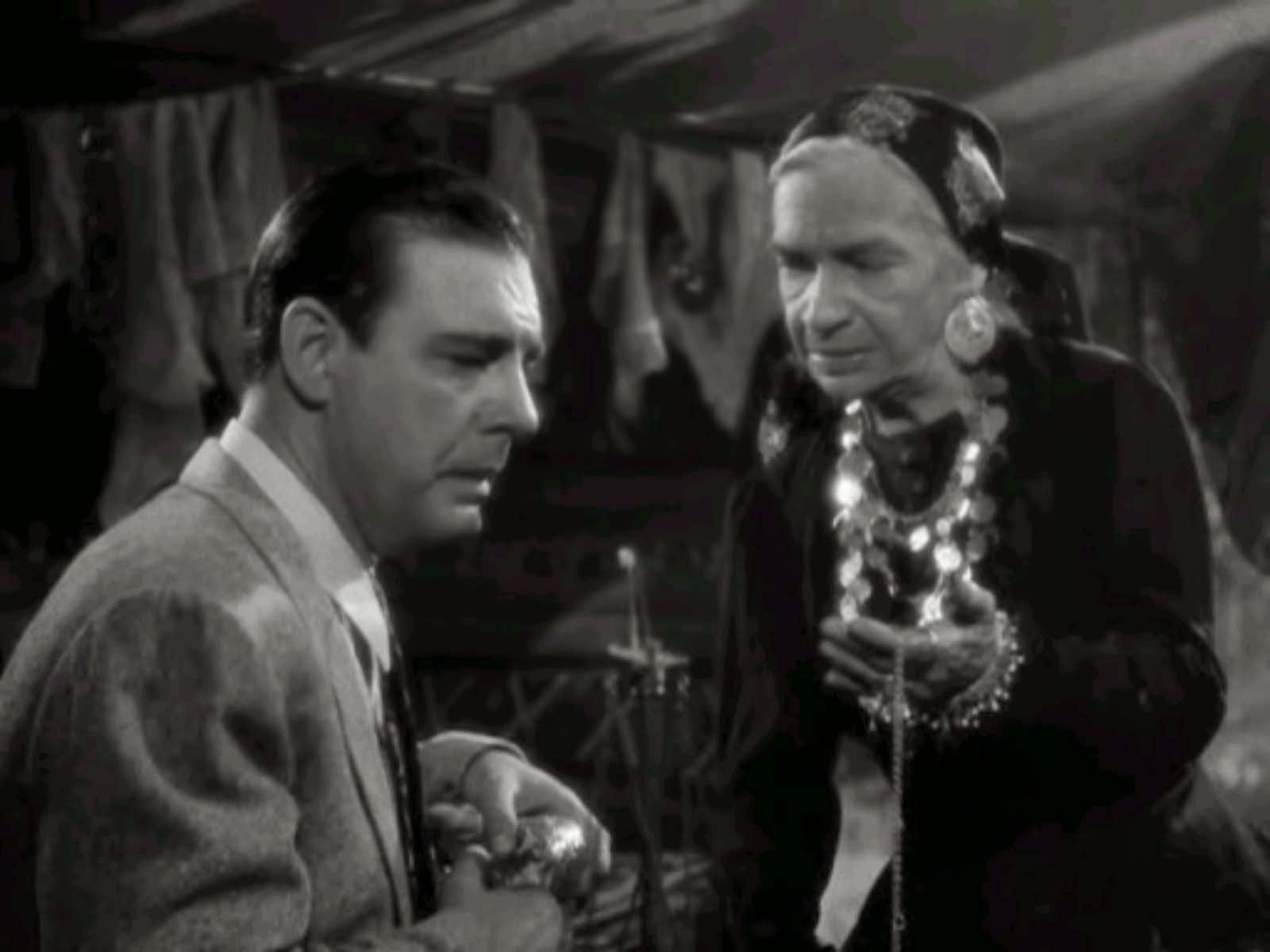
The Wolf Man - 1941
Written by Curt Siodmak
Directed by George Waggner

Among the Big Three Universal Monsters, well, okay, Frankenstein is still my favorite, but the Wolf Man is really more interesting in a lot of ways.  Dracula, I'm afraid it must be said, simply is not as good a movie as the other two.  Frankenstein is a wonderfully tragic story, but the monster himself has a limited range.  The Wolf Man, however, combines the best of both worlds.  He's a savage monster, and a tortured soul.  It's kind of a shame that he was never as highly regarded as the other two, and I chalk that up to the difficulty of creating a credible monster design with the tools they had available, and some burdensome monster rules.  That full moon thing tends to leave a monster with a lot of time on his hands to not kill.

A number of things struck me as I watched the original werewolf movie once again.

The first was the hilarious casting choice of Claude Rains as Lon Chaney Jr's father.  Born 17 years apart, Rains was barely old enough (and looked younger) to have a child Chaney's age, much less for him to be his second son.  The older brother, we're told, has passed away, thus accounting, evidently, for the next factor.  Rains was a slender man of all 5'6" with a sophisticated European accent.  Chaney, meanwhile, was a hearty slab of Oklahoma beef ringing in at 6'2" and looking even taller next to Rains.  A quick bit of exposition explains that resentment over that older brother taking preference in managing the Talbot Estate in England accounted for Larry's flight to America and thus, it is implied, their vastly different accents, but that still doesn't account for the genetic disparity.  It really doesn't take anything away from the film, but added a good laugh and some eye-rolling exercises.

"Well, hello ladies!  Larry is ON THE PROWL!"
Another thing I noticed was the dual meanings of "wolf man."  Obviously there's the werewolf aspect, but there's also the vernacular of the day of a sexually aggressive man being called a "wolf."  Indeed, what sets the series of events into motion is Larry spying a shopgirl in the village through a telescope and truckin' on into town to hit on her without relent.  And not just coy flirting, either.  He sees her in her bedroom and when he meets her, asks about the earrings she has on her dressing table and won't admit how he knows about them until she goes out with him.  She declines repeatedly, but he shows up at closing time nevertheless.  Something like this would have internet feminists spitting fire nowadays but at the time it would have been the kind of meet-cute that people could tell their grandchildren about.  Is it any wonder some people get overwhelmed with the rate of cultural change, why others pull their hair out in frustration with its glacial pace?

The more character-relevant thing I noticed was that, while this first Wolf Man appearance certainly puts Chaney through his paces as the overwrought victim of a curse, it's actually in some of the later crossover films that the curse takes on deeper meaning.  While Frankenstein and later Dracula feel largely wasted in Frankenstein Meets the Wolf Man, House of Frankenstein and House of Dracula, Larry/the Wolf Man is a more dimensional character, not only cursed to become the werewolf, but not to die, thus being much more a prisoner of his curse.  At one point, there's even an element introduced that he can only be killed by someone who loves him, which makes things ALL kind of complicated.  Imagine trying to get a hit on OkCupid with:

"But... I hate all my selfies."
"Husky (and I mean husky), sexually aggressive SWM, 36, seeks love with someone who doesn't mind me trying to kill them during a full moon.  Must be willing to kill me later.  Must love dogs.  No fatties."

Good luck getting anyone to read past "husky," Larry.

There's also a part of me that still pulled for Larry, even though I know how it's going to end, just to spite the sour-faced mother of the girl killed by the werewolf that bit him.  When things start falling apart for the guy, she crows so arrogantly.  I'm not saying I wish suffering on a grieving mother, but poetically speaking, it would have been satisfying if he'd chewed her face off.

I really like The Wolf Man.  The more I think about it, the greater a shame it seems that filmmakers haven't successfully done more with the concept.  If you haven't seen it, you really must.  It's vastly entertaining and really rather short -- only 70 minutes!  You'll piss away more time than that on Candy Crush this week, or whatever it is you people do with those phones of yours.


The Year of the Wolf


The anthologies are behind us, and we're on to Werewolf Week.  The truth is, I've been sitting on a bunch of werewolf movies with the intention of writing a Best Werewolf Movies list, but this is probably the closest I'm going to get to doing that.  The truth is, there just don't seem to be enough truly great ones to make it worth a Best Of list.  That being said, I expect to hit a lot of the high points this week.


Speaking of high points for werewolves, 1981 was it.  In one year, three major werewolf movies were released, then they disappeared back into the b-list.  I decided to watch all three of them in a row.  The things I do for you people...


FILM:

Wolfen - 1981
Written by David Eyre & Michael Wadleigh
from the Book by Whitley Strieber
Directed by Michael Wadleigh

Wolfen essentially presents as a mystery, opening with the grisly murders of a couple of big-deal New York socialites and power-brokers.  Evidently the case is so instantly startling to the NYPD that they feel obligated to call in hard-boiled and harder drinking retired cop, Dewey Wilson (Albert Finney) to investigate the case.  While the rest of the department is investigating the murders on the premise that they were the act of an anarchist terror cell, Dewey along with not-quite-age-inappropriate lady-cop Diane Venora (Rebecca Neff) and jiving medical examiner Whittington (Gregory Hines) are following a trail that leads from canis lupus hair fibers to Native Americans to shape-shifting werewolves.  Yeah... it makes more sense in the context of the investigation, although Dewey does Goldblum his connections once or twice.

This is one of those movies where the director would be justified in saying things like "The city of New York is really a character in the story" and yet we're not talking about a case where there's some romantic encounter on the Circle Line leading to dinner at Tavern on the Green and a stroll through Central Park.  This isn't the "family-friendly" corporatized post-Giuliani New York.  This is the urban decaying New York of the post-70s which conservatives still imagine when they think of the big scary city.  The Bronx, which feature prominently in the story, look like Dresden.after the bombing, creating a unavoidable example of the themes of class division that enter into the plot.  There was also some fascinating New York "inside baseball" about Native Americans as steelworkers that clicked neatly into the story.

The werewolf aspect seems to serve to illustrate some of these same themes of old ways versus new ways, natural people versus money people, rather than that to be the primary excuse for telling a "werewolf story" with the running and the biting.

I was really very pleasantly surprised by Wolfen.  I'd been given the impression that it was the lesser of the three werewolf movies from '81, but instead what I found was a slightly twisted police procedural with a strong sense of momentum, some enjoyable characters, and a unique take on werewolves that bucked convention in a clear way that wasn't overly hung up on its own mythology.  The special effects were certainly the least complicated, never showing us a true transformation and primarily using real wolves.  I didn't feel that this took anything away from Wolfen, and in fact, served not to distract, but I can see how that might be significant to some people.  Special effects were a big deal to me when I was a kid too.  So if the "least of these" was this good, I was eager to move on to the rest.


The Howling - 1981
Written by John Sayles & Terrence Winkless
from the Book by Gary Brandner
Directed by Joe Dante

If Wolfen is a mystery with a werewolf elements woven in, then The Howling, you could say, is a werewolf movie with a mystery woven in.  It uses elements of a mystery, but they're only mysterious to the characters who, by and large, come off as a bunch of self-absorbed nitwits.

The Howling opens with tough-as-nails TV news reporter Karen White (Dee Wallace) on her way to meet a serial killer/her stalker down in the seedy part of town with the porn stores and the ethnic people.  There are a couple problem right there, just for starters.  One, Dee Wallace is not believably "tough-as-nails."  She presents as a cream-puff, and, despite the roles she's played over the years, never convincingly exhibited strength in a role until she was into her 50s.  Secondly, are you freakin' kidding me with this meeting a serial killer who also happens to be your stalker shit?  The BEST excuse available is career ambition, which isn't actually a virtue taken on its own.  If she's not believably tough and she's demonstrably stupid and self-serving, why on Earth should we care what happens to her?  I certainly didn't, and that presents a problem.

Okay, maybe we got off on the wrong foot.  What follows is actually kind of interesting.  After meeting with the killer and getting rescued by a shoot-first-and-well-at-least-I-shot-first! rookie cop (seriously, the guy fires blindly THROUGH A DOOR in the direction of a scream), what follows is, I have to assume, a satire of modern life as the self-examining 70s turn to the self-without-the-examining-part 80s.  As she returns to the TV station, we're introduced further to a collection of crass, self-obsessed characters and their apparent guru, putting-the-self-in-"self-help" psychiatrist Dr. Waggner (Patrick Macnee).  When Karen folds up on camera when she's supposed to tell her tale of confrontation with a killer, the news director decides she needs to get away for some rest and self-actualization at Waggner's woo-woo Colony in the woods.

So Karen and her husband, the Marlboro Man (henceforth known as Bill) head off to camp where they meet a bunch of people as flaky as they are and Marsha (Elizabeth Brooks) the resident "nymphomaniac" sets her sights on Bill (Christopher put-the-Stone-in-Dee-Wallace-Stone).  Things are a little "off," and Karen is increasingly disturbed by strange sounds from the woods.  Soon enough, Bill has been attacked in the woods by some kind of creature, but he's doing fine. ...except for the part where he's suddenly making the filthy werewolf whoopee with Marsha.

Meanwhile, back home, Karen's co-workers are following up on the killer's story which picks up the stink of a wolf marking territory.  When the killer's body disappears from the morgue, things are definitely showing signs that there's more here than meets the eye.  The mysteries aren't so much solved as revealed, and the third act is a werewolf bonanza, featuring a major transformation scene that was a pretty big deal at the time.

For my money, I felt that The Howling had the weakest story of the three, by a considerable measure.  I didn't engage with the characters or care what happened to them.  I enjoyed the satire, but I'm not sure to what extent it was intentional versus me looking back at the early 80s with sharpened hindsight.  Given the involvement of Joe Dante and John Sayles, I'm prepared to believe that it was intentional.  I like the use of practical effects, but I found the werewolves to have kind of a silly (and inconsistent) design (due largely to ridiculously long ears and hair) and the transformation, while impressive for its time, hasn't aged well, and was never as good as American Werewolf's.  It makes no sense to me that the skin should bubble that way, other than that effects artist Rob Bottin felt obligated to distinguish himself from his mentor, Rick Baker, who was working on American Werewolf at the same time.  At one point during the transformation, Wallace actually looked bored and impatient in a cutaway shot, creating the only moment at which I sympathized with her in the movie.  Of the three movies here, The Howling is the most unabashed about its b-movie heritage, to the extent that it isn't really not one.  Why should it come as a surprise to me that this is the one that spawned a litter of sequels?


An American Werewolf in London - 1981
Written & Directed by John Landis

An American Werewolf in London is, in many ways, the most simple of the three, and that's not a bad thing.  There's very little mystery, and yet there is a consistent ramping-up of tensions.  Like See You Next Wednesday, the porno movie featured in its penultimate scene, it's long on foreplay, then obscenely explicit and orgiastic in its climax.  It also most deeply embraces its relationship with Lon Chaney's original Wolf Man, in all the best ways (except perhaps for a lack of gypsies).

David (David Naughton) and Jack (Griffin Dunne) are American college students doing the whole European backpacking thing.  For reasons unexplained, they have chosen the rainy ass-end of England to start their journey.  In a quaint-but-not-in-a-welcoming-way Welsh village, they're met with instant suspicion when they walk into the pub.  If a record had been playing, the needle would have fallen off.  They manage to cajole the surly bar mistress into a cup of hot tea, but when they inquire about the pentagram scratched into the wall, it becomes evident that it's time for them to leave; tea or no tea.  As they leave, they're granted a foreboding warning to stay on the road, off the moors, and to beware the moon.

Leaving rural hospitality behind them, they're once again on their way, and without so much as a word, soon off the road and trotting across the moors by night.  Rain comes.  Then howls in the distance.  Worry turns to panic as they realize they have no sense of direction.  The howls become nearer, and almost always in front of them, almost as though it were circling them... whatever it is.  They run.

Whatever it is attacks.  Jack is down.  David runs on, then turns back.  He finds Jack, horribly mauled to death, and then whatever it is attacks him too.  The villagers arrive with rifles and cut it down, and David loses consciousness...

He awakens in a London hospital three weeks later, nearly healed, but haunted by nightmares of everyone he loves being killed.  The nightmares seem to be seeping into his waking life, as a mangled vision of Jack appears to tell him that he's going to turn into a werewolf at the next full moon and he needs to kill himself to save others and to free the souls of the restless dead killed by the lineage of werewolves that ends with him.

Like in The Wolf Man, American Werewolf treats David's lycanthropy as a curse, a horrible burden.  For several days, David believes that he's losing his mind and the visions of a decaying Jack are merely the face and voice of his guilt.  That's both reasonable, but also an act of denial in its own right.  Leaving the hospital, he's taken up with a charming English nurse and found happiness that he doesn't want to end.  When, after a prize-winning transformation (literally -- Rick Baker won the first ever Oscar for Best Makeup for this) David wakes up naked in the wolf cage at the zoo to news reports of several murders, he comes to believe the unbelievable truth.

The story here is clean, unconvoluted, leaving plenty of room for humor and character-building.  The threat builds slowly after the initial attack.  In that way, it works more like a haunting, gradually drawing the unseen enemy within nearer to the surface, and conveniently working in the ever-more-disturbing visions of Jack, decomposing much more quickly than a corpse actually would but who cares, you've got Rick freakin' Baker showing his stuff here.  Meanwhile the romance builds and so does our investment in these characters.  Hope and despair tug back and forth, destined to collide.

It should go without saying that I enjoyed this one most of all, but there I've gone and said it anyway.  It simply wins every category by which a film can be judged against another, as far as I am concerned.  I was startled to find that there were people who prefer the effects in The Howling, because this was just masterfully done.  While much wolfier, my only complaint is that, like in The Howling, the wolf's hair is far too long.  Do these people never look at actual wolves?  Rather than the silly bubbling effect, the werewolf stretches into his transformed self.  David howls in pain as his bones change shape, his organs shift and his skin distends.  What clearer depiction of a cursed man could there be?

In the end, I'm glad I saw all three, and that I made a triple feature out of the whole affair.  They were three distinctly different takes on a sub-genre that doesn't always strike one as fertile ground for variety.  That being said, An American Werewolf in London is the only one that I expect to watch again, and that certainly should say something about what it has to offer.