What It Feels Like for a Girl (Part 1)


So far, most of these movies have followed the Wolf Man tradition and dealt with male werewolves.  Today I'm going to look at a pair of radically different films that place women in the the fore.  The werewolf mythos has made much of the theme of male aggression in the past, but these both recontextualize the tales in uniquely feminine perspectives.


FILM:


In The Company of Wolves - 1984
Written by Neil Jordan & Angela Carter
Directed by Neil Jordan

I have to apologize right off the bat for the inadequacy of my ability to discuss In The Company of Wolves in as thoughtful a manner as it deserves.  I'm going to need to see it at least once more before I really get a grasp on just what the hell is going on here.  The film plays on more than one level and is dense with symbolism.  I can't imagine that that's all meant to be clear before one can approach it with the perspective of having seen the complete story arc, given the revelations involved.

Director Neil Jordan is still most often referenced with The Crying Game, but looking at the body of his work reveals a strong and recurring attraction to the supernatural and the imagination, which, of course, are facets of the same gem.  He's made films about vampires, ghosts, selkies (something of a were-seal in Irish legend) and here, werewolves.  Themes of transformation are also recurrent in his work, whether the mystical or the gender related.  Probably the most frequent element of all in his films is the consideration of sexuality, particularly its role in identity.  In this, Jordan's second film, all of those aspects of his directorial tastes are on full display.

This is also the second of at least nine times that Jordan has used Stephen Rea, who has done at least three werewolf movies in his career.  I don't really have a point here.  I just find it interesting in a trivial way.

The majority of the movie takes place in a young adolescent girl's dream, building up to a distinctly original reinterpretation of Little Red Riding Hood.  Now I, for a long time, have been considering the psychological, symbolic and sexual connotations of the LRRH story, but whatever I'd considered, it's clear to me now that Angela Carter had been there, written a thesis about it, then moved on to even larger considerations and implications.

Within the dream, Rosaleen's sister has been devoured by wolves; an inherent risk for "straying off the path."  Following this event, her grandmother shares with her various tales of the dangers of wolves (often while knitting for her the red shawl that she will come to wear proudly in a world of muted tones).  Over the arc of the narrative, Rosaleen goes from meek child to budding young woman, and the appeal of straying off the path grows, and the lure of wolves becomes more seductive.  Obvious parallels to sexuality are only the beginning.  There's almost certainly something about independence and identity in there too.

None of this is to suggest that you need to watch the film as part of a women's studies curriculum, mind you.  I'm sure it's perfectly possible to enjoy the movie at face value and chalk up recurrent symbols to the fingerprints of cinematic auteurism.  Visually, In the Company of Wolves is lush and beautiful, filled with stimulating imagery that needn't have meaning to be enticing.  A bird's nest filled with eggs that reveal baby figurines inside can simply be strange and surreal without symbolizing fertility, which is merely a guess on my part.

As for the werewolves, Jordan approaches them from both ends of the spectrum.  On the one hand, we have a lot of just plain wolves running around in places, although the wolves are being played by Belgian Shepherds here.  On the other hand, we have some pretty disturbing and explicit werewolf transformations, particularly the one involving Stephen's Rea's character.  The effects aren't quite as high-end as American Werewolf's or even The Howling's, although I found it to be better thought out and even more unnerving than the latter.

It's never really a distinctly scary movie, but Jordan creates such a compellingly surreal atmosphere that conveys an appropriate sensation of dreaming.  There are different kind of dreams, and some of them convey a growing sense of undefined danger and dread as they go through their paces, visiting both seductive and unnerving imagery as they lure us in.  That's the kind of dream that Jordan and Carter craft for us here.  While the overarching narrative isn't necessarily the most compelling story when taken at face value, In the Company of Wolves is a completely unique werewolf movie with more than its share of moments and ideas all wrapped in gorgeousness, which more than earns the repeated viewings it's going to take to really digest it.


Ginger Snaps - 2000
Written by Karen Walton & John Fawcett
Directed by John Fawcett

The makers of Ginger Snaps have some female oriented observations about the werewolf mythos as well, although they approach them much differently.  Key to its development is the observation that both adolescent girl and werewolves are subject to a bloody "monthly curse."

Ginger and Brigette Fitzgerald are morbid pair of Canadian sisters.  At 16 and 15 (respectively) neither one of them have yet gotten their monthly friend, a fact which is of considerable concern to their busybody mother who listens more to parenting manuals than she does to her daughters.  Between their over-engaged mother and their disengaged father, they have made a pact with each other than they will either get the hell out of Nowheresville, Ontario ASAP, or come to a drastic end trying.  In a school filled with hollow mundanity, their escape and identity is rooted in their outsider status.  Ginger is the smart-mouthed and aggressive one who balks at attention from boys.  Brigette is the silently plotting brains of the team who not-so-secretly covet Ginger's strength.  Their roles and relationships to their family, school, classmates and each other are summed up neatly with a class photo project in which they depict themselves in a variety of possible suicide scenarios.

At the precise moment when Ginger first gets her period, one night in the park, she is attacked by some sort of feral beast that drags her into the woods.  Brigette helps her to flee, and the beast is hit by a van driven by the local dope dealer.  Previously inseparable, the changes that these events trigger in Ginger will become a growing wedge between them, in a way not dissimilar to the changes that all adolescents experience.  Except this one goes to eleven.

Suddenly Ginger becomes dramatically hormonal, sprouting hair where she never had it before (never mind that it's coarse and grey, growing from the bite marks on her shoulder) and the attention of boys is more than welcome.  Brigette, meanwhile, is desperate to both save her sister from the condition about which she has growing suspicions, and to keep Ginger from leaving her behind.

Getting right to the point; Ginger Snaps is my favorite werewolf movie, period (no pun intended).  Ginger and Brigette are strongly developed characters that would be enjoyable to watch no matter what the story vehicle.  I would watch them in any variation on the high school movie, whether or not there was a monster involved.  This is due not merely to the writing, but to the powerful performances from the film's two lead actresses; Katharine Isabelle (Ginger) and Emily Perkins (Brigette).

The first time I saw Ginger Snaps, I declared (to an empty room, but still out loud), "Oh THAT girl's gonna be a star" in reference to Isabelle.  Nevermind that she's beautiful.  She exudes the same kind of magnetic "cool to hang out with" appeal that has worked so successfully for Jennifer Lawrence.  Months after watching the Ginger Snaps films (more on that later), I was watching a movie called American Mary, and without realizing that I was watching the same actress, I declared to the empty room, "Oh SHE needs to get famous," only to realize once I jumped online that it was Katharine Isabelle again.  Purely in the interest of science, let me be clear, I had not made this declaration at any point in between, and I don't run around making it about every pretty face I see.  Isabelle plays Ginger with enthusiasm, making her antisocial behavior all the more appealing.  The humor and personality with which she fills Ginger overflows in such way that you realize it's bigger than the role.  She's certainly a working actress, but Hollywood hasn't yet given her the vehicle that would really put her into orbit.

Absolutely none of this raving is intended to take anything away from Emily Perkins.  It's certainly Ginger that steals the show, but it's Brigette that carries it.  While Isabelle is tasked with the slow-motion explosion of an adolescent girl coming unhinged as she turns into a werewolf, Perkins is the one that has to hold it all together while Brigette feels her world falling apart.  She really becomes the lone protagonist and draws us close to see how she has to become her own person in the face of this cataclysm.  The role calls for range, and Perkins delivers it.

Perhaps the biggest surprise is Mimi Rogers as the girls' mother.  Several of the most laugh-out-loud hilarious moments come from her highly satirized portrayal of suburban parenting.  When the girls end up with too much blood on their hands (literally), Mom steps up with a plan to rescue them.  She's just a mom that cares, you guys!

The third act is a high tension race against tragedy, and it's here that Perkins is most clearly called upon to carry the film.  Once Ginger fully transforms, it's Brigette that we connect with and root for.  This does, however, bring up one of the less satisfying aspect of the film.  The final werewolf isn't all that we might have hoped for.  I'm not faulting the director for choosing to go the practical effects route, but the final wolf form looks kind of diseased and mutanty with wispy hair and wet, soggy flesh like a drowned and bloated molerat.  I'd be more concerned about it touching me than biting me.  Fortunately, the film isn't reliant on giving the werewolf a lot of screen time.

My only other complaint is a selfish one.  The funny parts are so funny and the sisters so personally appealing that I wanted more.  The blessing there is that Ginger Snaps attained enough cultish success to inspire a duet of sequels.  For more about those, come back tomorrow!


New Moon Rising


FILM:

Wer - 2013
Written by William Brent Bell & Matthew Peterman
Directed by William Brent Bell


Wer is a completely fresh and au courant take on the werewolf legend, updating the concept in the most significant way that I have seen in a generation.  I don't expect it to redefine the sub-genre, but it certainly breathes fresh life into the idea.

What starts out as a mystery and legal thriller eventually turns into an all-out action/horror piece in the second half.  It's not exactly a found footage film, but it does rely heavily on footage from video cameras, police cameras, security cameras and such, combined with psuedo-documentary shooting (like, say, The Office, though never acknowledging the camera) for the meat of the storytelling.  The news reports and found footage cut into the film provide a sense of verisimilitude that sells the idea that this is a more realistic approach to the concept in our modern context.

The film opens with vacation video of an American family in France, out enjoying a campfire in a field by moonlight -- full moonlight.  Something stirs in the trees.  Bad things happen.  Very bad things.  Cut to news reports about the attack. and the capture of the suspect, then hospital footage of the surviving family member talking to the police.  Whoever it was, whatever it was, was hairy and had these teeth...

Taking the case on behalf of the defendant is a French-American lawyer with the civil rights commission, Kate Moore.  Kate very aggressively challenges the French police who are all too willing to treat their suspect as though he's already been convicted.  He is, after all, a giant of a man, extraordinarily hairy, socially isolated, lives conveniently close to the crime and... Eastern European.

Kate and her team (one of whom happens to be a former lover) press the authorities to come up with some physical evidence linking their client, Talan Gwynek to the crime as evidence carries much more weight than testimony in the French legal system, and so far the police have none.  DNA analyses repeatedly come back as tainted.  The deeper they look into Talan's story, the more convinced they become that he suffers from a genetic condition called porphyria; an actual disorder that can cause bone deformities, skin problems (including excess hair growth) and receding gums (which would make the teeth look abnormally large).  In other words, all the things that have made Talan an outcast, but also something that would make him too weak to commit the kind of carnage of which he is accused.

I'm going to pause here for a moment to discuss a situation in horror movies that try to inhabit our skeptical world while still being monster movies in the end.  Characters spend the first act or two doubting and denying that vampires or zombies or ghosts or werewolves could possibly exist, and on the face of it, we find this acceptable because that's what we imagine we'd do in that situation.  The snag in this situation is that we as viewers already know that there's going to be a vampire of zombie or ghost or werewolf, or we wouldn't have bothered to watch the movie in the first place.  As such, the amount of time spent in denial can become increasingly frustrating to us as viewers.

I bring this up because, while I could play along and keep up the sense of mystery, we all know that there's going to be a werewolf in this werewolf movie.  So, although Wer does an excellent job of treating Talan's various conditions as scientifically explainable and logically believable to the characters, someone's throat has got to get torn out sooner or later.

Someone's throat indeed; and once it does, the chase is on.  Wer makes extraordinarily clever use of its lower-budget CGI effects.  We don't get a transformation as complex as American Werewolf's or Professor Lupin's, but the subtler werewolf is befitting the film's more believable world's tone.  There's one specific moment where the narrative turns for both the characters as well as the viewers, and the simple effect used there creates a jarring sense that we (and by "we" I particularly mean "they," the characters) are dealing with an entirely new situation that outstrips expectations.

Meanwhile, throughout the story, two subplots have been building that will develop into Wer's final confrontation and its final twist.  The twist at the end isn't a jump-out-and-grab-you one, but it does change some of the film's meaning.  It's a rare treat that a horror film's final twist is actually supported by the narrative and not merely tacked on for "gotcha" value, so the film scores a full point for that alone (were this a scoring game).

I almost didn't watch Wer, because the whole defense attorney angle didn't really sound that appealing to me, but I found it to be a tremendously refreshing take on the mythos, and I'm encouraged to know that the old dog can still hunt.


El Retorno del Año del Lobo


Well I'll be a son of a wolf bitch -- I missed a big werewolf movie from 1981.  Granted, it's not a big budget American feature, but Paul Naschy, El Hombre Lobo himself, is nothing to sneeze at.


FILM:


Night of the Werewolf - 1981
Written & Directed by Paul Naschy

Back in May when I did my feature on the Monster Mash-ups, I devoted an entire entry to El Hombre Lobo, Spanish actor and sometime writer & director Paul Naschy who played a werewolf in more than a dozen films.  His work was a new discovery for me at the time and I was only able to watch one of his films before finishing the feature.  Since that time, from the reading I'd done, I've suspected that he, to one extent or another, had made the same movie (albeit remixed) several times throughout his career.  That would appear to have been a somewhat accurate impression.

Naschy almost always played the character of Waldemar Daninsky in the Hombre Lobo films, although there was little-to-no continuity between them, and as far as I know, none were direct sequels to any others.  He frequently comes into conflict with the vampire witch Elizabeth Bathory (who is served by a skeletal knight) and in the ones that I've seen, he has a doomed female servant and falls in love with one of the college girls that show up to serve as a conduit for the story taking place.  Those elements all come into play here, although in a somewhat remixed form from what I saw in Noche de Walpurgis AKA The Werewolf Vs The Vampire Woman.  Granted, this is an acknowledged remake, but many of those elements do seem to recur in Naschy's Lobo films.

The film opens in the Middle Ages, during the sentencing phase of a trial for witchcraft.  This was, of course, the most popular phase of Medieval trials, and constituted the greatest effort on everyone's part.  The condemned is Countess Elizabeth Bathory and her cohorts who have been found guilty of murder and witchcraft.  Bathory, owing to her status, will not be executed, but confined to her quarters to live out the rest of her days, at which time she will be burned.  Her handmaidens will be imprisoned with her, because she certainly can't be expected to take care of herself, and various other accomplices witll be executed in a variety of ways.  It's good to see that the double-dealing judicial system enjoys such a grand heritage.  After one brusque beheading, it's the silent and brooding Waldemar Daninsky who faces his fate.  Convicted of devil-worship and murder by dint of being a werewolf, he neither cries foul nor curses his executors.  An iron mask is clamped over his face and a silver cruciform dagger driven through his heart.  The the frame freezes and we simply stare at him while some rockin' boogie music plays, eventually turning into the opening credits.  Seriously, we look at the mask with blood pouring out of the mouth for an awfully long time.

Centuries later, in the "now" of three decades ago, three foxy Spanish grad students (one who has devoted herself to Satan, 'cause, you know, those Liberal college professors) believe that they have found the location of Bathory's tomb and set out to find it, although one has a more detailed plan than the others are aware of.  Meanwhile, a pair of bumbling grave robbers find the crypt of Daninsky and immediately bull the silver dagger from his heart, waking him instantly, causing their own eternal slumber.  In no time, Daninsky is back to pouting about his fully furnished castle in velvet tunics that totally didn't get eaten by moths in the past 800 years.  His lovely but auto-de-fe-scarred friend and servant Mircaya is by his side to deliver exposition unbecoming his station.

Daninsky rescues the women from some swarthy robbers/rapists and grants them shelter in his castle.  One will fall in love with Waldemar.  One will raise Elizabeth Bathory and become a vampire herself, and one, well, it takes blood to raise the countess, so...

Meanwhile, Waldemar can't help but roam around the countryside mauling anyone he finds by the light of the full moon.  He doesn't even eat them, just kills on sight.  While he frequently advises his beloved to lock herself in on the nights of the full moon, it seems a little irresponsible that he isn't locking himself in.  He at least made a token effort toward this in the previous version.

It turns out that Daninsky was enslaved to Bathory through witchcraft, all those centuries ago, and she manipulated him to kill on her behalf -- although it seems that he was still a werewolf, so he was going to be killing anyway.  At any rate, he's free of her now and determined to prevent her from coming into her full power again, which evidently would unleash Hell on Earth.  However, to finally be freed of his curse, he will need someone who loves him to kill him with the silver dagger, thus assuring that he will not rise again.  Much of the werewolf lore is fairly faithful to the extended lore built up for Lon Chaney's Wolf Man, and indeed Naschy's Hombre Lobo makeup strongly resembles the hairy human face approach taken by the 1941 original.  Naschy, however, plays him much snarlier with considerable commitment, and drools water like a six-month-old.

Kill-kill-kill, fight-fight-fight, burn-burn-burn; die... The End.

For as much action as there is, there's still a lot of time in the first couple acts where not enough is happening.  The story could be greatly streamlined, which would actually make it more effective.  I am, however, forced to recognize that my expectations as a 21st century moviegoer are considerably less patient and more demanding of gratification than Naschy's audience.  It's really pretty satisfying in terms of creepy cool monster moments in a pre-Howling/American Werewolf sort of way.  The coolest monster is neither the wolf nor the vampires, but Bathory's skeletal knight bodyguard who gets more screen time here than he did in Noche de Walpurgis, but still gets hustled in and out far too quickly for my tastes.  The final fight between Bathory and Daninsky mostly involves a lot of pushing and shoving, about which I really don't have a point other than that I'm already imagining how I would retell this story in a film with all the modern conveniences.

Night of the Werewolf is really a pretty good b-flick.  I feel a little bit bad even calling it a b-movie when it comes from a different cultural context, although that's how it would have been released stateside.  While I don't recommend it for everyone, it's really not a bad time at all for someone interested in going a little deeper into cinematic werewolf lore or the scope of horror history.


Leader of the Pack


FILM:


The Wolf Man - 1941
Written by Curt Siodmak
Directed by George Waggner

Among the Big Three Universal Monsters, well, okay, Frankenstein is still my favorite, but the Wolf Man is really more interesting in a lot of ways.  Dracula, I'm afraid it must be said, simply is not as good a movie as the other two.  Frankenstein is a wonderfully tragic story, but the monster himself has a limited range.  The Wolf Man, however, combines the best of both worlds.  He's a savage monster, and a tortured soul.  It's kind of a shame that he was never as highly regarded as the other two, and I chalk that up to the difficulty of creating a credible monster design with the tools they had available, and some burdensome monster rules.  That full moon thing tends to leave a monster with a lot of time on his hands to not kill.

A number of things struck me as I watched the original werewolf movie once again.

The first was the hilarious casting choice of Claude Rains as Lon Chaney Jr's father.  Born 17 years apart, Rains was barely old enough (and looked younger) to have a child Chaney's age, much less for him to be his second son.  The older brother, we're told, has passed away, thus accounting, evidently, for the next factor.  Rains was a slender man of all 5'6" with a sophisticated European accent.  Chaney, meanwhile, was a hearty slab of Oklahoma beef ringing in at 6'2" and looking even taller next to Rains.  A quick bit of exposition explains that resentment over that older brother taking preference in managing the Talbot Estate in England accounted for Larry's flight to America and thus, it is implied, their vastly different accents, but that still doesn't account for the genetic disparity.  It really doesn't take anything away from the film, but added a good laugh and some eye-rolling exercises.

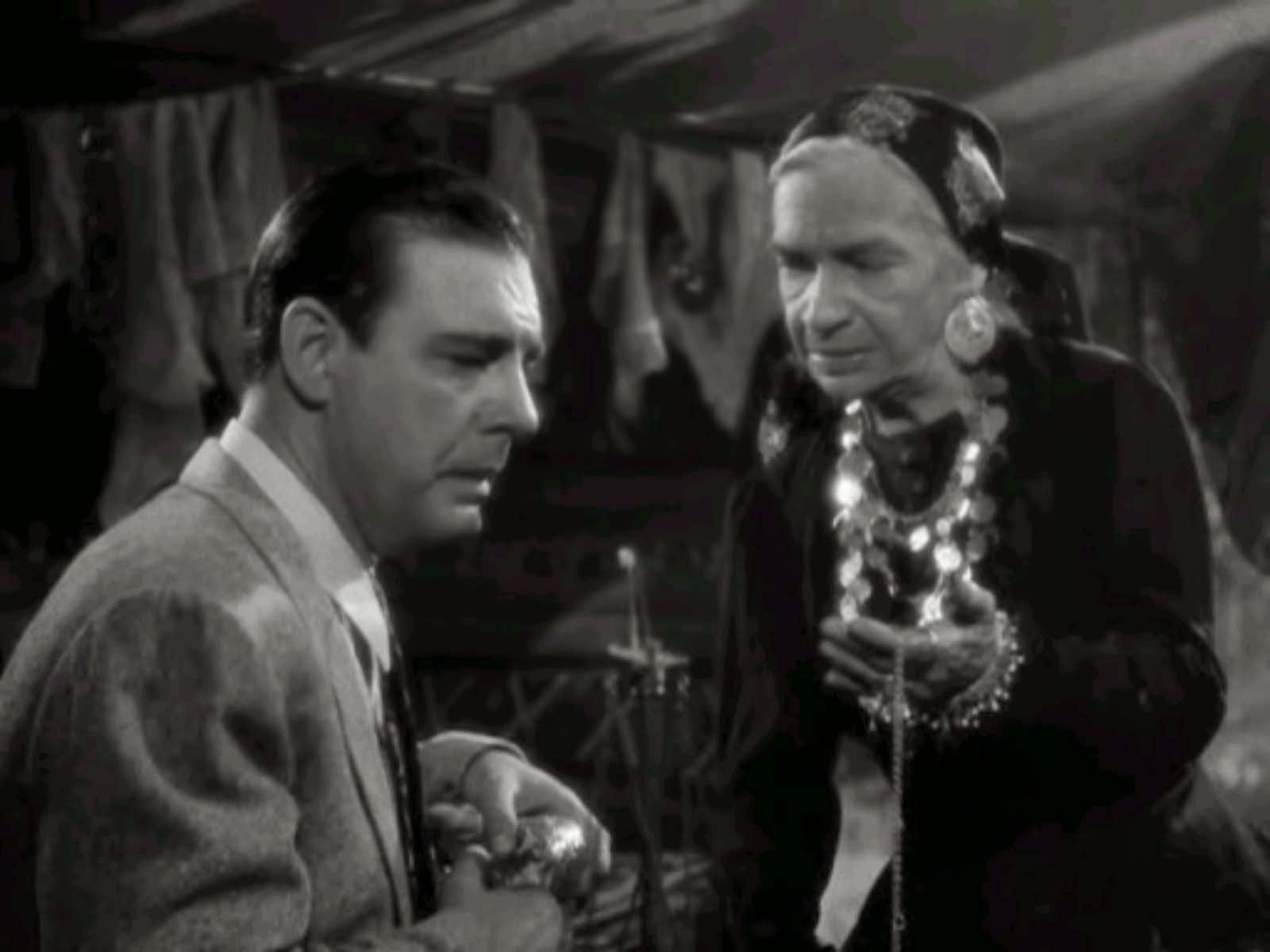
"Well, hello ladies!  Larry is ON THE PROWL!"
Another thing I noticed was the dual meanings of "wolf man."  Obviously there's the werewolf aspect, but there's also the vernacular of the day of a sexually aggressive man being called a "wolf."  Indeed, what sets the series of events into motion is Larry spying a shopgirl in the village through a telescope and truckin' on into town to hit on her without relent.  And not just coy flirting, either.  He sees her in her bedroom and when he meets her, asks about the earrings she has on her dressing table and won't admit how he knows about them until she goes out with him.  She declines repeatedly, but he shows up at closing time nevertheless.  Something like this would have internet feminists spitting fire nowadays but at the time it would have been the kind of meet-cute that people could tell their grandchildren about.  Is it any wonder some people get overwhelmed with the rate of cultural change, why others pull their hair out in frustration with its glacial pace?

The more character-relevant thing I noticed was that, while this first Wolf Man appearance certainly puts Chaney through his paces as the overwrought victim of a curse, it's actually in some of the later crossover films that the curse takes on deeper meaning.  While Frankenstein and later Dracula feel largely wasted in Frankenstein Meets the Wolf Man, House of Frankenstein and House of Dracula, Larry/the Wolf Man is a more dimensional character, not only cursed to become the werewolf, but not to die, thus being much more a prisoner of his curse.  At one point, there's even an element introduced that he can only be killed by someone who loves him, which makes things ALL kind of complicated.  Imagine trying to get a hit on OkCupid with:

"But... I hate all my selfies."
"Husky (and I mean husky), sexually aggressive SWM, 36, seeks love with someone who doesn't mind me trying to kill them during a full moon.  Must be willing to kill me later.  Must love dogs.  No fatties."

Good luck getting anyone to read past "husky," Larry.

There's also a part of me that still pulled for Larry, even though I know how it's going to end, just to spite the sour-faced mother of the girl killed by the werewolf that bit him.  When things start falling apart for the guy, she crows so arrogantly.  I'm not saying I wish suffering on a grieving mother, but poetically speaking, it would have been satisfying if he'd chewed her face off.

I really like The Wolf Man.  The more I think about it, the greater a shame it seems that filmmakers haven't successfully done more with the concept.  If you haven't seen it, you really must.  It's vastly entertaining and really rather short -- only 70 minutes!  You'll piss away more time than that on Candy Crush this week, or whatever it is you people do with those phones of yours.


The Year of the Wolf


The anthologies are behind us, and we're on to Werewolf Week.  The truth is, I've been sitting on a bunch of werewolf movies with the intention of writing a Best Werewolf Movies list, but this is probably the closest I'm going to get to doing that.  The truth is, there just don't seem to be enough truly great ones to make it worth a Best Of list.  That being said, I expect to hit a lot of the high points this week.


Speaking of high points for werewolves, 1981 was it.  In one year, three major werewolf movies were released, then they disappeared back into the b-list.  I decided to watch all three of them in a row.  The things I do for you people...


FILM:

Wolfen - 1981
Written by David Eyre & Michael Wadleigh
from the Book by Whitley Strieber
Directed by Michael Wadleigh

Wolfen essentially presents as a mystery, opening with the grisly murders of a couple of big-deal New York socialites and power-brokers.  Evidently the case is so instantly startling to the NYPD that they feel obligated to call in hard-boiled and harder drinking retired cop, Dewey Wilson (Albert Finney) to investigate the case.  While the rest of the department is investigating the murders on the premise that they were the act of an anarchist terror cell, Dewey along with not-quite-age-inappropriate lady-cop Diane Venora (Rebecca Neff) and jiving medical examiner Whittington (Gregory Hines) are following a trail that leads from canis lupus hair fibers to Native Americans to shape-shifting werewolves.  Yeah... it makes more sense in the context of the investigation, although Dewey does Goldblum his connections once or twice.

This is one of those movies where the director would be justified in saying things like "The city of New York is really a character in the story" and yet we're not talking about a case where there's some romantic encounter on the Circle Line leading to dinner at Tavern on the Green and a stroll through Central Park.  This isn't the "family-friendly" corporatized post-Giuliani New York.  This is the urban decaying New York of the post-70s which conservatives still imagine when they think of the big scary city.  The Bronx, which feature prominently in the story, look like Dresden.after the bombing, creating a unavoidable example of the themes of class division that enter into the plot.  There was also some fascinating New York "inside baseball" about Native Americans as steelworkers that clicked neatly into the story.

The werewolf aspect seems to serve to illustrate some of these same themes of old ways versus new ways, natural people versus money people, rather than that to be the primary excuse for telling a "werewolf story" with the running and the biting.

I was really very pleasantly surprised by Wolfen.  I'd been given the impression that it was the lesser of the three werewolf movies from '81, but instead what I found was a slightly twisted police procedural with a strong sense of momentum, some enjoyable characters, and a unique take on werewolves that bucked convention in a clear way that wasn't overly hung up on its own mythology.  The special effects were certainly the least complicated, never showing us a true transformation and primarily using real wolves.  I didn't feel that this took anything away from Wolfen, and in fact, served not to distract, but I can see how that might be significant to some people.  Special effects were a big deal to me when I was a kid too.  So if the "least of these" was this good, I was eager to move on to the rest.


The Howling - 1981
Written by John Sayles & Terrence Winkless
from the Book by Gary Brandner
Directed by Joe Dante

If Wolfen is a mystery with a werewolf elements woven in, then The Howling, you could say, is a werewolf movie with a mystery woven in.  It uses elements of a mystery, but they're only mysterious to the characters who, by and large, come off as a bunch of self-absorbed nitwits.

The Howling opens with tough-as-nails TV news reporter Karen White (Dee Wallace) on her way to meet a serial killer/her stalker down in the seedy part of town with the porn stores and the ethnic people.  There are a couple problem right there, just for starters.  One, Dee Wallace is not believably "tough-as-nails."  She presents as a cream-puff, and, despite the roles she's played over the years, never convincingly exhibited strength in a role until she was into her 50s.  Secondly, are you freakin' kidding me with this meeting a serial killer who also happens to be your stalker shit?  The BEST excuse available is career ambition, which isn't actually a virtue taken on its own.  If she's not believably tough and she's demonstrably stupid and self-serving, why on Earth should we care what happens to her?  I certainly didn't, and that presents a problem.

Okay, maybe we got off on the wrong foot.  What follows is actually kind of interesting.  After meeting with the killer and getting rescued by a shoot-first-and-well-at-least-I-shot-first! rookie cop (seriously, the guy fires blindly THROUGH A DOOR in the direction of a scream), what follows is, I have to assume, a satire of modern life as the self-examining 70s turn to the self-without-the-examining-part 80s.  As she returns to the TV station, we're introduced further to a collection of crass, self-obsessed characters and their apparent guru, putting-the-self-in-"self-help" psychiatrist Dr. Waggner (Patrick Macnee).  When Karen folds up on camera when she's supposed to tell her tale of confrontation with a killer, the news director decides she needs to get away for some rest and self-actualization at Waggner's woo-woo Colony in the woods.

So Karen and her husband, the Marlboro Man (henceforth known as Bill) head off to camp where they meet a bunch of people as flaky as they are and Marsha (Elizabeth Brooks) the resident "nymphomaniac" sets her sights on Bill (Christopher put-the-Stone-in-Dee-Wallace-Stone).  Things are a little "off," and Karen is increasingly disturbed by strange sounds from the woods.  Soon enough, Bill has been attacked in the woods by some kind of creature, but he's doing fine. ...except for the part where he's suddenly making the filthy werewolf whoopee with Marsha.

Meanwhile, back home, Karen's co-workers are following up on the killer's story which picks up the stink of a wolf marking territory.  When the killer's body disappears from the morgue, things are definitely showing signs that there's more here than meets the eye.  The mysteries aren't so much solved as revealed, and the third act is a werewolf bonanza, featuring a major transformation scene that was a pretty big deal at the time.

For my money, I felt that The Howling had the weakest story of the three, by a considerable measure.  I didn't engage with the characters or care what happened to them.  I enjoyed the satire, but I'm not sure to what extent it was intentional versus me looking back at the early 80s with sharpened hindsight.  Given the involvement of Joe Dante and John Sayles, I'm prepared to believe that it was intentional.  I like the use of practical effects, but I found the werewolves to have kind of a silly (and inconsistent) design (due largely to ridiculously long ears and hair) and the transformation, while impressive for its time, hasn't aged well, and was never as good as American Werewolf's.  It makes no sense to me that the skin should bubble that way, other than that effects artist Rob Bottin felt obligated to distinguish himself from his mentor, Rick Baker, who was working on American Werewolf at the same time.  At one point during the transformation, Wallace actually looked bored and impatient in a cutaway shot, creating the only moment at which I sympathized with her in the movie.  Of the three movies here, The Howling is the most unabashed about its b-movie heritage, to the extent that it isn't really not one.  Why should it come as a surprise to me that this is the one that spawned a litter of sequels?


An American Werewolf in London - 1981
Written & Directed by John Landis

An American Werewolf in London is, in many ways, the most simple of the three, and that's not a bad thing.  There's very little mystery, and yet there is a consistent ramping-up of tensions.  Like See You Next Wednesday, the porno movie featured in its penultimate scene, it's long on foreplay, then obscenely explicit and orgiastic in its climax.  It also most deeply embraces its relationship with Lon Chaney's original Wolf Man, in all the best ways (except perhaps for a lack of gypsies).

David (David Naughton) and Jack (Griffin Dunne) are American college students doing the whole European backpacking thing.  For reasons unexplained, they have chosen the rainy ass-end of England to start their journey.  In a quaint-but-not-in-a-welcoming-way Welsh village, they're met with instant suspicion when they walk into the pub.  If a record had been playing, the needle would have fallen off.  They manage to cajole the surly bar mistress into a cup of hot tea, but when they inquire about the pentagram scratched into the wall, it becomes evident that it's time for them to leave; tea or no tea.  As they leave, they're granted a foreboding warning to stay on the road, off the moors, and to beware the moon.

Leaving rural hospitality behind them, they're once again on their way, and without so much as a word, soon off the road and trotting across the moors by night.  Rain comes.  Then howls in the distance.  Worry turns to panic as they realize they have no sense of direction.  The howls become nearer, and almost always in front of them, almost as though it were circling them... whatever it is.  They run.

Whatever it is attacks.  Jack is down.  David runs on, then turns back.  He finds Jack, horribly mauled to death, and then whatever it is attacks him too.  The villagers arrive with rifles and cut it down, and David loses consciousness...

He awakens in a London hospital three weeks later, nearly healed, but haunted by nightmares of everyone he loves being killed.  The nightmares seem to be seeping into his waking life, as a mangled vision of Jack appears to tell him that he's going to turn into a werewolf at the next full moon and he needs to kill himself to save others and to free the souls of the restless dead killed by the lineage of werewolves that ends with him.

Like in The Wolf Man, American Werewolf treats David's lycanthropy as a curse, a horrible burden.  For several days, David believes that he's losing his mind and the visions of a decaying Jack are merely the face and voice of his guilt.  That's both reasonable, but also an act of denial in its own right.  Leaving the hospital, he's taken up with a charming English nurse and found happiness that he doesn't want to end.  When, after a prize-winning transformation (literally -- Rick Baker won the first ever Oscar for Best Makeup for this) David wakes up naked in the wolf cage at the zoo to news reports of several murders, he comes to believe the unbelievable truth.

The story here is clean, unconvoluted, leaving plenty of room for humor and character-building.  The threat builds slowly after the initial attack.  In that way, it works more like a haunting, gradually drawing the unseen enemy within nearer to the surface, and conveniently working in the ever-more-disturbing visions of Jack, decomposing much more quickly than a corpse actually would but who cares, you've got Rick freakin' Baker showing his stuff here.  Meanwhile the romance builds and so does our investment in these characters.  Hope and despair tug back and forth, destined to collide.

It should go without saying that I enjoyed this one most of all, but there I've gone and said it anyway.  It simply wins every category by which a film can be judged against another, as far as I am concerned.  I was startled to find that there were people who prefer the effects in The Howling, because this was just masterfully done.  While much wolfier, my only complaint is that, like in The Howling, the wolf's hair is far too long.  Do these people never look at actual wolves?  Rather than the silly bubbling effect, the werewolf stretches into his transformed self.  David howls in pain as his bones change shape, his organs shift and his skin distends.  What clearer depiction of a cursed man could there be?

In the end, I'm glad I saw all three, and that I made a triple feature out of the whole affair.  They were three distinctly different takes on a sub-genre that doesn't always strike one as fertile ground for variety.  That being said, An American Werewolf in London is the only one that I expect to watch again, and that certainly should say something about what it has to offer.