Follow Me...

FILM:

Welcome to another one of my obtusely themed articles!  This time, I have two movies with similar titles that include the word "follow" but as it turns out, they share more in common than that.  Both films explore themes of family, loss and grief,using fantastical story devices (haunting & time travel) as conduits for that exploration.  There are other similarities, but I'm disinclined to expose all of them at this juncture.  Follow along, won't you?


I Will Follow You Into The Dark - 2012
Written & Directed by Mark Edwin Robinson

Sophia (Mischa Barton) is a young woman who has lost both of her parents within six months of each other.  Oh his death bed, her father, heretofore a religious man, declaimed all his faith in God and the afterlife.  Sophia picks up that sense of hurt and spite and adds it to her own jaded skepticism, causing a minor scene at his funeral, and carrying a sense of hopelessness with her into her life in the months following that loss.  She (or perhaps just the movie) assumes that, if everything dies, and everyone we love will one day leave us, then what's the use of making connections?  Now, you and I both know that, if everything dies and everyone we love will one day be lost, we should want to make the most of the time we have, but this is a movie that has other things it wants to say about that.

Six months into her self-imposed emotional exile, she meet-cutes a guy who challenges her desire to remain cut-off from others.  At this point, the movie becomes a fairly tolerable romance.  Sophia resists the urge and won't return calls, but when strange things start happening to her and she finds herself needing the comfort of another, it's Adam (Ryan Eggold) to whom she turns.  While their relationship comes up to a simmer, we're also getting the groundwork for a ghost story.  Adam's apartment building was once a hospital, and the top floors were where patients were essentially left to die.  In retrospect, the back-story doesn't really track, but I'm not sure it needs to.  I Will Follow You Into The Dark isn't quite so much a ghost story as a film that uses a ghost story (and genre tropes) to accomplish something else.  We've seen plenty of movies before about haunted hospitals (and former hospitals) in the past that, when it comes up here, we just kind of go "Oh, okay, I've been here before and I know what goes with this situation."

When Sophia finally lets herself fall for Adam, she can see their future unfolding in front of her.  They take the first few steps into their life together, when, suddenly, Adam is gone.  She awakens in his bed to find blood where he should be.  She and Adam's roommate follow a trail of blood up to the off-limits haunted top floors of the building; blood that the police cannot find.  So they, along with Sophia's roommate and the woman he's dating take it upon themselves to find Adam, dead or alive, wherever he might be.  At this point, the movie plays the part of a fairly standard haunted hospital tale.  There's a good reason why there are so many haunted hospital movies.  They're damned spooky, and we get some decent chills here.  Unfortunately, it tries to do more with its ghost story than it's prepared to resolve sufficiently.  I'm not sure that the filmmakers really intended to resolve the ghost story, however, because in the end, the only thing that gets tied up is the romance, and Sophia's hopeless skepticism.

I think a lot of people will be prone to mistaking I Will Follow You Into The Dark for a straight horror story, when that doesn't seem to really match its actions.  The horror is too inadequately developed to be taken seriously as a contender in that arena.  Ultimately, it serves the story about love and faith.  The problem with the story about faith is that it hinges on some kind of false assumptions about people who don't specifically believe in a particular brand of afterlife.  Maybe that's just my own personal gripe and I'm not allowing the filmmakers to create their own world with their own rules.  In that context, the romance actually kind of works, and there's a connection that ties their first kiss to their final outcome.  If I go along with that, shutting out the part of me that watches horror movies and the part of me that ponders the more delicate points of cosmology and belief, then what's left is a romance that actually kind of appeals to me in my sweet and soppy places.

The much-maligned Mischa Barton is pretty good here, and Ryan Eggold is believably charming as the feet-sweeper-offer.


I'll Follow You Down - 2013
Written & Directed by Richie Mehta

Like the last movie, I'll Follow You Down deals heavily in themes of family, love and loss.  Instead of using underdeveloped supernatural tropes, however, it uses better developed science-fiction; specifically time travel.  I wrote recently about Frequencies, and how it seemed to be a part of an anomalous blip (along with About Time and Her...) of films in 2013 that used sci-fi conceits to deal with similar themes, and this would be another fair addition to that pack.  It's very similar to About Time as a set of keywords, but the execution goes of entirely in its own direction.

When Erol was a child, his father Gabe (Rufus Sewell) disappeared while attending a science conference at Princeton University, leaving not a trace.  His mother (Gillian Anderson) never quite recovered from the loss and uncertainty.  As he grew older, Erol (Haley Joel Osment, all growed up) found himself with a gift for physics, like his father, and grew into a relationship with the actual girl-next-door.  As a grad student with an almost Will Hunting-like knack for the mathematics of physics, he's approached by his grandfather (Victor Garber) who also happens to be a physics whiz.  Grandfather Sal enlists his assistance to continue some of the work that Erol's father had been doing before his disappearance; unlocking the secrets of time travel.

Erol and Sal become convinced that Gabe did indeed figure it out, and traveled to the past, becoming trapped (or dead) in 1944.  The real conflicts in the story come not from the puzzling out of the science, but the ethical, and far more personal questions raised by the potential of time travel.  If Erol can go back and save his father, thus rewriting the timeline, what will be lost?  As he becomes more and more obsessed, even addicted to the pursuit of this great knowledge, Erol must also figure out what it will take to break his father's own addiction to it at a time when he'll be flying high on the success of proving that knowledge.

All the issues become compounded when Erol's fiancee starts to figure out what he's considering.  She sees how the obsession has taken him, and she finally starts to consider the implications of having their timeline rewritten -- especially once she becomes pregnant.  What happens to them, to their relationship, to their child, when their lives are changed in childhood?  What happens in this timeline as a result of trying to save it?  Where About Time took a much more lyrical approach to many of the same themes and questions, I'll Follow You Down plays them for drama.  It does give the questions a more palpable tension, and the whole thing is structured more like a thriller than anything else.  Without (hopefully) giving too much away, the ending, while essentially a "happy" one, was also disturbing, and left me with a sense of ill-ease that lasted into the next day.  That's not a complaint.  That's an effectively delivered emotional punch.

I'll Follow You Down uses a sci-fi conceit, but it isn't about the sci-fi.  It's about the people, and the things that they've gone through and the choices they've made as a result of this one incident, and as they approach the nest potential incident.  The performances were strong and supported the human drama well.  Gillian Anderson conveyed a sense of emotional fragility that allowed her character's choices to still startle, but not surprise.  Haley Joel Osment, it turns out, can play adult roles.  I'm not sure he'll ever be the "star" he was as a child, but he'll give good things to the movies he's in.


Feelin' Kinda Ghibli

FILM:


Much has been made, over the years, of the artistry of the animated films of Hayao Miyazaki and Studio Ghibli, and rightly so.  They are indeed stunningly gorgeous, and despite the tendency in our world to simplify and streamline, they have become increasingly so.  Each movie brings a new batch of details, observations of nature, that I have never seen before in an animated film.  But that's not what I want to talk about today.  Today, I'm preoccupied with the emotional content of Miyazaki & Ghibli's films.  I think this gets overshadowed a lot, because there are so many outstanding aspects of their films.  Nevertheless, I find that the emotional content -- and I'm not even talking about the obviously sad and happy moments here -- is not only richer and more refined than we're used to expecting from animated films, but stands in rare and lofty company among all of cinema.

Miyazaki is the master upon whom the studio, Ghibli, was founded, but he's not the only director among the bunch anymore, and if he's to be believed, the master himself has retired, so it's up to his heirs (literal and spiritual) to continue his work.  When I speak of Ghibli, I'm including Isao Takahata (director of Grave of Fireflies and Only Yesterday), the late Yoshifumi Kondo (director of Whisper of the Heart, originally tapped as Miyazaki's replacement until his untimely passing), Hiromasa Yoneayashi (director of The Secret World of Arrietty), Goro Miyazaki (director of From Up On Poppy Hill, also Hayao's son) and the other artisans working with Hayao Miyazaki, but for the most part, I will refer to them collectively as Studio Ghibli, which has followed his lead.

That lead has guided the creation of animated films that express feelings of more subtle delicacy than most live-action films.  This, shockingly, disappointingly, can make Ghibli's films a bit hard to digest for certain self-professed (alleged) "anime" fans, more accustomed to stories that focus on the collecting of X number of ancient/cosmic artifacts to save the world/prove themselves the Chosen One, with an emotional range spanning from "UH!" to "YAAAAAAAAAAHHH!!!"  Their films deal with emotions that don't always have names.  A moment may not necessarily be simply "sad" but can be, say, a nuanced sort of melancholy tinted with the sweet satisfaction that it won't always be thus, and the comfort that it's -- at least for the moment -- not anxiety.  This is what capital-A Art is.  It doesn't simply tell you, and it goes beyond merely showing you.  It creates that feeling within you.  Miyazaki (in particular, but we can include some of his studio mates) is a better actor with a pencil than most Oscar-winning performers are with their whole voice, face and body.

I first started to catch on to this richness in Miyazaki's Kiki's Delivery Service.  While it does indeed include a climactic action set-piece, the real conflict has nothing to do with the crashed dirigible.  The antagonist of the movie is not a person or separate entity, but self-doubt, and the greatest battle Kiki wages is against melancholy.  Not exactly what you were expecting from a story about a teenage witch who sets off on her own for a year of independent study.  American culture, especially our media culture, and extra-especially our animation, doesn't like to acknowledge feelings like melancholy and self-doubt.  The morals of our stories tend to be "Be yourself, and if that doesn't work, be even MORE yourself!"  Nevermind that we don't often take the time to find out who ourselves are, or that our corporate culture actively punishes us for straying from shared mediocrity.  Our protagonists might momentarily feel badly about themselves, but persevere through sheer American belligerence.  No one can keep us down for much longer than the muical montage it takes for us to bounce right back!  The bastards won't grind US down!  But that's not how life really works, and that's not how Miyazaki works.  It's not the girl who hurts Kiki's feelings that needs to be overcome, heck, it really isn't even about her.  It's Kiki's feelings themselves which must be overcome, and then, only by other feelings.  The little bit of spiritual advice she gets from a friend eschews the typical "Yah! Focus! Persevere!" ethos that we're used to, and instead advises her to get her mind off of it and let the change come in its own way.  It was strange and a little startling to me at first.  No movie has ever offered this kind of advice, which I now recognize as completely correct, based on my own experiences as a writer and artist, which, not-so-coincidentally, Kiki's friend is as well.

Another prime example of this emotional complexity comes from Yoshifumi Kondo's Whisper of the Heart.  The story is about a couple of young people who meet and who want things.  I could be more specific than that, but that's kind of what it boils down to, particularly on the emotional landscape.  It's really, very barely a "story" in the conflict/resolution model that we're used to expecting.  The main character is Shizuku, a schoolgirl.  She likes to write, but is that really what she wants to be?  Is she really that good at it?  Will she be accepted for it, even if she is?  She meets a boy who wants to be a violin maker, but he faces similar questions, and they're questions that don't necessarily have definitive answers.  Then there's the matter of their budding friendship.  If he gets accepted to an apprenticeship program, what does that mean to her?  It's a fascinatingly open-ended emotional narrative.  Joy is tempered by sadness, and melancholy is sort of an exhalation between a moment of youthful satisfaction and the next moment of trepidatious hopefulness.  There aren't always answers to the big questions, because first of all, that's why they're the BIG questions -- they require continued asking and the answers are neither definitive nor permanent.  They're life, and that's what these characters are grappling with.  A recurring theme throughout Whisper of the Heart is Shizuku's adaptation of John Denver's "Take Me Home Country Roads," and it's an apt one.  She has translated it into Japanese, and adapted it to her context, living in suburban Tokyo.  It speaks to a yearning; both for leaving the world which she has known and outgrown, to see what the world has to offer, as well as for returning to that feeling of belonging; finding the sense of home once again, even though it can't be the same as it once was.  It's a basket of difficult-to-define feelings... just like adolescence.

I hope I'm not giving the impression that Ghibli's films are all mopey intellectual ponderings.  Far from it.  They're filled with wonder and imagination.  The characters are beautifully realized and they learn and grow.  Even the more traditional "villains" are more complex than simple hand-wringing caricatures of "evil."  They're simply people who want other things, and have other expectations about how they might achieve them.  I think Princess Mononoke is Miyazaki's most successful film in the States.  It's certainly the one that gets the most appreciation from people who are otherwise skeptical about his films (again, these self-professed anime fans, often teen, and the young adult males who are under the impression that the film industry exists solely to enhance their power fantasies and male identity).  Even Mononoke is filled with emotional complexity and ambiguous achievements.  The "good guys" aren't blameless when it comes to mindless destruction and the "bad guys" often have valid points, and valid reasons for their anger.  Winning isn't necessarily the same thing as victory, and things are lost that make the whole world a little poorer.  In that way, Mononoke actually captures the essence of the end of Lord of the Rings better than the Peter Jackson movies did.  Today's triumph is tempered with the knowledge that it can only last for so long, and the more complex our world becomes (out of necessity) the less we will be able to take comfort in easy answers.  With so much emotional vagary in Ghibli's films, it's particularly ironic that they're distributed (poorly) by Disney, possibly the biggest advocates of broadly, narrowly and overbearingly expressed emotions in the world.

All of this brings me to Miyazaki's final film, The Wind Rises, in which this tender and mature consideration of human emotions reaches its fully-embraced pinnacle.  It's Miyazaki's most adult film, by a fair measure, which probably accounts for Disney's unenthusiastic promotion and distribution, despite an Oscar nomination (which fell, egregiously, to Disney's own deeply flawed Frozen in the end).  It's the fictionalized story of Jiro Horikoshi, a boy fascinated with flight, who grew into an aeronautical engineer during the run-up to WWII.  This, briefly, led to some low-level "controversy" among low-level thinkers who clearly hadn't seen the movie, or who were simply congenitally incapable of getting the point.  You see, among other airplanes designed by Hoshikoshi, the most notorious was the Zero; one of the fighters used in the attack on Pearl Harbor, and often employed in kamikaze attacks.  Naturally, the usual suspects got all bent out of shape (are they really "out of shape" when they're always IN that shape?) about a film that "glorified" (it didn't) the creator of a plane that was "responsible" (guns don't kill people, but planes do?) for taking so many American lives.  You know, because we're the only nation allowed to engage in nationalism.  So, never mind that that wasn't what the movie was about, and in fact, if you actually SEE the movie and UNDERSTAND it (I know that's a lot to ask of some people), you might find that it includes all kinds of complex emotional content about the tragedy of something that is born out of the spirit of wonder and beauty being used as a tool of war.

From the very beginning, Wind is filled with complicated emotions.  Young Jiro is filled with awe about flight, studying all he can and dreaming about its possibilities at night.  At the same time, he's afraid that his eyesight will preclude him from having anything to do with airplanes, and facing the cultural and economic state of Japan, which is a poor environment for doing cutting-edge engineering.  As Jiro grows, so to does the scale of his life's conflicts.  Flight, his passion, remains a source of hope, but one fraught with the obstacles of reality.  Nothing is ever just one thing, just one shallow interpretation of human emotion.  Characters are often calm in tumultuous situations, and we are filled with the sense of what we would be feeling in those situations, and understand that they must too, but they are prisoner to the need to go on, to keep moving forward within the lives that they must live.  In the good times, there is fear, and in the bad times, there is hope.  While taking a train home from school, there's a devastating earthquake (which is handled like no earthquake I've ever seen before on film, but is immediately recognizable as more realistic in terms of tone), but it's also the event which causes him to meet his future wife.  It's like this throughout the film.  By the final quarter of the film, I felt myself on the verge of tears almost all the time; not because it was sad but because I was feeling so much, and those feelings were frequently conflicting, that I was simply overwhelmed by the beauty and richness of it all. 

They don't hold your hand.  They don't tell you what you should feel.  They don't manipulate the audience with cheap and transparent ploys.  They create places with potency, and allow you to extrapolate the appropriate feeling for yourself.  I guess I shouldn't be surprised that they should still be niche works of art.  Forget about animated films.  There are very few people making ANY kind of films with this emotional richness today.  Fewer still among Americans, and almost none at all with significant budgets behind them.  For all that Miyazaki and his collaborators at Studio Ghibli have accomplished visually over the years, their greatest works of art may be the rich and varied emotional hues with which they have brought their worlds to life.


Tune In, Fall In Love, Freak Out

FILM:


Frequencies - 2013
Written & Directed by Darren Paul Fisher

Something very interesting happened in 2013, and as far as I can tell, no one noticed.

There's been a lot of bandwidth committed to the decline and fall of the romantic comedy; much of it myopic and limited by standard expectations.  Yes, perhaps what we have come to expect from the commercial "rom-com" has fallen into sharp decline.  Hugh Grant and Katherine Heigl haven't been foisted on us in vacuous "girl movies" for a few years.  Matthew McConaughey decided to go be freakin' awesome instead of flashing his dimples at another fashionable blonde.  But something else has happened, and it's kind of amazing.

There is still romance in film, but it got less screwball, and a lot more clever, at least for one year.  Call them... romantic dramedies, with a sci-fi twist.  I did a fair amount of raving about Spike Jonze's Her... and Richard Curtis' About Time back around list-making time, but it took me a while to catch up with the WAY-under-the-radar Frequencies.  Well, better late than never.

The sci-fi conceit of Frequencies is that all human beings vibrate at certain (wait for it) frequencies which determine their favor with the universe, and therefore, their fate.  People with high frequencies are luckier; the universe goes out of its way to give them what they want or need.  People with low frequencies will rarely be in the right place at the right time, are destined for struggle and will rarely fit in.  Low frequency humans can still be intelligent, but they're bound for failure.  There are also emotional side effects to one's frequency, and the highest ones convey an emotional disconnect.

And that's where Zak and Marie come in.  We join them in childhood as they take a blindfolded exam to determine their frequencies.  Zak, it turns out, has an ultra-low frequency.   Marie has an ultra-high.  She affects the outward signs of human emotions to put others at ease.  Zak is in love with her.  It turns out that ultra-highs and ultra-lows cause conflicts in nature when they're too close together -- like, thunderstorms and parts falling off of airplanes conflicts -- for more than a minute.  Romeo and Juliet had nothing on this star-crossed love.

As they grow up, they occasionally meet up for a minute here and there.  Zak sees these meetings as dates.  Marie sees them as experiments.  After graduation, they each go about their own separate destinies, until fate (or something else) brings them together again.

And that's all I'm going to tell you about that.  The story is so unique that there is incredible joy in its discovery, and I want you to have that for yourself.  But what Frequencies is about is so much more than its story.  The element of frequencies serves a few metaphors, the most obvious being caste/class roles, but others crop up along the way.  There are some beautiful considerations on what it means to love.  There's also a recurring theme of fate and self-determination that you'll want to pay attention to because it becomes a much bigger deal at the end. Frequencies considers the power of words and music, and whether our choices define our fate or vice versa.  It's like the best all-night philosophizing session you had in college, baked into a magical and refreshing narrative.

While there have been more romances in film with sci-fi plots than you'd expect, there aren't so many that use these things to really roll around in philosophical concepts, and I think that's what makes About Time, Her... and Frequencies so distinguished.  The romantic stories and the science fiction conceits all serve larger considerations about life that apply to us much more universally than Kate Hudson trying on dresses or aliens/robots/monsters smashing cities.

I had almost no idea what to expect from Frequencies, going into it.  What I discovered was a masterfully cut gem of refined beauty.  If it sounds like I'm gushing, then you have understood me correctly.


Pretty on the Inside

FILM:


The Pretty One - 2013
Written & Directed by Jenee LaMarque

For some reason, I went into The Pretty One expecting something a little more like a thriller.  After all, it concerned twins, death and lies; notable ingredients for creepiness.  What I found inside was much different, to my pleasant surprise.

Laurel is a gawky young woman whose fear of the world is largely rooted in her lack of self-awareness.  She doesn't know who she is, which makes it hard for her to understand how she can possibly fit into the outside world.  She still lives with her father, taking care of him, helping him in his business of copying master paintings, and wearing her late mother's dresses.  Another movie could easily take the relationship one incestuous step further, but that's not the story that Jenee LaMarque is here to tell, and the the full extent of the unhealthy bond is mitigated by her father's girlfriend.

Laurel's twin sister, Audrey, comes back to town for their shared birthday and sees how stunted Laurel is in an environment content to continue seeing her as an awkward child.  Audrey is everything that Laurel is not; confident, driven, self-identified, less affected by others, and maybe a little more callous -- except where Laurel is concerned. She determines to take Laurel back to the city with her, giving her the opportunity to finally become herself.  In preparation for her big city debut, Audrey takes Laurel to the salon for a makeover, and having little sense of what a more confident self would look like, Laurel gets the same styling as Audrey.

Then they get hit by a truck.

Audrey wakes up in the hospital with a broken arm, just enough facial damage to remind us that she was in an accident, and a temporary case of amnesia.  Laurel, she's told, died in the accident, burned beyond recognition.  It's not until the morning of Laurel's funeral that Audrey realizes that she is actually Laurel, and it was Audrey who dies in the accident.  Before she can straighten things out, her father and his girlfriend start saying the kind of dumb things that people say when they're trying to be comforting but mostly because they feel uncomfortable.  Things like "better this way" and "maybe it's a blessing" and other such foolishness that are intended to soothe Audrey, but instead communicate to Laurel a dismissiveness toward who she was and the life that she lived.  In her pain and anger, she decides to keep the truth to herself.

I don't feel like I'm giving too much away here.  It's really just the set-up for the meat of the story.  Most plot blurbs sum that all up in one or two sentences but it does contain a lot of important character building that speak to why Laurel makes the choices she does.  What follows is Laurel's attempt to live her life through Audrey's identity, and discovering the parts that work for her and the parts that don't.  Audrey, it turns out, had secrets and made bad choices of her own.  Furthermore, she struggles to properly mourn Audrey while she's being Audrey.  Her new life presents exciting new opportunities for her, but they're hobbled by the lies that define that existence.  When her own identity, which has finally found room to grow, outgrows her commitment to Audrey's identity, Laurel has to make some hard choices and deal with the real consequences.

The biggest thing that The Pretty One has going for it is lead actress Zoe Kazan.  She is just so damned charming I can hardly stand it.  How charming is she?  She's so charming that she made the film Ruby Sparks (which she also wrote) work despite the skin-crawling creepiness of Paul Dano.  But she's also just good.  She plays Laurel and Audrey as believably different people despite some of the clumsier split-screen moments in their scenes together.  Laurel's posture makes her look smaller, not just physically, but as a presence.  She broadcasts the emotional state of her characters on a visceral level that draws the viewer into them, or at least that's what I experienced.  I felt like I knew what she was feeling before she really gave it away.  I predict many more good things from her in the years ahead.

Other performances were functional, but not particularly distinguished.  I don't mean that as a negative.  They primarily served the purpose of illustrating what Laurel was going through in different situations.  I still haven't been able to figure out if Jake Johnson is a good actor or not.  He's likeable, but his performances don't strike me as particularly naturalistic.  For what it's worth, that's a combination that has often worked out perfectly well in Hollywood.

The script definitely made some choices and forged ahead with the story it wanted to tell, but then don't they all?  The story was so focused on Laurel that it seemed at time like Audrey got short-changed.  The gravity of her death was diminished by Laurel's issues.  It's not exactly a knock, but it is something that stood out to me as a viewer.  The direction was relatively restrained, which I think was a good choice.  It hung back and just let Kazan carry the film, which she certainly did.  As mentioned, it was the split-screen moments that seemed the clunkiest, but they were few, relative to the overall story.

I will definitely be taking another look at The Pretty One.


Ruth Graham (to Put it Politely) is Completely Full of ...It

Here's Why: An Appreciation of "Young Adult" Lit


BOOKS:

While I hesitate to encourage the clicks, this article is a direct response to Ruth Graham's anti-YA screed on Slate (rhymes with "hate bait").  To sum up, she believes that adults should be ashamed of reading books that are "written for teenagers" enough that she took to a high-profile internet forum in the effort to shame them.  Now, I don't really have to prove that ALL Young Adult lit is appropriate of ALL adults, because that's not the point I'm making.  Graham, however, DID go to some pretty foolish extremes in her discounting of everything under the YA sobriquet, as relates to adults in general.

I have read all kinds of books, all by myself and by my own motivation in my adult life.  I have, on occasion, tried to catch up on the "classics" omitted by my education.  I've read genre fiction.  I've read biographical non-fiction.  I've read the kind of contemporary adult fiction that people who feel it's their place to tell other people what they should be reading tell other people they should read.  And after a couple decades and change of reading those things, I've settled into a fairly comfortable and regular relationship with that which we call (despite its poor definition) "Young Adult" lit.

In the interest of full disclosure, I should state up-front that I am a writer and illustrator currently trying to carve out a sustainable career in the field of children's books and YA lit.  The reasons it appeals to me as a writer are much the same as the reasons it appeals to me as a reader, but where necessary, I will attempt to distinguish which of these factors informs a given perspective.

The first and biggest fault in Ms. Graham's logic should make many of the rest irrelevant, but those others will be addressed primarily in the interest of praising something I love (on the internet!  Can you believe it?)  Graham's core premise is that YA books are "written for teens."  This means that she either knows, or is assuming she knows the precise thoughts and intentions of every author working in the field.  Since she neither offers evidence of that knowledge, nor even acknowledges the extent of her presumption, we have to conclude that she is simply deciding what all of these other authors were thinking while they were creating their works.  The classification of "Young Adult" is a marketing distinction, not an authorial one.  As a simple matter of fact, Ruth Graham has no idea for whom any given book was written, much less ALL of them.

Speaking specifically for myself, I can tell you that I am constantly aware that I am writing for a larger audience than the "12 to 17 year olds" that she presumes.  I put things in there that only an adult will fully understand, but represent issues that teens and even 20-somethings will grapple with from their less expanded perspectives.  I take into consideration the thought that it will be read by mothers and daughters, or initially by a child and then later by the man that he becomes.  I can't speak for the rest of my profession in the same way that Graham feels comfortable doing, but I would bet that I'm not the first writer to take this into consideration.

So on this point alone, I have a hard time taking the rest of her suppositions very seriously, other than as a serious offense to sensibility.  But as long as I have a good head of steam up, let's continue.

She pretends to play fair by excluding "trashy stuff like Divergent and Twilight" but then goes on to mock a single line of corn pone prose in Eleanor & Park.  E&P may not have supernatural elements in it, but it's still romance, and prone to the tendencies of romance.  While I don't believe that it's acceptable to shame people for enjoying YA lit (a broad catchall for a full range of genres), I do believe there is a case to be made against romance fiction as a conduit for unhealthy acculturation of monolithic gender roles -- not that that does or does not apply to E&P, which I have not read.  As such, I'm neither going to defend nor deride Eleanor & Park beyond saying that romance does tend to be self-indulgent.  It does bring out some pretty cliche feelings in us, even as complex adult human beings in the real live world.  And it does often make us feel like goofy teenagers all over again.  It frankly makes a lot more sense to read about teens going through all of that than a lot of romance for grown women.  Library section notwithstanding, E&P comes off as a much more mature consideration of romance than, say, 50 Shades of Grey.  That's actually a fairer comparison than Graham makes at any point during her piece.

When Graham talks about "you," what she's really saying is "me."  Consider:

"I will say that my own life as a YA reader way back in the early 1990s was hardly wanting for either satisfaction or sophistication. Books like The Westing Game and Tuck Everlasting provided some of the most intense reading experiences of my life. I have no urge to go back and re-read them, but those books helped turn me into the reader I am today. It’s just that today, I am a different reader."

"I have no urge."  "I am a different reader" therefore you are not unless you're different the same way I am.  Really, Ruth?  I'm a very different reader than I was too, and yet my own path allows me not to care about things like "should" and "supposed to" and other people's arbitrary sense of shame.  I'd be more ashamed of telling people how they should be living their lives.  This is the logic of the opponents of marriage equality.  "It's not for me, therefore it's not for you."

"I’m a reader who did not weep, contra every article ever written about the book, when I read The Fault in Our Stars. I thought, Hmm, that’s a nicely written book for 13-year-olds. If I’m being honest, it also left me saying 'Oh, brother' out loud more than once. Does this make me heartless? Or does it make me a grown-up?'"

I can absolutely guarantee you that no one cares how YOU reacted to the book as much as you clearly care how everyone else reacted to it, Ruth.  Your reaction to the book is irrelevant, but it's your reaction to everyone else's reactions that make you anything BUT a grown-up.  This is an important realization that is dawning upon me as I re-read your words.  YOU are afraid of what people think of YOU.  YOU are desperate to validate YOUR adulthood and as such, feel obligated to cloak yourself in joylessness and an unearned authority to judge those who either haven't attained your position of lofty superiority, or those like myself, who have simply grown PAST you.  I don't feel the need to define myself by what I like, or even more pathetic, to allow others to define me by it.

Graham goes on to quantify readers who read for enjoyment as less than.  Adulthood is complicated and joyless, hence our literature must be as well.  Or MAYBE adults have experienced that complexity in their own lives and crave a well-crafted story that makes a little more sense by the last page.  Or MAYBE you're assuming an awful lot about how YA books end, because I seem to recall that, despite his accomplishments, Harry Potter ended with both hope and sorrow, much like real life "victories."  Prices were paid, lives were lost, not all misdeeds were punished, and that series is targeted much younger than many under the YA umbrella.


Or, for example...
Harry Potter leads me to a much bigger point which is less a defense against Graham's ineffectual jousting, and more a praise of YA in general.  This is a concept that I find best explained through film by comparing the films of Pixar with those made by almost any other studio, but I notice it most with Dreamworks, and it reaches its most exemplary form in the Shrek movies.  What makes, say, Toy Story so different from Shrek?  They both attempt to appeal to "all ages" but they do it in very different ways.  Toy Story and the other Pixar films tell stories that tap into universal themes and issues that almost anyone can relate to.  They are given depth through character development and the comedy is born out of situations and behaviors that reveal and challenge them.  Shrek and its ilk use story as a vehicle for setting up gags.  It's separated into the parts that are meant to appeal to kids (read: dumb kids) and the gaggy in-jokes that are meant to merely make the "dragged along" experience palatable for adults (read: dumb adults).

What the Pixar films do so well is what good YA lit does well.  They may deal in large themes (and that's not a negative.  A lot of us LIKE large themes.  Large themes are interesting!) but they mine them deeply for essential experiences and considerations.  Look, I read (for example) The Corrections by Jonathan Franzen because I was supposed to, and you know what?  FUCK The Corrections by Jonathan Franzen.  It wasn't about anything but a narrowly defined sense of being lost in one's own adulthood, and frankly, I've got that one covered in ways that I can relate to much more personally.  The more narrowly defined our oh-so-elevated adult fiction becomes, the less it speaks to all of us.  You want to talk about "not weeping" over The Fault in Our Stars?  Those authors smiled upon by the New York Times Book Review leave me (and a great many grown-ups who don't feel the thrill of academic masturbation) totally cold, but that doesn't mean I'm going to scold Ruth Graham and Oprah Winfrey for having such restrained tastes.

Pssh, "kid stuff"
I'm only going to make one more point about this lest it devolve into a rant.  The "reading for pleasure" derision, I'm going to skip altogether because it's a weightless punch.  That point applies to two particular books; Great Expectations, and Catcher in the Rye.  In her article, Graham lists Dickens as an acceptable author for mature adults.  Let's all pause for a moment and consider when, where and at what age most Americans read Dickens...  That's right, in high school.  And why do we still read Dickens in high school in this day and age?  We're told, because of the universal themes.  Me, I'm pretty sure it's just because abuse tends to perpetuate from one generation to the next.  Another book people often read in high school is Catcher in the Rye.  Both are considered classics of English language literature.  Both are about young people (see also: Hamlet, etc.)  These are what we're supposed to be reading, per Graham.  And yet she casts her scorn upon books about young people because they are books for young people.  One could almost reach the impression that she was merely flailing out from a fairly limited personal perspective without really giving a full consideration of what she was saying.  Perhaps the art of the essay isn't the same thing as the scientific method, and a seemingly well-structured debate isn't the same thing as a fact.

Okay, I have time for one more book.  Now that I think about it, I really should have just opened with it and dropped the mic.  That book is The Astonishing Life of Octavian Nothing: Traitor to the Nation by MT Anderson.  Books, actually.  Book one is subtitled The Pox Party and book two is The Kingdom on the Waves.  They tell the story of a slave before and during the American War for Independence and they are high among the best things I have ever read in my life..  They also happen to be shelved in Young Adult fiction.  They're "Young Adult" the same way that, say, Roots and Red Badge of Courage are "young adult."  Yes, there are young people IN the books, and yes, young people can get a lot OUT of the books, but that doesn't mean that they're FOR young people alone, or that their effectiveness is diminished when being read by less-young adults.  If anything, it's increased, and the ending is far from tidy.

Ka-tum-tump.

As, sadly, the ending of this public display of ignorance is sure to be for Ruth Graham.  She done messed around in that there briar patch and come up with her hands full of tar.  Here's hoping that she learns the moral of her own story since she missed the message of so many books for young people, "Live and let live, because nobody likes a judgmental asshole."

A Thin Line Between "Love" and Hate

FILM:


I Love You Too - 2010
Written by Peter Helliar
Directed by Daina Reed

I have watched and enjoyed no small number of movies about developmentally arrested and emotionally stunted men who, by the grace of a love well beyond their deserving, manage to grow up ju-u-ust enough to hold onto women far better than them.  It's pretty much the foundation of much of what we consider "guy comedies" or "romantic comedies you can get your selfish-ass boyfriend to go to."  The Tao of Steve is still an independent classic, as far as I'm concerned.  Kevin Smith, of course, has built a fairly successful career on this premise.  Judd Apatow has created or backed several of the pillars of the sub-genre, but even has been growing out of it.

And I think maybe I just did too.

I don't know if it's just that the tropes of the sub-genre are starting to wear thin for me, or if I Love You Too just played them so ham-handedly that I'm kind of put-off by the whole idea in general -- sort of the way that it can take a long time before you can eat a certain food again after throwing it up.

I Love You Too is an Australian "guy comedy" about an idiot, and the way-too-good-for-him woman who loves him for absolutely no reason whatsoever.  The idiot in question is Jim (Brendan Cowell), who easily pulls one-night stands (unbeknownst to the women involved until he doesn't call) despite a complete absence of personality.  I suppose he's affable, particularly in comparison to his perpetual wing man and even bigger, tackier idiot, Blake (Peter Helliar).  On one of these instances, he effortlessly picks up Alice, and surprisingly, three years later they're still together.  Alice is professional, stunningly gorgeous, and seemingly intelligent if you completely overlook her three year relationship with a clueless man-child.

Push finally comes to shove when Alice allows the lives of others to raise the question of "where this is going" with Jim, and Jim can't even say that he loves her.  She dumps him on his birthday which, I guess is supposed to make us feel badly for him, but he totally deserved. So Jim goes on a bender with waiting-in-the-wings-man, Blake.  Deeply intoxicated, Jim decides to "borrow" a car but can't get his head together enough to get it out of parallel parking.  Before he passes out, he finds a letter in the car, and reads it.

He's awakened the next morning by the car's owner, Charlie (Peter Dinklage) knocking on the window.  This leads to a thoroughly unlikely friendship with Charlie attempting to tutor Jim on the expression of adult emotions as a path to winning back the girlfriend he was never good enough for in the first place.  Jim wants Charlie to teach write him help him teach him how to write the same kind of love letter that he found in the car.  Charlie tries to explain that it has to come from an examination of one's true thoughts and feelings, and there's the rub.  Jim doesn't HAVE thoughts or feelings.

If "the unexamined life is not worth living" what makes it worth watching?

The reason I was watching this movie in the first place was Peter Dinklage, and in that singular way, I was not disappointed.  Charlie was a great character.  I would gladly watch a whole movie just about his character, and indeed, he felt like he belonged in an entire other movie.  He was intelligent and thoughtful, with a mature range of emotions and a much stronger personal story.

Everyone else sucked as human beings.  I hated them almost as much as the end of the movie hated its viewers.  Jim does the ABSOLUTE LEAST he can do, and Alice falls for it.  Jim's hard-to-take wing man Blake hooks up with Alice's hard-to-take wing woman because yes, it's THAT lazy.  And the ONE good guy suddenly drops dead as soon as he's no longer advancing the loser moron's narrative.  It's hard to even conceive that the same screenwriter who created Charlie and put him in a movie would have come up with all these other horrible people.  One would have to hide out beneath the bleachers during a workshop about constipation at a nudist colony to find this many useless assholes in one place.

I'm sure there are plenty of people who won't have the problems I had with the film.  They, however, are a problem for society.  Any man seeing this and allowing it to add to his impression that it's okay to be THAT stupid and closed-off while believing that he's worthy of a good woman's love is a problem.  Any woman seeing this and thinking that it's reasonable to settle for a grown-ass man THAT personally clueless just because he has a nice smile is a problem.  We, as a culture desperately struggling to grow the fuck up, need better standards for our men, better standards for our women, better standards for what we classify as "love," and better standards for our movies.

Yes, some -- some -- of the funny parts were funny.  No, that didn't make this bullshit sandwich any more palatable.


Monster Mashington DC

FILM:

The American President.  He (or she, just hang on) is committed to protecting the nation from all enemies foreign, domestic or supernatural, right?  We are assured that the Pentagon has considered plans for a Zombie Apocalypse, but if the movies are to be believed (and why wouldn't they be?) this is not the first time that the President has had to deal with the Undead Un-American Activities.  Many of our greatest presidents have faced down some of our most classic monsters already, and they did not shirk their responsibilities.

What with the internet being the hotbed for "This + That" nerdistry and wannamemes that it is, there are as many spawns of this idea as a hot bed is wont to bring forth, especially with zombies.  There is zombie every-damn-thing on the internet.  Go on, think of a word, add zombie to it and Google.  Yup, there it is.  Zombie Pool, both billiards and swimming.  Zombie Ice Cream.  Zombie Pope.  As such, I'm not addressing every damn variation on this theme, but simply hitting some of the bigger cinematic moments in American Presidents versus Classic Monsters.  Fanfic (and there's puh-lenty) need not apply.


Abraham Lincoln: Vampire Hunter - 2012

Abraham Lincoln vs Vampires

I was surprised to discover that this was a June release, because it has the key ingredients of a May movie; specifically traditional monsters, a forgettable story, B-list effects and double cheese.  That's not to say that it's bad, mind you.  I often have more fun with May movies than I do with, say, the July ones.  They're frequently more fun, and AL:VH is certainly that.

The film doesn't so much posit an alternate timeline as a secret history.  Lincoln, in his youth, had a run in with some pretty vicious vampires, which led him to a night job as a slayer of the undead while he pursued his legal and political career by day.  He trains with a mentor hunter in the finer points of axe-handling, which you just know is gonna end poorly for the mentor yet motivationally for Honest Abe.  This comes in handy, since there is a much larger vampire threat with endangers the future of American freedom... or something.

The movie makes more than a token effort to fit the vampires in around the events of Lincoln's life.  Sure, whenever you shake a tree like this, four score and seven history nerds fall out to tell why nuh-uh, but for a movie that tell you in its title that it gives not one shit about such fussbudgets, it's more faithful than it needs to be.

The action is slick and cool.  Lincoln is a reluctant badass, much as history holds him to be... plus, you know, the axe.  Lincoln wields it like a kung fu artist and it provides a unique visual profile to what might otherwise have been some pretty rote violence.  The not-terribly-memorable villain is played by an Englishman, because ALL the villains are played by Englishmen nowadays.  The narrative takes itself seriously internally, but it is fully aware that you won't.

Really, the weakest thing about it is that I've seen it twice and I still don't remember the full core story.  I think that's probably because it was pulled along more by the chronology of Lincoln's life (lives being less tightly structured than stories) rather than by A-to-B narrative tropes.

It's good mindless fun that won't fill you up or weigh you down.


FDR: American Badass! - 2012

Franklin Roosevelt vs Werewolves


This movie has every excuse to be terrible, and there's certainly no denying the bargain basement production values, but despite all the obvious shortcomings, it's really rather funny thanks to its script and performers.  I can only assume it was conceived as a low-budget satire on the idea of Abraham Lincoln: Vampire Hunter, being released straight-to-video within months of the bigger-budgeted film.  Where Lincoln takes itself remarkably seriously, FDR takes absolutely NOTHING seriously, and that is its trump card.

As a younger man, Franklin Roosevelt was good at everything and so beloved by everyone that his massive ego was merely another beloved characteristic.  And then he was attacked by a werewolf, and werewolf bites cause polio, dontcha know?  In a sight gag that will recur throughout the movie, FDR's legs are reduced to wildly quivering children's legs.  That sets the "story" into motion, and establishes the level and premise for much of the movie's humor.  As FDR, Barry "Brad" Bostwick is an over-the-top caricature of the manly man of bygone days.  He drinks hard, he laughs hard at his own jokes, and he's predominantly concerned with how the polio will affect his "cack."  After the werewolf attack, he's more determined than ever to become President.

Little does he know at the time, but the werewolf was a German agent.  It seems that all the Axis powers are werewolves, and werewolves Hitler, Hirohito and Mussolini chat with each other on the phone like teenage girls while making their plans for world conquest.  Fortunately, FDR is a take-charge kind of leader, and takes point on the D-day invasion with his armored and machine gun-enabled wheelchair.

In case I've been too subtle, this is not a delicate comedy of manners.  It's crude in as many ways as possible, but there's an ounce of brain under the hood of it all, as opposed to, say, just another Wayans movie.  My personal favorite joke comes from a left-field cribbing of Bon Jovi lyrics in a campaign meeting FDR has with a struggling constituent.  Some people will be put off by some of the humor which comes across as racist or sexist, but there are enough instances that expose enough awareness to suggest that what they are really mocking is not races and sexes, but racists and sexists.

For a movie that didn't need to accomplish much to attain "so bad it's good" low-low-budget and expectations status, it really seemed to me that FDR: American Badass! delivered more than it needed to, and much more cleverly than is likely to be appreciated.


Bubba Ho-Tep - 2002

John F Kennedy vs a Mummy


Bruce Campbell is a sad old man in a nursing home.  He drifts in and out of awareness, and isn't sure he cares.  He also may or may not be Elvis.

Ossie Davis is his best friend in the nursing home.  He also may or may not be JFK.

Together they become aware of an entity that haunts the nursing home by night, sucking the life energy out of the home's defenseless residents.  He definitely IS an Egyptian mummy!

Jack and Elvis have to push themselves to their limits to confront the mummy and free the souls of their friends.  While it takes the obvious guise of a monster movie, much of what makes Bubba Ho-Tep so good is the way it uses these recontextualized horror tropes to consider issues of age, ability and respect.  The majority of monster movies are about impulsive young people who don't think about what they're doing.  Jack and Elvis aren't like that.  They don't run screaming like a bunch of ninnies.  They face their enemy fully accepting that they will likely die.  It's not about survival for them.  They're past that point.  It's about being useful, having value, and dedicating their lives to doing something with meaning.  They continue to EARN respect, even if no one gives it to them anymore.

Must-see if you appreciate the way that Bruce Campbell can turn just about any line into something hilarious and cool.  Easily one of the best mummy movies ever, which isn't really saying that much.

See also: JFK vs zombies in Call of Duty: Black Ops.


Mars Attacks! - 1996

The President vs Martians


Yeah, you could just as easily put Independence Day in this slot, but Mars Attacks! is the better movie by far.  They're essentially the same movie, but ID takes itself completely seriously, which makes it all the more ridiculous.  Mars Attacks! however, is based on a fan favorite trading card series from the 1960s and takes very little seriously.  ID wants you to care about the outcome.  MA! gives you credit for already knowing that the human have to win in the end, so it doesn't really matter if it's a silly victory.  That approach is woven throughout the movie.  ID teases you with its aliens and insists that they're badass and scary even after it's been revealed that they're cheesy and dopey.  MA!'s aliens fully embrace their anachronistic origins and simply play their required role.  This all frees up MA! to be more creative and fun while essentially doing the same things.

It's an ensemble cast, and just happens to include Jack Nicholson in two roles, one of whom is the President.  While one might initially question the judgment of casting Nicholson in two roles when he is always so clearly Nicholson, Mars Attacks! reminds you that it couldn't possibly matter.  The film is full of recognizable faces and at no point does it matter if they embody the role with transcendent gravitas.  It's more like an episode of the Love Boat.  It's just fun to have them there because they're them, and them being them is a convenient shorthand to who they're playing.  There's no extra exposition required, which again, frees up MA! to be the silly fun that it is.

Nicholson's President oozes with transparent people-pleasing charm.  His triteness is summed up with the go-to refrain for late 20th century naivete, "Can't we all just... get along?" shortly before he learned the hard way that the Martians have not come all this way to... get along.

See also: President Colbert vs aliens in Monsters vs. Aliens


Death Race 2000 - 1975

"Frankenstein" vs the President

Death Race 2000 is one of that select class of 70s exploitation films that manages to have it both ways.  It's a brutal satire that gets away with just being brutal if that's the way you watch it.  The premise presages the like of The Running Man, The Hunger Games or CBS's Survivor, where a cross-country race in which hapless victims of automotive homicide are scored for points, all of this in a bread-and-circuses effort to distract from the corruption of the government.  The racers are all over-the-top personalities a la Hanna Barbera's Wacky Races, professional fake wrestling or "Real" "Housewives."

Under the surface of all these goings-on there's the political machinations of the president, and the underground movement to overthrow him.  One of the most successful racers, Frankenstein played by David Carradine, is sympathetic to the cause.  He's seen and been the worst of the best and the best of the worst.

In the interest of full disclosure, Frankenstein is not a Frankenstein's monster.  He's just a man who survived a disfiguring accident and earned the moniker for his appearance.  Nevertheless, it was too golden an opportunity to round out the roster of classic monsters faced by presidents.

Death Race 2000 was a midnight movie classic that has now attained the status of just plain classic.  The satire is still bitingly timely, which says a whole lot of bad things about the ground we've covered in the past 40 years.


Obama vs Zombie image from the internet, no rights or credit claimed

What a Drag It Is Getting Old

FILM:

Just lately, I happened to watch a few comic/drama movies that all deal with issues relating to old age and death.  I hadn't set out to.  They were all in my drama backlog for different reasons.  It just worked out that way.


Song for Marion - 2012
AKA Unfinished Song
Written & Directed by Paul Andrew Williams

This was on my viewing list because I was on a Gemma Arterton binge after re-watching Byzantium.  While she does deliver one of her most human performances here, it's really a showcase for Terrence Stamp more than anything else.

Stamp plays Arthur, a man of (unsurprisingly) little action and fewer words.  He loves his wife, Marion (Vanessa Redgrave) but struggles to express it.  He allows himself a very limited set of expectations, and finds he's happy enough with that life and outward appearance, which sometimes causes him to struggle to understand or appreciate the less tightly-capped lives of others.  Marion, for example, belongs to a choir group for senior citizens, which Arthur just can't understand.  He sees it as undignified, and he sometimes fumbles in his impulse to deride the group while still adoring his wife.

Arterton as Elizabeth is the school teacher who leads the choir, selecting the kind of modern music like Salt n' Pepa's "Let's Talk About Sex" and Motorhead's "The Ace of Spades" that the middle aged find youthful when sung by the old aged.  The purpose of the group is to have fun and to share fun, and that's just a concept that Arthur struggles to get his head around.

His emotional detachment has left a great rift between him and his son, whose commitment to parenting further shames Arthur, making it even harder for him to feel capable of healing the old wounds between them.  When Marion has a recurrence of the cancer she's struggled with before, it become clear that the end for her is near, and Arthur goes into a full-tilt panic.  He feels more powerless than ever, and CAN NOT face the idea of a world without Marion.  He becomes desperate to protect her, but there's no protecting to be done.  Her fate is sealed, and keeping her in bed isn't going to stop it.  Marion insists on continuing to sing in the choir, and Arthur, more unwilling than ever to leave her side, gets dragged along (with fairly predictable and heart-warming results).

While it would be easy to accuse the film of saccharine or schmaltz or other such unhealthy comfort eating, the performances really elevated it above the level of an after-school special for seniors.  In fact, it probably plays better to people who have aging parents than the aging parents themselves.  It's not hard to imagine our loved ones struggling to remain vital and engaged in their advancing years.  Redgrave brings that vitality to Marion, which makes Arthur's sense of loss palpable.  While Arthur's character is much different, I was reminded of Stamp's performance in The Limey, as a hard man with nothing much to say struggling to express the emotions he never wanted to acknowledge he had.  While The Limey allowed him to express that frustration through violence much of the time, here, Stamp is forced to internalize it, letting us witness his pain, and his pain about feeling pain.  We also discover that he has a shockingly beautiful singing voice.  Gemma Arterton frequently plays women with hard edges; femmes fatale, quite often.  Here, she has none of that.  She has enthusiasm for her work and expresses genuine concern for Arthur's pain and her kindness becomes more beautiful than her, well, beauty.  Christopher Eccelston gets the somewhat thankless role as Arthur and Marion's son James.  Despite the absence of grandstanding opportunities, he brought a kind likeability and a pain only thinly masked by bitterness to the role.  Maybe it's just me, but I've tended to associate him with so many cold and/or villainous roles that his vulnerability here was a real eye-opener.  I found myself genuinely moved by Song for Marion, both to laughter and... that other thing.


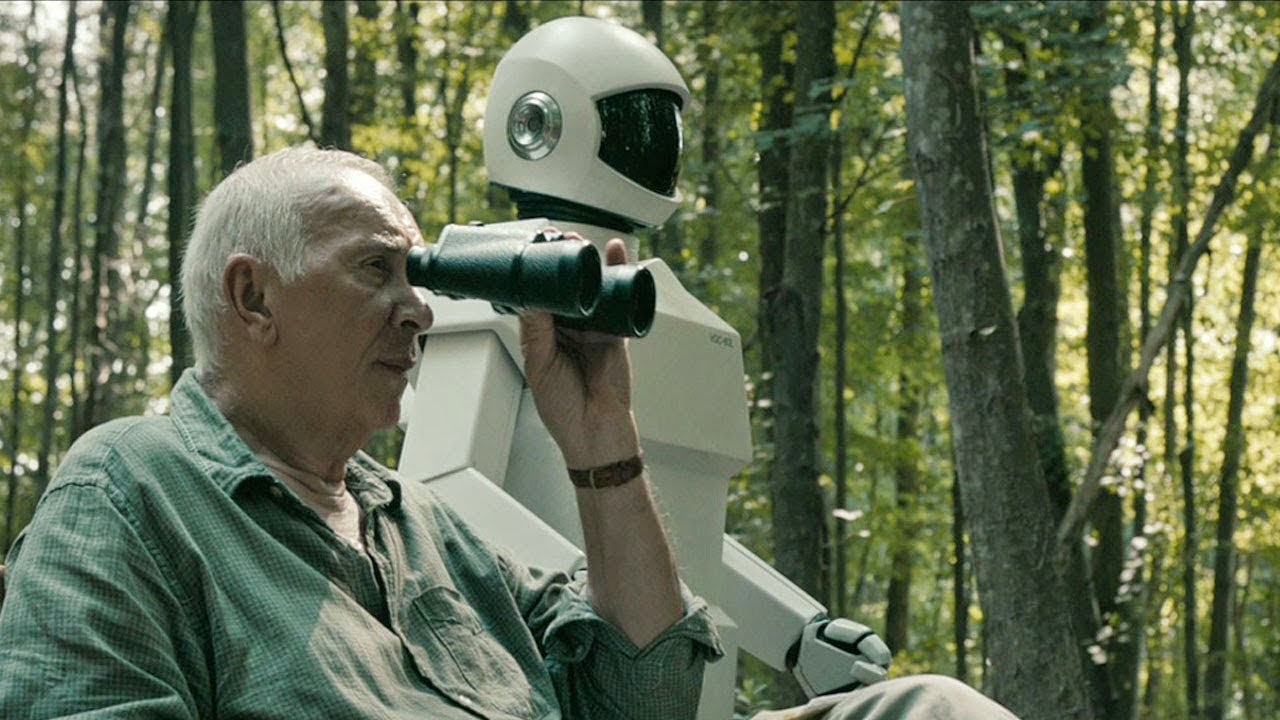
Robot & Frank - 2012
Written by Christopher d Ford
Directed by Jake Schreier

It's dark.

Nimble fingers work the lock-pick.  A figure in black slips into the house.  He starts working the place over for valuables.  He becomes more frantic, knocking over a framed photo.  It falls, the glass cracking.  The burglar looks stunned.  His face is in the photo.  It's his house.

The burglar is Frank, played by Frank Langela.  He was a cat burglar, but he's retired now, he just... forgets sometimes.  Frank forgets a lot of things these days.

Frank's kids worry about him.  His daughter Madison (Liv Tyler) video calls as after as she can, but her work takes her overseas.  His son Hunter (James Marsden) calls and drives up to see him every week or two.  Frank resents the concern (as a reflection of his shame over needing it), but he's not always sure if Hunter is a married professional with kids of his own, or a student at Princeton.  His favorite way to fill the day is to walk into town and visit the local library.  Jennifer the librarian (Susan Sarandon) gently teases him about having read the same books over and over.  Frank has a thing for her.  After the library, he likes to have lunch at his favorite cafe.  Wait, where's the cafe?  How did there get to be a Lush here?  He ate here yesterday... didn't he?  To channel his frustration, Frank shoplifts a fancy soap, but the shopkeeper is strangely suspicious of him already.  Back at home, he adds the soap to a cache of similar items.

The more his memory goes off, the more his kids worry, and the more agitated Frank gets, until one day Hunter shows up with something for his father; a robot.  The robot is programmed to keep Frank active and engaged, encouraging a healthy regimen and a consistent routine.  Frank is, shall we say, not amused, but Hunter won't tell him the password, and so, for the time being, Frank finds himself with a white plastic shadow.  It's not long, however, before he finds that the robot makes a convenient ear for his complaints.  It's not long after that that he discovers (quite by accident) that the robot isn't overly particular about the legality of shoplifting, and Frank adds another fancy soap to his collection.

This gets Frank thinking, and the thinking gets his mind back in the game. He gets more engaged in his own life and the world around him.  He develops more of a relationship with the robot, which is frankly (no pun intended) fairly narcissistic, given that the robot really only acts as an extension of Frank's needs.

Robot & Frank deals with the issue of aging, regret and (most especially) memory in many ways.  There's a major reveal late in the movie that plays a little fast and loose with memory for the sake of emotional impact, but there are other instances which it's more more balanced and thoughtful.  Frank is forced to make a decision about Robot's memory, and while the issue of their potential friendship would seem to be the more obvious cause for his turmoil, I really think that it has more to do with his pain about his own memory.  Yes, there's still a sense of empathy for the "other" for which he has developed some sort of feelings, but then the "other" doesn't HAVE emotions with which to empathize, and again, I believe much of this interaction reflects Frank's narcissism.  That doesn't make Frank a bad guy.  It just means he's scared, and not without cause.

Peter Sarsgaard brings a pretty strong "I'm sorry Dave, I'm afraid I can't do that" tone to the robot's voice, which kept me wondering what he might eventually do.  It straddles the line between calming, and disturbing-because-it's-so-determined-to-be-calming, which I'm not sure is as effective as it should be.  In fact, it was so unsettling that I thought it was Michael Emerson (Lost, Person of Interest) until the credits.

One interesting discovery in Robot & Frank is that Frank Langella has a charming side.  I've gotten so used to his playing villains, heavies and other emotional pressure cookers that I was completely unprepared for how disarming he could be.  Given his responsibility for carrying the film, that quality transfers to the overall product in a highly effective way.


Get Low - 2009
Written by Chris Provenzano & C Gaby Mitchell
Directed by Aaron Schneider


Some actors spend their careers playing a wide variety of characters, putting on accents and trying to lose themselves in the character.  Robert Duvall isn't that kind of actor.  He's rarely done accents, and rather than going wide, he goes deep.  thoughtful southerners with great depth of character.  His characters needn't be specifically southern, but he brings that to them, and whether they're outwardly reserved or gregarious, these things cover and tap a deep well of personal character buried inside of them.  That depth gets an incredible opportunity to stretch its legs once more in Get Low.

Because I had originally added Get Low to my viewing list in the fits of a Bill Murray view-a-thon, it had completely slipped my mind that Robert Duvall was in it when I finally sat down to watch it, for for the first ten minutes or so, I could not identify who was behind the unruly beard and taciturn demeanor of the old country hermit.  Duvall plays Felix Bush, the backwoods hermit in 1930s Tennessee.  Felix is the stuff of local legend.  Kids dare each other to break windows in his cabin, and adults in town gossip about his history.  Did he kill someone?  Did he kill a LOT of someones?  You heard he robbed banks?  I heard something even worse.

When the local preacher visits (at considerable risk to his well-being) to tell him that one of his old associates has passed on, it serves as a conduit for Felix to confront the looming specter of his own mortality.  He hitches the cart to his cantankerous old mule (kindred spirits, no doubt) and ambles up the main street of town to discuss his own funeral arrangements with the parson.  Laying a grubby wad of "hermit cash" on the table, Felix grills the preacher about what he'd say in his memory.  The evasive response which dances around his reputation does not please Felix, and the wad of cash is gruffly withdrawn.  In an economic bit of narrative, there is another family coming into the church on their own business.  The young husband happens to work for the local funeral home, so he picks up on Felix's desires to plan a funeral as well as his dissatisfaction with the church.  His stepmother just happens to be a pivotal figure from Felix's past with whom he's reluctant to engage.  To cap things off, one of the locals decides to demonstrate his manhood by hurling insults and threats at the old man of rumors, and find himself with the "stuffing" kicked out of him in short order.

The young man, Buddy, reports back to Frank Quinn (Bill Murray), the owner of the funeral home, that the notorious old mountain man is looking for a funeral with a wad of cash, and they travel out to the homestead to make their pitch.  Getting a look at the place, Frank immediately promotes Buddy to sales associate and sends him in alone.  Felix's reputation once again becomes a topic of conversation, which gets the old man to thinking.
After the initial reluctance inherent to his character, Felix arrives at a plan.  He wants to plan his funeral.  It should be, he decides, a party, with food, music and the sharing of every story that anyone had ever heard about him.  If that meant gathering the people of four counties, then so be it.  Oh, and one more thing; he wanted it while he was still alive.

Through the process of planning Felix's funeral party and dealing with all of the issues that he and the town had with each other, peeks at his history emerge, hinting at why he sealed himself off from the world some 40 years prior, what his relationship with Miss Mattie (Sissy Spacek) had and had not been, and who the woman was in the old photograph that he talked to at night.  He has his own story to tell, but his own laconic nature, and ultimately his shame present obstacles that seem insurmountable to him at this late hour in life.

And that's what Get Low is really about.  Felix has imprisoned himself in his solitude over the guilt and shame that he carries from his past.  It's a heartfelt and deeply moving portrait of regret turned in upon itself.  As I've been rolling it around in my head the past few days, I've found myself comparing and contrasting it to another of Duvall's greatest performances in The Apostle.   Where The Apostle's Sonny flees his past and can't resist being who he's always been, Felix becomes so trapped in the past that surrenders the gregarious character he once was to sink into solitude and the bitterness that such isolation begets.